Introduction
This book is for the owner or manager of a small business who keeps hearing that artificial intelligence will change everything, and would like someone to explain, calmly and plainly, what it can actually do for them on Monday morning. You might run a café, a cleaning company, a shop, a building firm, a salon, an agency or a stall. You might have tried a chat assistant once, been impressed or disappointed, and not known what to do next. You are probably busy, careful with money and suspicious of hype. Good. That is exactly the right attitude.
The honest picture is this. AI tools are already useful for small businesses, especially for writing, admin, customer replies and making sense of information. In Britain, the share of businesses using AI has grown quickly since 2023, but most firms are still at an early stage, and the most common barriers are not cost but skills, time and trust. AI also makes mistakes, some of them confident and convincing, and it raises real questions about privacy, accuracy, fairness and the law. This book covers both sides.
How this book is built
Every chapter follows the same shape. It explains one area of business where AI can help, shows practical examples and prompts you can adapt, marks clearly where AI must stop and a person must take over, and finishes with key takeaways and a checklist of things to do next. If you are short of time, read the takeaways and do the checklist; come back for the reasoning when you need it.
The chapters build on each other. Chapters 1 and 2 explain what AI is and how to start safely. Chapters 3 to 5 cover the everyday uses that pay off most: writing and marketing, customer service, and admin. Chapters 6 and 7 deal with the two biggest risks, data protection and accuracy. Chapters 8 to 10 cover choosing tools, sales and research, and images and video. Chapter 11 helps you bring your team with you and write a one-page AI policy, and Chapter 12 turns everything into a 90-day plan.
Throughout, you will find:
- Charts from official data. Figures come mainly from the Office for National Statistics’ Business Insights and Conditions Survey and the government’s AI Adoption Survey 2026. Each chart names its source.
- Real cases. Some come from courts and regulators, such as an airline held responsible for its chatbot’s advice and a taxpayer who cited cases an AI had invented. Others are clearly marked as illustrative examples, based on common situations rather than a named business.
- Numbered references. A small raised number after a fact points to the References section, so you can check the source yourself.
- A glossary and an index. Technical terms are explained when they first appear and collected in the Glossary.
A word about tools, prices and rules
AI changes fast. Tools appear, merge and disappear; features and prices change every few months; and the law is still developing. This book therefore names products only as examples, gives prices only as rough guides “at the time of writing”, and focuses on habits and principles that will still hold when the tools have changed. Everything was checked in November 2026. Before you rely on a price, a setting or a rule, check the supplier’s website, GOV.UK, the Information Commissioner’s Office or, in Sri Lanka, the relevant authority.
This book is education, not legal, tax, financial or technical advice. It will help you ask better questions and make better decisions, but it cannot know your circumstances. For anything significant, talk to a qualified adviser.
AI was used as a tool in preparing this book, in the way the book recommends: as an assistant for drafting and checking, with every fact and source verified by hand.
What AI Can and Can't Do for Your Business
In September 2023, the Office for National Statistics started asking a simple question in its regular survey of British businesses: are you using any form of artificial intelligence? Nine in every hundred said yes. Three years later, in September 2026, the answer was thirty in every hundred1.
That is a remarkable change in a short time. It also means that most businesses, seven in ten, still are not using AI at all. If you are one of them, you are not behind. You are in the majority, and you have the advantage of being able to learn from everyone who went first, including the ones who got it wrong.
This book is for the owner of a small business who keeps hearing that AI will change everything and wants to know, calmly and honestly, what it can actually do for a shop, a salon, a cleaning firm, a consultancy, a takeaway or a trade business. This chapter sets out what the data says, what artificial intelligence) really is, where it helps and where it does not, and how to think about it before you spend a penny.
What the numbers say
The best British figures come from two places. The first is the ONS Business Insights and Conditions Survey, known as BICS, which asks thousands of firms the same questions every few weeks. The second is a large government survey of 3,503 businesses carried out between January and April 2026 for the Department for Science, Innovation and Technology2.
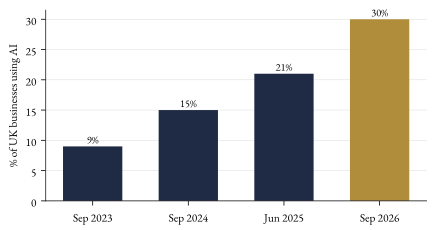
BICS shows a steady climb. In September 2023, 9% of all businesses said they used AI. A year later, in September 2024, it was 15%3. By June 2025 it was 21%4, and by September 2026 it had reached 30%1. The government survey found a similar jump: 32% of businesses using at least one AI technology in 2026, up from 16% in 20252.
Notice that the two surveys do not give exactly the same number. They ask slightly different questions of slightly different groups of firms at different times. That is normal, and it is a good habit to look at more than one source before believing any single statistic, including the ones in this book.
Size matters, but less than you might think
Bigger firms use AI more. In June 2026, 49% of businesses with 250 or more employees used AI, compared with 28% of businesses with fewer than ten5. By September 2026, the figure for the largest firms had reached 51%1.
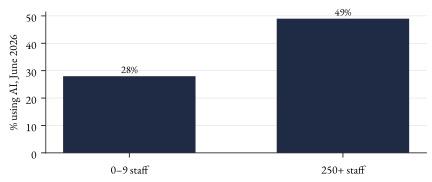
What is striking is not the gap but how small it is. More than a quarter of micro businesses, many of them one-person firms, are already using AI. Unlike most business technology of the past, from accounting systems to customer databases, the most popular AI tools cost little or nothing to try and need no IT department. A sole trader with a phone can use the same chat assistant as a bank.
Some trades use it far more than others
The industry differences are much bigger than the size differences. In June 2026, 58% of information and communication businesses used AI, compared with 13% in construction5. The government survey found the same pattern, with 61% in information and communication, 45% in real estate and 39% in business services and administration2.
That makes sense. AI tools today are best at work done with words, numbers and screens. A builder’s most important work happens on site with materials and hands. A builder’s quotes, invoices, emails and adverts, however, are exactly the kind of work AI can help with. We will come back to this idea often: do not ask “can AI do my job?” Ask “which parts of my week are paperwork, writing or searching, and could AI do those faster?”
What “AI” actually means
The word “AI” is used for many different things, and salespeople use it loosely. For a small business, it helps to know three meanings.
Older, everyday AI. Spam filters, the fraud checks on your card, the way your phone recognises faces in photos, and the route your satnav picks all use forms of AI. You have been using this kind for years without calling it AI.
Predictive AI. Software that spots patterns in your data and makes predictions: which customers are likely to stop buying, how much stock you will need next month, which transactions look unusual. Some accounting and booking systems now include features like this.
Generative AI. This is the new wave, and the reason for all the excitement. Generative AI creates new content in response to an instruction, called a prompt. Chat assistants write emails and answer questions; image tools make pictures from a description; other tools make audio, video and computer code.
Most chat assistants are built on what is called a large language model). It has learned patterns from enormous quantities of text and works by predicting, word by word, what a good answer is likely to look like. This is why it can write fluently about almost anything. It is also why it can be confidently wrong. It is not looking facts up in a book of truth; it is producing what sounds likely. When it produces something false and presents it as fact, that is called a hallucination, and we will spend a whole chapter on it.
A simple way to think about it
Think of a generative AI assistant as a very fast, very well-read new assistant who started this morning. It can draft almost anything in seconds and never gets tired. But it does not know your business, it sometimes makes things up to please you, and it needs clear instructions and checking. You would not let a new starter send a contract to a customer unchecked. Treat AI the same way.
What businesses actually use it for
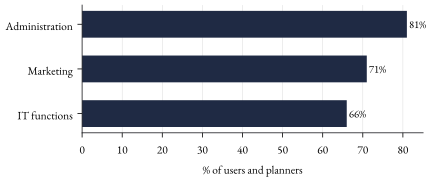
The government survey asked businesses that use or plan to use AI what they use it for. Administration came top at 81%, followed by marketing at 71% and IT at 66%2. ONS found that improving business operations was the most common purpose, cited by close to 60% of businesses with ten or more staff5.
In plain terms, this means things like:
- drafting emails, letters, quotes and replies to customers;
- writing social media posts, adverts and product descriptions;
- summarising long documents, contracts or meeting notes;
- turning rough notes into tidy procedures or job descriptions;
- answering common customer questions;
- organising spreadsheets, writing formulas and spotting patterns in sales figures;
- translating messages for customers or staff;
- brainstorming names, offers or ideas.
None of these is magic. Each is a task you or someone in your team already does, done faster. That is the right way to think about AI in a small business: as a way to give hours back, not as a replacement for knowing your trade.
What it does well, and what it does badly
The table below sums up what AI tools are good and bad at, based on the evidence in this chapter and the cases later in the book.
| Usually good at | Often bad at |
|---|---|
| A fast first draft of almost any text | Facts, figures, prices and quotes, unless you supply them |
| Rewording for a different tone or reader | Knowing your business, customers or local rules |
| Summarising a document you give it | Laws, tax rules and deadlines, which may be out of date or wrong |
| Brainstorming many options quickly | Judgement about what is right for your customers |
| Explaining a topic in simple language | Admitting when it does not know |
| Turning a list into a table or procedure | Keeping private information private unless set up properly |
Table 1.1. Typical strengths and weaknesses of generative AI tools for a small business.
The left-hand column is about speed and shape. The right-hand column is about truth and judgement. Your job, as the owner, is to keep doing the right-hand column yourself.
Do the benefits show up?
Businesses that use AI mostly say it helps. In the government survey, 71% of adopters said it improved workforce productivity and 60% said it made processes more efficient or flexible. Half said overall productivity had increased2.
Costs are a different story. Only 24% of adopters said their operating costs had gone down; 64% had seen no immediate effect and 9% said costs had gone up2. And despite the headlines about robots taking jobs, about half of businesses in every size band told ONS that AI had not affected their headcount. Among firms using AI to improve operations, 63% reported no change in staff numbers, 6% a decrease and 1% an increase5.
The honest summary is this: AI mostly helps people do their work faster and a little better. It rarely transforms a small business overnight, and it rarely saves money unless you deliberately use the time it frees up for something valuable, such as more sales calls, better service or simply a shorter working week.
A worked example: one owner’s week
Imagine Priya, who runs a two-person cleaning company in Leicester. She keeps a rough diary for a week and finds that she spends:
- 3 hours writing quotes and replying to enquiries;
- 2 hours on social media posts;
- 1½ hours chasing unpaid invoices;
- 1 hour writing a new staff checklist;
- 30 minutes translating messages for a cleaner whose first language is Portuguese.
That is 8 hours of writing and admin. Suppose a chat assistant cuts each task by half, which is realistic once she has good templates (later chapters show how). She saves about 4 hours a week, or around 200 hours a year if she works 50 weeks.
What is that worth? If Priya uses even half that time to win and clean for one extra customer a week at £60 a visit, she earns about £3,000 more a year (50 × £60). If her AI tool costs £20 a month, that is £240 a year. The return is clear. But notice the condition: the money only appears if she uses the saved time for something valuable. Saving time and then filling it with more scrolling earns nothing.
Why many businesses hold back
If AI is cheap and useful, why do seven in ten businesses still not use it? The government survey gives clear answers.
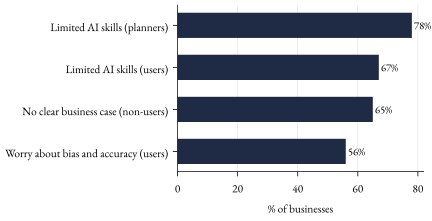
The biggest barrier is skills. 78% of businesses planning to use AI, and 67% of those already using it, said limited AI skills, expertise or knowledge held them back. Among businesses not using AI, 65% said they lacked a clear business case or proof that it would pay off. And more than half of users (56%) and planners (60%) worried about bias and accuracy2. Money, interestingly, is not the main problem: 47% of businesses that could estimate their spending had spent nothing at all on AI in 20252, and ONS found cost was named by only about 7% to 14% of firms, depending on size5.
Every one of these barriers is reasonable, and every one can be dealt with. Skills can be learned in a few hours (Chapter 2). The business case can be tested cheaply, as Priya’s example shows (Chapter 12). Accuracy worries are right, and the answer is a simple checking routine (Chapter 7).
Klarna, 2024–2025
Klarna, the Swedish payments company, became a famous example of a business going “all in” on AI. In February 2024 it announced that its new AI assistant had handled two-thirds of its customer service chats in its first month, 2.3 million conversations, doing the work of about 700 human agents and resolving problems in under two minutes on average6.
The company cut back on hiring. Then, in May 2025, its chief executive, Sebastian Siemiatkowski, told Bloomberg that customers should always be able to reach a human. He admitted that cost had been “a too predominant evaluation factor”, which had led to lower quality, and the company began recruiting human customer service staff again6.
Klarna did not abandon AI: it said the assistant still handled about two-thirds of enquiries. What changed was the balance. The lesson for a small business is the same one this chapter keeps returning to. Use AI to handle the routine work quickly, and keep people for the moments that need judgement, care and trust. Your customers will forgive a slower reply; they will not forgive feeling that nobody is listening.
Getting the mindset right
Before the practical chapters, here are four principles that will save you time, money and embarrassment.
Start with a problem, not a tool. Look at your week, as Priya did, and find the hours spent on writing, searching and admin. Choose one task to improve. Do not buy a shiny tool and then look for a use.
You are responsible for what AI produces. If an AI writes a wrong price in a quote or gives a customer bad advice, it is your business that answers for it. Chapter 4 tells the story of an airline that learned this in front of a tribunal.
Never put private information in without thinking. Customer details, staff records and confidential figures need care. Chapter 6 explains the law and simple settings that keep data safe.
Check before you send. Every piece of AI output that reaches a customer, a supplier, a bank or a tax office should be read by a human first. This one habit prevents most AI disasters.
In short
AI is no longer only for big companies or technology firms. By 2026, about a third of British businesses were using it, mostly for everyday writing, marketing and admin. It makes people faster rather than replacing them, and its benefits show up when you use the saved time well. Its weaknesses are facts, judgement and privacy, and they are yours to manage.
The next chapter takes you through your first week with an AI assistant, step by step.
- About 30% of UK businesses used AI by September 2026, up from 9% in 2023; more than a quarter of micro businesses already use it.
- AI is used mostly for administration, marketing and IT: everyday writing and paperwork.
- Generative AI predicts what sounds right; it can be fluent and wrong at the same time.
- Most adopters report productivity gains, but only a quarter report lower costs; the value comes from how you use the time saved.
- The main barriers are skills, an unclear business case and worries about accuracy, not money.
- Keep a rough diary for one week and total the hours spent writing, searching and on admin.
- Circle the one task that takes most time and is mostly words or numbers.
- Write down what you would do with an extra two hours a week.
- List any customer or staff information that must never be pasted into an AI tool.
- Decide who in your business will check AI output before it is sent.
- Read Chapter 2 and try your first prompt on the task you circled.
References for this sample
- Office for National Statistics (2026). Business insights and impact on the UK economy: 8 October 2026 (BICS Wave 165, 21 September to 4 October 2026). ONS. https://www.ons.gov.uk/businessindustryandtrade/business/businessservices/bulletins/businessinsightsandimpactontheukeconomy/8october2026 (accessed November 2026).
- Department for Science, Innovation and Technology (2026). AI adoption survey report 2026: executive summary. GOV.UK. https://www.gov.uk/government/publications/ai-adoption-survey-2026/ai-adoption-survey-report-2026-executive-summary (accessed November 2026).
- Office for National Statistics (2024). Business insights and impact on the UK economy: 3 October 2024 (BICS Wave 117, 16 to 29 September 2024). ONS. https://www.ons.gov.uk/businessindustryandtrade/business/businessservices/bulletins/businessinsightsandimpactontheukeconomy/3october2024 (accessed November 2026).
- Office for National Statistics (2025). Business insights and impact on the UK economy: 3 July 2025 (BICS Wave 135, 16 to 29 June 2025). ONS. https://www.ons.gov.uk/businessindustryandtrade/business/businessservices/bulletins/businessinsightsandimpactontheukeconomy/3july2025 (accessed November 2026).
- Office for National Statistics (2026). Artificial intelligence in UK businesses: 2023 to 2026. Article, 20 July 2026. ONS. https://www.ons.gov.uk/businessindustryandtrade/business/businessservices/articles/artificialintelligenceinukbusinesses/2023to2026 (accessed November 2026).
- Customer Experience Dive (2025). Klarna reinvests in human talent for customer service after AI push. 9 May 2025, reporting Klarna CEO interview with Bloomberg, 8 May 2025. https://www.customerexperiencedive.com/news/klarna-reinvests-human-talent-customer-service-AI-chatbot/ (accessed November 2026).