Introduction
This book is for the owner of a small business who needs more customers and has very little money to spend finding them. You might run a salon, a café, a cleaning round, a tutoring service, a building firm, a market stall or an online shop. You might have tried boosting a Facebook post, paid for a leaflet drop or been sold a “marketing package” that did nothing, and you are wary of spending again. Good. Wariness is the right starting point.
The honest picture is this. Most small businesses in Britain have no employees at all. Their owners do the marketing themselves, in spare minutes, with almost no budget. That is not a disadvantage to be ashamed of. Many of the most effective tools, a well-kept Google Business Profile, genuine reviews, a short list of customers who have agreed to hear from you, a good relationship with the business next door, cost nothing but time. Paid advertising can help, but only once you know who you are trying to reach and how you will tell whether it worked.
How this book is built
Every chapter covers one part of marketing a small business, shows worked examples with the sums laid out, sets out the rules you must follow, and finishes with key takeaways and a checklist. If you are short of time, read the takeaways and do the checklist; come back for the reasoning when you need it.
Chapters 1 and 2 explain how to think about a small budget and who your customer really is. Chapters 3 to 7 cover the free and nearly free tools: Google, your website, social media, reviews and word of mouth, and email, text and WhatsApp. Chapter 8 deals with paid ads, Chapter 9 with local and offline marketing, and Chapter 10 with influencers, content and AI. Chapter 11 shows how to measure what works, and Chapter 12 turns it all into a 90-day plan.
Throughout, you will find:
- Charts from official data. Figures come from sources such as the Department for Business and Trade, Ofcom and the regulators. Each chart names its source.
- The real rules. Marketing is regulated. This book explains, in plain English, the rules from the Advertising Standards Authority, the Competition and Markets Authority and the Information Commissioner’s Office that small businesses most often break by accident.
- Worked examples. Budgets and results in examples are clearly marked as illustrations, not promises.
- Numbered references, a glossary and an index, so you can check sources and look things up.
A word about platforms and prices
Online platforms change their features, rules and prices constantly. This book names them as examples and gives costs only “at the time of writing” (November 2026). Before you spend money, check the platform’s own help pages. This book is education, not legal or professional advice: for anything significant, especially around the law, take advice for your own situation.
AI was used as a tool in preparing this book: as an assistant for drafting and checking, with every fact and source verified by hand.
Why £100 Is Enough to Start
At the start of 2025 there were about 5.7 million private sector businesses in the UK. Three in every four of them, more than 4.2 million, had no employees at all: just the owner, sometimes with a partner1. Another 1.15 million employed between one and nine people. Only a tiny fraction were the kind of business that has a marketing department, an agency on retainer or an advertising budget measured in thousands.
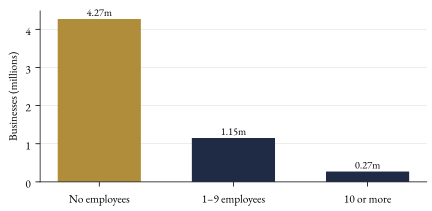
If you run a small business, you are in the overwhelming majority. Together, small and medium-sized businesses, known as SMEs, provided 60% of private sector jobs and 51% of turnover1. Most of them find customers the way you will: with limited time, a small budget, and a lot of trial and error.
This book is about making that trial and error cheaper, faster and more likely to work. This first chapter explains where your customers spend their time, why a small budget is not the main problem, and how to think about the £100 a month in the title.
Where your customers are
People in the UK now spend a remarkable amount of time online. Ofcom, the communications regulator, found in 2025 that adults spent about four and a half hours online a day, most of it on smartphones2. Services owned by just two companies, Alphabet (which owns Google and YouTube) and Meta (which owns Facebook, Instagram and WhatsApp), accounted for more than half of all the time people in the UK spent online2.
That matters for a small business in two ways. First, many of your customers will look for you, or for businesses like yours, on Google Search and Google Maps before they visit, call or buy. Second, much of their attention is on a handful of apps, which is why Google and Meta dominate small business advertising.
A new way of searching
Something else is changing. Ofcom found that about 30% of searches now show AI-generated overviews at the top of the results, and 53% of adults said they saw them often. ChatGPT received about 1.8 billion visits from the UK in the first eight months of 2025, up from 368 million in the same period of 2024, although Google Search remained dominant, with around three billion searches a month2.
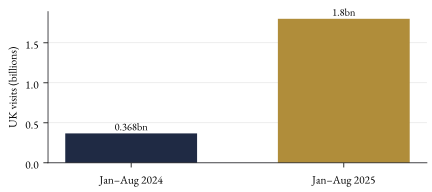
For a small business, the practical lesson is reassuring rather than frightening. AI tools and search engines both draw on what is published about you online: your Google Business Profile, your website, your reviews and what others say about you. The same basic work that helps you appear in ordinary search results helps you appear in AI answers too. Chapters 3, 4 and 6 cover that work.
Money is rarely the real problem
Most small business owners think their marketing problem is a lack of money. Usually, it is something else:
- No clear customer. Trying to appeal to everyone, and reaching no one in particular.
- No clear offer. People do not understand quickly what you do, for whom, and why they should choose you.
- Leaky basics. A Google listing with wrong opening hours, no photos and no reviews; a website that does not work on a phone; calls that go unanswered.
- No measurement. Spending money without any way of telling what it produced.
None of these is fixed by spending more. All of them are fixed by thinking and a few hours of work. That is why the early chapters of this book cost almost nothing, and paid advertising does not appear until Chapter 8.
How to think about £100 a month
A hundred pounds a month is £1,200 a year. For a business with no employees, that is a meaningful sum, and it should be treated like any other investment: spent on purpose, measured, and stopped if it does not pay back.
Two numbers matter more than the size of the budget.
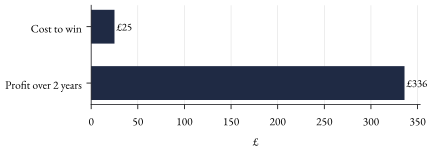
- What it costs you to win a new customer. If you spend £100 and win four new customers, your cost per customer is £25.
- What a new customer is worth to you. Not just their first purchase, but the profit from everything they are likely to buy over time, sometimes called customer lifetime value.
A worked example
This is an invented illustration. Amara runs a mobile hairdressing business. A typical appointment costs £40, and after travel and products she keeps about £28 as profit. Her regular customers book about six times a year, and most stay with her for at least two years.
- Profit per visit: £28
- Visits per year: 6, so profit per customer per year: 6 × £28 = £168
- Over two years: £336
If Amara spends £100 in a month and it brings her four new regular customers, each one cost her £25 to win and is worth about £336 in profit over two years. That is an excellent return. If the same £100 brings her no customers, she needs to know quickly so she can stop, change something and try again.
The rest of this book helps you push the first number down and the second number up.
Time is a budget too
For most small business owners, time is scarcer than money. The table shows a sensible way to think about the first few months, when free tools do most of the work.
| Activity | Money each month | Time each month | Covered in |
|---|---|---|---|
| Google Business Profile: photos, posts, replying to reviews | £0 | 1–2 hours | Chapter 3 |
| Asking happy customers for reviews | £0 | 1 hour | Chapter 6 |
| One or two social media accounts | £0 | 3–4 hours | Chapter 5 |
| Emails or messages to customers who agreed to hear from you | £0–£15 | 1–2 hours | Chapter 7 |
| Small paid ad tests | £50–£70 | 1–2 hours | Chapter 8 |
| Leaflets, local partnerships or an event | £15–£35 | 2–3 hours | Chapter 9 |
| Recording results | £0 | 30 minutes | Chapter 11 |
This is an illustration, not a rule. A plumber may get most new work from Google Maps and reviews, and spend nothing on social media. An online shop may need more paid advertising and less local activity. The point is to decide deliberately, rather than spreading small amounts of money and time thinly across everything.
Doing it legally
Marketing in the UK is regulated, and the rules apply to the smallest businesses as much as to the largest. Three bodies matter most:
- The Advertising Standards Authority (ASA) enforces the advertising codes: ads must be legal, decent, honest and truthful, and paid content must be clearly labelled.
- The Competition and Markets Authority (CMA) enforces consumer law, including the ban on fake reviews that took effect in April 2025 (Chapter 6).
- The Information Commissioner’s Office (ICO) enforces the rules on marketing emails, texts and personal data (Chapter 7).
You do not need to be a lawyer. But you do need to know the handful of rules that small businesses most often break by accident, and this book points them out as they come up.
- Three in four UK businesses have no employees. Most small firms do their own marketing on small budgets.
- UK adults spend about four and a half hours online a day, and more than half of that time is on services owned by Google’s parent company and Meta.
- AI search is growing fast, but it draws on the same information as ordinary search: your Google profile, website and reviews.
- Lack of money is rarely the real problem. Unclear customers, unclear offers, leaky basics and no measurement usually are.
- Judge any spending by two numbers: what it costs to win a customer and what that customer is worth over time.
- Treat time as a budget too, and start with the free tools.
- Write down, in one sentence, who your best customers are.
- Work out roughly how much profit a typical customer brings you in a year.
- Search for your business on Google and Google Maps from a phone. Note anything wrong or missing.
- List everything you currently spend on marketing each month, including time.
- Decide on a monthly marketing budget you can afford for at least three months, and write it down.
- Start a simple record of where each new customer heard about you.
References for this sample
- Department for Business and Trade (2025). Business population estimates for the UK and regions 2025: statistical release. GOV.UK. https://www.gov.uk/government/statistics/business-population-estimates-2025/business-population-estimates-for-the-uk-and-regions-2025-statistical-release (accessed November 2026).
- Ofcom (2025). From apps to AI search: how the UK goes online in 2025. 10 December 2025. https://www.ofcom.org.uk/media-use-and-attitudes/online-habits/from-apps-to-ai-search-how-the-uk-goes-online-in-2025 (accessed November 2026).