Introduction
This book is for anyone in the UK who runs, or is thinking of starting, a small private limited company. You might be a sole trader wondering whether to incorporate, a new director who has just received a certificate of incorporation, or a business owner who has run a company for a while and wants to be sure everything is done properly.
It explains, in plain English, how to set up a company, the new Companies House rules on identity verification, your duties as a director, keeping company money separate, paying yourself, corporation tax, VAT, the yearly filing duties, employing people, and what to do when you want to grow, sell or close. Every chapter has worked examples using the rates for the 2026/27 tax year, a list of common mistakes, answers to questions owners ask, key takeaways and a checklist.
Rates, thresholds and Companies House rules change, often every April. Always check GOV.UK, HMRC and Companies House before you act. This book is education, not legal, tax or financial advice.
Sole Trader or Limited Company?
Almost every small business in the UK starts in one of two ways: as a sole trader, where you and the business are legally the same person, or as a private limited company, a separate legal person that you own and run. At the start of 2025 there were about 3.0 million sole proprietorships and 948,000 companies with no employees in the UK1. Both forms are common, and both can work well.
Many owners assume a limited company is always “better” or always “saves tax”. Neither is true. The right choice depends on your profits, your plans, the risks in your work and how much paperwork you are willing to take on. This chapter compares the two honestly, with worked examples using the 2026/27 tax rates, so you can decide what suits you.
The basic difference
A sole trader’s business is not separate from the owner. The profits are your income, the debts are your debts, and you report everything on your Self Assessment tax return.
A limited company is a separate legal person. It owns its own money and assets, signs its own contracts and owes its own debts. You take part in it in two ways: as a shareholder, who owns it, and as a director, who runs it. In a small company you are usually both.
| Sole trader | Limited company | |
|---|---|---|
| Legal status | You and the business are the same | The company is a separate legal person |
| Liability for business debts | Unlimited: your personal assets are at risk | Usually limited to what you invested in shares |
| Setting up | Tell HMRC you are self-employed | Register with Companies House; fee £100 online2 |
| Tax on profits | Income tax and Class 4 National Insurance | Corporation tax on company profits; then personal tax on what you take out |
| Public information | Very little | Company details, directors and accounts on the public register |
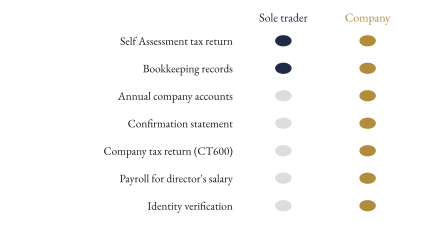
| Yearly paperwork | Self Assessment return | Company accounts, confirmation statement, company tax return, payroll, your own tax return |
| Taking money out | Draw what you like | Salary, dividends or loans, each with its own rules |
Sources: Companies House fees (GOV.UK); author’s summary.
Limited liability: what it does and does not protect
The main legal advantage of a company is limited liability. If the company cannot pay its debts, its creditors can usually only claim against the company’s assets, not your house or savings. That protection is real and valuable, especially in businesses that take on contracts, stock, premises or staff.
But it has limits:
- Personal guarantees. Banks and landlords often ask directors to guarantee loans or leases personally. If you sign one, you are personally liable.
- Directors’ duties. Directors who break their duties, trade wrongfully when the company cannot pay its debts, or act fraudulently can become personally liable (Chapter 4).
- Taxes. In some cases, such as unpaid PAYE or VAT caused by deliberate behaviour, directors can be made personally responsible.
- Insurance still matters. Limited liability does not replace public liability or professional indemnity insurance.
How the tax compares
A sole trader pays income tax on profits above the personal allowance of £12,5703, plus Class 4 National Insurance of 6% on profits between £12,570 and £50,270 and 2% above that4.
A company pays corporation tax on its profits: 19% on profits up to £50,000 and 25% on profits over £250,000, with marginal relief in between5. The owner then takes money out, usually as a small salary plus dividends. In 2026/27 the first £500 of dividends is tax-free; above that, dividends are taxed at 10.75% in the basic rate band, 35.75% in the higher rate band and 39.35% in the additional rate band6.
A popular approach is a director’s salary of £12,570, the personal allowance. That is above the employer’s National Insurance threshold of £5,0003, so the company pays some employer’s National Insurance. A company whose only employee is its director cannot claim the Employment Allowance to cover it7.
Worked example: £40,000 and £50,000 of profit, 2026/27
Amara is a self-employed graphic designer. She compares staying a sole trader with running a one-person company, paying herself a salary of £12,570 and the rest of the profit as dividends. The figures ignore pensions, student loans and other income.
| Profit £40,000 | Profit £50,000 | |
|---|---|---|
| Sole trader: income tax | £5,486.00 | £7,486.00 |
| Sole trader: Class 4 National Insurance | £1,645.80 | £2,245.80 |
| Sole trader: take-home | £32,868.20 | £40,268.20 |
| Company: employer’s NI on £12,570 salary | £1,135.50 | £1,135.50 |
| Company: corporation tax at 19% | £4,995.95 | £6,895.95 |
| Company: dividend paid out | £21,298.54 | £29,398.54 |
| Company: dividend tax | £2,235.84 | £3,106.59 |
| Company: take-home (salary + dividend − dividend tax) | £31,632.70 | £38,861.95 |
Source: author’s calculation using 2026/27 rates from HMRC, Crunch and FreeAgent. Simplified: no accountancy fees, pension contributions or other income.
At these profit levels, Amara would take home more as a sole trader: about £1,236 more at £40,000 and £1,406 more at £50,000, and that is before paying an accountant for company accounts.
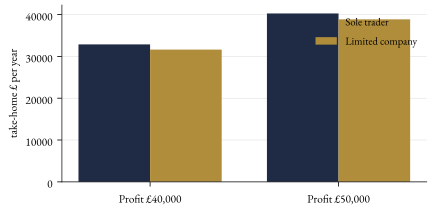
This surprises many people. The combination of 15% employer’s National Insurance, higher dividend tax rates and the Employment Allowance rules means that for many one-person businesses with modest profits, a company no longer saves tax on money taken out. A company can still help in other ways:
- Leaving profits in the company. Profits kept in the company are taxed at 19% (on profits up to £50,000) rather than at your personal rates. If you do not need all the money now, for example because you are saving to buy equipment or grow, a company can help.
- Higher profits. At higher levels the comparison changes, and pension contributions paid by the company can be very tax-efficient. Ask an accountant to run your own figures.
Other things to weigh
| Factor | Points towards sole trader | Points towards limited company |
|---|---|---|
| Risk in the work | Low-risk, small contracts | Contracts, stock, premises, staff, big orders |
| Profits | Modest, all needed to live on | Higher, or some can be left in the business |
| Clients | Individuals, small local customers | Larger businesses that prefer or require a company |
| Privacy | You want little on public record | You accept your name and accounts are public |
| Paperwork and cost | You want the simplest set-up | You will pay for an accountant and software |
| Future plans | Staying small | Taking on partners, investors or selling the business |
Source: author’s summary.
Moving from sole trader to company: a checklist
If you decide to incorporate, the switch involves more than registering at Companies House. A typical sequence:
| Step | What to do |
|---|---|
| 1 | Agree the date with your accountant, ideally at a natural break such as a month end |
| 2 | Verify your identity and register the company (Chapters 2 and 3) |
| 3 | Open a business bank account in the company’s name |
| 4 | Tell customers and suppliers, and move contracts and invoices to the company |
| 5 | Decide which assets move to the company (equipment, stock, website, domain) and how |
| 6 | Register the company for corporation tax, and as an employer if you will pay a salary |
| 7 | Move VAT registration if you are registered |
| 8 | Tell HMRC you have stopped trading as a sole trader, and file your final Self Assessment |
| 9 | Update insurance, website details, email signatures and invoices with the company name and number |
Source: author’s summary.
Transferring a business into a company can have tax consequences, for example on equipment or goodwill, so plan the move with your accountant.
Common mistakes
- Incorporating only to “save tax” without running the numbers for your own profits.
- Treating company money as your own. Once you have a company, its bank account belongs to the company (Chapter 5).
- Forgetting the extra costs: accountancy, payroll, software and Companies House fees.
- Assuming limited liability covers everything. Personal guarantees and directors’ duties still apply.
- Leaving it too late to decide. Changing structure mid-year can complicate tax; plan the switch with your accountant.
Questions owners ask
“Can I switch from sole trader to a company later?” Yes. Many businesses start as sole traders and incorporate when profits, risks or clients make it worthwhile. You will need to transfer contracts, bank accounts and assets, and tell HMRC.
“Do I need an accountant for a company?” Not by law, but most small companies use one, at least for the annual accounts and company tax return. The deadlines and penalties are covered in Chapters 7 and 9.
“Is my home address made public if I become a director?” You must give Companies House a service address, which can be public, and your usual residential address, which is kept off the public register. Your registered office must be an appropriate address, not a PO box8.
- A sole trader and their business are legally the same; a limited company is a separate legal person.
- Limited liability protects your personal assets from most company debts, but not personal guarantees or breaches of directors’ duties.
- In 2026/27, for many one-person businesses with modest profits, a company does not save tax on money taken out.
- A company can help if you leave profits in the business, earn higher profits, or need to look established to clients.
- Always run your own numbers, including accountancy and other costs.
- Write down your expected profit and how much you need to take out each year.
- Compare take-home pay as a sole trader and through a company, using this year’s rates.
- Add the extra costs of a company: accountancy, software, payroll, Companies House fees.
- Think about the risks in your work and whether limited liability matters.
- Consider your clients, privacy and future plans.
- Discuss the decision with an accountant before you incorporate.
References for this sample
- Department for Business and Trade (2025). Business population estimates for the UK and regions 2025: statistical release. https://www.gov.uk/government/statistics/business-population-estimates-2025/business-population-estimates-for-the-uk-and-regions-2025-statistical-release (accessed November 2026).
- Companies House (2026). Companies House fees. https://www.gov.uk/government/publications/companies-house-fees/companies-house-fees (accessed November 2026).
- HM Revenue & Customs (2026). Rates and thresholds for employers 2026 to 2027. https://www.gov.uk/guidance/rates-and-thresholds-for-employers-2026-to-2027 (accessed November 2026).
- ByteStart (2026). What National Insurance do self-employed people pay in 2026/27? https://www.bytestart.co.uk/self-employed-tax/national-insurance/ (accessed November 2026).
- Crunch (2026). Corporation Tax rates: what your business needs to know. https://www.crunch.co.uk/knowledge/article/corporation-tax-rates-what-your-business-needs-to-know (accessed November 2026).
- FreeAgent (2026). Dividend tax rates. https://www.freeagent.com/rates/dividend-tax/ (accessed November 2026).
- Xero (2026). Employment Allowance: what it is and who can claim. https://www.xero.com/uk/guides/employment-allowance/ (accessed November 2026).
- Companies House (2024). Get ready for changes to UK company law. https://companieshouse.blog.gov.uk/2024/01/22/get-ready-for-changes-to-uk-company-law/ (accessed November 2026).