Introduction
This book is for anyone in the UK who wants to start selling online, or who has started and wants to do it properly. You might make candles, jewellery or cards at your kitchen table. You might buy and resell vintage clothes, books or spare parts. You might already have a shop or a market stall and want to sell online as well. You might have sold a few things on eBay or Vinted and wondered whether it could become a real business.
The honest picture is this. Selling online has never been easier to start, and never easier to get wrong. About a quarter of everything people in Britain buy from shops is now bought online, and marketplaces let anyone open a shop in an afternoon. But behind every listing sit fees, postage costs, returns, consumer law, tax and customers who expect fast replies. Many new sellers are busy without being profitable, or find out about a rule only after they have broken it. This book is about avoiding both.
How this book is built
Every chapter covers one part of selling online, shows worked examples with the sums laid out, sets out the rules you must follow, and finishes with key takeaways and a checklist. If you are short of time, read the takeaways and do the checklist; come back for the reasoning when you need it.
Chapter 1 explains why now is a good time to sell online, and what the market really looks like. Chapter 2 helps you choose what to sell, and Chapter 3 compares the main marketplaces with running your own shop. Chapters 4 to 6 cover the practical work: listings that sell, pricing and profit per order, and stock, packing and postage. Chapters 7 and 8 explain the law and tax in plain English. Chapter 9 shows how customers find you, Chapter 10 covers customer service, reviews and returns, and Chapter 11 explains how to grow without running out of cash or time. Chapter 12 turns it all into a 90-day launch plan.
Throughout, you will find:
- Charts from official data. Figures come from sources such as the Office for National Statistics, HMRC, GOV.UK and the regulators. Each chart names its source.
- The real rules. Selling to the public is regulated. This book explains, in plain English, the consumer, data and tax rules that small online sellers most often break by accident.
- Worked examples. One seller, Priya, a candle maker, appears in several chapters so that you can follow the same numbers from pricing to tax. She and the other people in examples are invented, and their figures are clearly marked as illustrations, not promises.
- Numbered references, a glossary and an index, so you can check sources and look things up.
A word about platforms and prices
Marketplaces, carriers and payment providers change their fees, features and rules constantly, and tax thresholds and postage prices change every year. This book names platforms as examples and gives costs only “at the time of writing” (November 2026). Before you spend money or rely on a rule, check the platform’s own help pages or the official guidance listed in the references. This book is education, not legal, tax or financial advice: for anything significant, take advice for your own situation.
AI was used as a tool in preparing this book: as an assistant for drafting and checking, with every fact and source verified by hand.
Why Sell Online Now
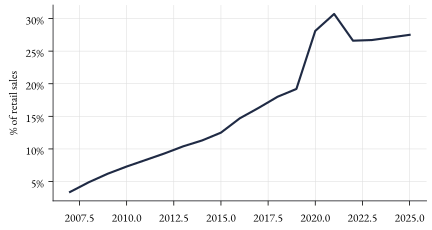
In September 2026, more than a quarter of everything people in Great Britain spent in shops was spent online. The Office for National Statistics (ONS) put the figure at 28.8%, almost the same as the month before1. Twenty years ago it was a small corner of retail. In 2007, online sales were just 3.4% of the total2.
This book is for people who want a share of that spending without a big budget, a warehouse or a technical background. You might be thinking about selling handmade jewellery, Sri Lankan spices, second-hand books, car parts, children’s clothes or something you have not chosen yet. You might already sell at a market stall or from home and want to reach people beyond your town. Either way, the first question is a fair one: is it still worth starting, now that so many others already sell online?
This chapter answers that question with real numbers. It looks at how big online shopping has become, what happened during and after the pandemic, who the small sellers are, and what has changed in the rules. By the end you should have a clear, honest picture of the opportunity and the work involved.
How big online shopping has become
The ONS measures online sales as a share of all retail sales every month. The long-term trend is clear. From 2007 to 2019 the share grew almost every year, from 3.4% to 19.2%2. That is a steady, gradual shift: roughly one extra percentage point of all retail spending moving online each year.
Then came 2020. With shops closed for long periods, the online share jumped to 28.1% for the year, and in 2021 it reached 30.7%2. When shops reopened, some of that spending went back to the high street, and the share fell to 26.6% in 2022. Since then it has crept up again: 26.7% in 2023, 27.1% in 2024 and 27.5% in 20252.
| Year | Online share of retail sales | What was happening |
|---|---|---|
| 2007 | 3.4% | Early days of online shopping for most households |
| 2015 | 12.5% | Smartphones in most pockets |
| 2019 | 19.2% | Last full year before the pandemic |
| 2021 | 30.7% | Peak during pandemic restrictions |
| 2022 | 26.6% | Shops reopen; some spending returns |
| 2025 | 27.5% | Slow, steady growth again |
Source: ONS time series J4MC (annual averages).
Two lessons come out of this. First, online shopping is not a fad that peaked in lockdown. Even after the fall in 2022, the share stayed far above where it was before the pandemic. Second, growth is now slower and steadier. You should not plan a business on the idea that online spending will keep jumping every year. It is a large, mature market, which means plenty of customers, but also plenty of competition.
The latest figures
Monthly figures move up and down. In September 2026 the value of online sales fell 0.4% compared with August, after rising 3.0% the month before. But compared with September 2025, online sales were 6.8% higher, and in the third quarter of 2026 they were 7.4% higher than a year earlier1. Over the same year, the volume of all retail sales grew only 0.8%1.
Values and volumes
The ONS reports both the value of sales (the pounds spent) and the volume (the amount bought, after taking out price rises). When prices are rising, values can grow faster than volumes. That is why the 6.8% rise in online sales values and the 0.8% rise in retail volumes are not directly comparable. What matters for you is that online is holding its share of a large market.
Where the customers are
People in the UK spend a large part of their day online. Ofcom, the communications regulator, found in 2025 that adults spent about four and a half hours online a day, most of it on smartphones3. A few large companies take most of that time: services owned by Alphabet (Google and YouTube) and Meta (Facebook, Instagram and WhatsApp) accounted for more than half of all time spent online3.
For a seller, this tells you two things. Your customers will mostly find you, look at your photos and pay on a phone screen, so every listing and every page must work well on a small screen. And the places people already spend time, such as Google search, YouTube, Facebook, Instagram and the big marketplaces, are where you will have to be seen.
Ofcom’s research also notes that some ordinary people now sell “semi-professionally” on sites such as Vinted and Amazon Marketplace, or run small Facebook shops4. Selling online is no longer only for registered companies with a website. It is something many households already do in a small way.
Who the small online sellers are
The UK is a country of small businesses. At the start of 2025 there were about 5.7 million private sector businesses, and three in four of them, more than 4.2 million, had no employees at all5. Most online sellers fit this picture: one person, or a couple, working from home.
A 2025 survey of 1,000 UK small businesses selling through online platforms, commissioned by eBay, gives a useful snapshot of how they started6:
- 44% launched with less than £1,000, and 3% started with no money at all.
- 38% started in a bedroom, 21% at the kitchen table and 15% in a garage.
- 69% said their online business was now their main job or a serious pursuit.
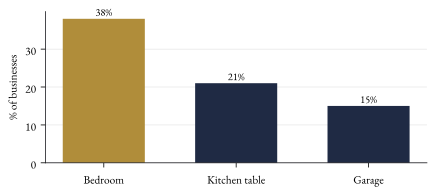
eBay UK small-business survey, 2025
In August 2025, eBay UK published a survey of 1,000 UK small businesses that sell through online platforms6. It is a survey of eBay’s own audience, so it is not a picture of every online seller, but it shows clearly what life is like for small sellers.
Nearly four in five (78%) said they were confident their business would grow over the next 12 months. When asked why, 30% pointed to strong customer demand, 20% to new selling tools and AI, 17% to more support from platforms, and 16% to improving economic conditions such as interest rates.
The same sellers were honest about what holds them back. The biggest barrier was the wider UK economy (37%), followed by a lack of time (30%), access to funding (24%), confidence (24%) and paperwork and admin (20%).
What stands out is how small most of these businesses were at the start. Almost half began with less than £1,000, and most began at home: in a bedroom, at the kitchen table or in a garage. Yet more than two-thirds now treat the business as their main job or a serious pursuit.
The lesson is not that every home business grows. It is that a small, cheap start is normal, and that time and admin, not just money, are what most sellers struggle with. This book is built around that reality.
Why small sellers can still win
If big retailers and huge marketplaces dominate online shopping, how does a one-person business compete? Not by trying to be Amazon. Small sellers win in a few specific ways.
Niches. A large retailer stocks what sells in big numbers. A small seller can serve a narrow group very well: left-handed tools, Sri Lankan cooking ingredients, replacement parts for one brand of vintage sewing machine, modest fashion, large-print puzzle books. The marketplaces bring the shoppers; your knowledge of the niche brings the sale.
Care and trust. Many shoppers will pay a little more to buy from someone who answers questions quickly, packs carefully and clearly knows the product. Reviews make that care visible to the next customer.
Speed and flexibility. You can add a new product this afternoon, change a photo tonight, or try a new price tomorrow. A big business takes weeks to do the same.
Low fixed costs. A small seller working from home has no shop rent. That gives you room to make a profit on smaller volumes, as long as you know your numbers.
That last point is the one most new sellers get wrong, so it is worth seeing with real sums.
A worked example: is it worth it?
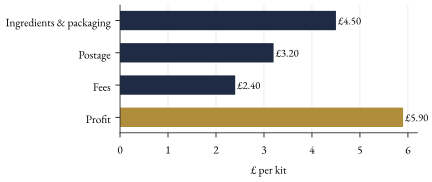
Imagine Nadeesha, who wants to sell hand-packed Sri Lankan spice kits online. This is a made-up example to show the arithmetic; the prices are illustrative, not quotes from any platform.
| Per kit | Amount |
|---|---|
| Selling price (including postage charged to customer) | £16.00 |
| Ingredients and packaging | £4.50 |
| Postage paid by Nadeesha | £3.20 |
| Marketplace and payment fees (say 15% of £16) | £2.40 |
| Profit per kit, before her time and tax | £5.90 |
At £5.90 a kit, Nadeesha needs to sell 170 kits a month to make about £1,000 of profit before tax (£5.90 × 170 = £1,003). That is about six kits a day, every day. If each kit takes 15 minutes to pack and post, that is 42.5 hours of packing a month, before photos, listings, customer messages and buying stock.
This is not a reason to give up. It is a reason to plan. Nadeesha might raise her price, sell larger kits, reduce postage costs with a lighter box, or sell some kits through her own website where fees are lower. Chapter 5 shows how to work out the full cost of every order, and Chapter 2 shows how to choose products with healthier margins from the start.
Your time has a cost
The “profit” in this example is before paying yourself for your time and before tax. A business that makes £1,000 a month from 80 hours of work is paying you about £12.50 an hour. Always compare that with what else you could earn, and with the National Minimum Wage, before deciding the business is worth it.
Three ways to sell online
Before going further, it helps to know the three main routes. Chapter 3 compares them in detail, with fees.
Marketplaces. Sites such as Amazon, eBay, Etsy and Vinted already have millions of shoppers. You list your products, and the marketplace handles the shop window and usually the payment. In return, it takes fees on each sale, sets the rules, and owns the relationship with the customer. Marketplaces are the fastest way to make a first sale.
Your own online shop. A website built on a service such as Shopify, WooCommerce, Wix or Squarespace gives you your own address, your own brand and your own customer list. Fees per sale are usually lower, but nobody arrives by accident: you have to bring every visitor yourself, through search, social media, email or advertising.
Social selling. Many small sellers start by selling through Facebook, Instagram, TikTok or WhatsApp, to people who already follow them or live nearby. It costs little to start and builds a personal connection, but it is harder to grow and to keep proper records.
| Route | Fastest to first sale? | Who brings the customers? | Control over brand and customers | Typical costs |
|---|---|---|---|---|
| Marketplace | Yes | The marketplace | Low | Fees on every sale |
| Own shop | No | You | High | Monthly plan plus payment fees |
| Social selling | Often | You and your followers | Medium | Mostly your time |
Fees and features change often; Chapter 3 compares them at the time of writing.
Most successful small sellers end up using more than one route: a marketplace to be found, their own shop for repeat customers, and social media to stay in touch. You do not need all three on day one. Start with the one that fits your product and your time.
What you need to start
You can start selling online with surprisingly little. At the very least you will need:
- A product you can supply reliably, at a price that leaves a profit after all costs (Chapters 2 and 5).
- Good photos and clear descriptions, taken on a smartphone in good daylight (Chapter 4).
- A way to get paid, usually built into the marketplace or shop platform.
- A way to post orders, such as Royal Mail or a courier, and suitable packaging (Chapter 6).
- A simple record of every sale and cost, from day one (Chapter 8).
- Clear policies on delivery, returns and refunds that meet the law (Chapter 7).
What you do not need at the start is a company, an accountant, a warehouse, a logo designer or a big advertising budget. Those may come later, if the business grows. Many sellers lose money by spending on the things that look like a business before they have proved that customers will buy.
What has changed in the rules
Selling online is easier to start than ever, but it is not a rule-free zone. Several changes in recent years matter to every small seller, and later chapters cover each one in detail.
HMRC can now see what you sell on platforms. Since 1 January 2024, online platforms such as marketplaces must collect details of sellers and their income each calendar year and report them to HM Revenue & Customs (HMRC) by the following January7. Your details are not reported if you make fewer than 30 sales of goods in a calendar year and receive less than 2,000 euros (about £1,700) for them7. This is a reporting rule, not a new tax: what you owe depends on the normal tax rules covered in Chapter 8. But it does mean you should keep proper records from the first sale.
Customers have a right to cancel. When you sell goods at a distance, you must tell customers they can cancel their order up to 14 days after it is delivered8. If you do not tell them, they can cancel at any time in the next 12 months8. Some sales are exempt, such as goods worth £42 or less and regular food and drink deliveries8. Chapter 7 explains the rules in full.
Fake reviews are banned. Since 6 April 2025, the Digital Markets, Competition and Consumers Act 2024 has banned fake reviews, hiding negative reviews, and reviews that hide an incentive such as a discount for a five-star rating9. Chapter 10 shows how to collect genuine reviews within the law.
Product safety rules for marketplaces are being updated. The Product Regulation and Metrology Act 2025 lets the government make new product safety rules, including requirements for products marketed through online marketplaces and for the businesses that run them10. The detailed rules come in later regulations, so check the Office for Product Safety and Standards guidance for your products before you sell.
Education, not advice
This book explains the law and tax rules in plain English, at the time of writing. It is not legal or tax advice. Rules and platform fees change; always check GOV.UK and the platform’s own pages, and get professional advice for your situation.
Is now a good time to start?
There is no perfect time to start a business. But the facts in this chapter point to a few honest conclusions.
- The market is large and steady. More than a quarter of retail spending is online, and the share has held up since the pandemic2.
- Starting small is normal. Most small online sellers start at home with little money6.
- The hard part is time and admin. Sellers say time and paperwork hold them back as much as money6. Good systems from day one save hours later.
- The rules are clearer, and more visible. HMRC reporting, cancellation rights and review rules mean you should run your shop properly from the first sale, not “sort it out later”.
- Profit comes from the details. Fees, postage, returns and your own time decide whether a sale makes money. That is what the rest of this book is about.
The next chapter starts where every good online shop starts: choosing what to sell.
- Online sales were 28.8% of Great Britain’s retail sales in September 2026, up from 3.4% in 200712.
- The online share jumped during the pandemic, dipped in 2022 and has grown slowly since: it is a big, mature market, not a gold rush.
- Most small online sellers start at home with little money; time and admin are their biggest struggles.
- Small sellers win through niches, care, speed and low fixed costs, but only if they know their profit per order.
- Since 2024 platforms report sellers’ income to HMRC above certain limits, and customers have a 14-day right to cancel most online orders.
- Write down three product ideas and the customers you think would buy them.
- Search for each idea on two marketplaces and note how many sellers and what prices you see.
- Use the worked example in this chapter to estimate the profit on one sale of your best idea.
- Work out how many sales a month you would need to make £500 and £1,000 of profit.
- Estimate how many hours a week you can realistically give the business.
- Set up a simple spreadsheet or notebook to record every sale and cost from day one.
- Bookmark the GOV.UK pages on online selling and digital platform reporting.
References for this sample
- Office for National Statistics (2026). Retail sales, Great Britain: September 2026. 23 October 2026. https://www.ons.gov.uk/businessindustryandtrade/retailindustry/bulletins/retailsales/september2026 (accessed November 2026).
- Office for National Statistics (2026). Internet sales as a percentage of total retail sales (ratio) (%), time series J4MC. https://www.ons.gov.uk/businessindustryandtrade/retailindustry/timeseries/j4mc/drsi (accessed November 2026).
- Ofcom (2025). From apps to AI search: how the UK goes online in 2025. 10 December 2025. https://www.ofcom.org.uk/media-use-and-attitudes/online-habits/from-apps-to-ai-search-how-the-uk-goes-online-in-2025 (accessed November 2026).
- Ofcom (2026). Adults' media use and attitudes report 2026. 2 April 2026. https://www.ofcom.org.uk/media-use-and-attitudes (accessed November 2026).
- Department for Business and Trade (2025). Business population estimates for the UK and regions 2025: statistical release. GOV.UK. https://www.gov.uk/government/statistics/business-population-estimates-2025/business-population-estimates-for-the-uk-and-regions-2025-statistical-release (accessed November 2026).
- ChannelX (2025). Four in five online small businesses expect growth in next year (eBay UK survey of 1,000 UK small businesses). 27 August 2025. https://channelx.world/2025/08/four-in-five-online-small-businesses-expect-growth-in-next-year/ (accessed November 2026).
- HM Revenue & Customs (2026). Selling goods or services on a digital platform. GOV.UK. https://www.gov.uk/guidance/selling-goods-or-services-on-a-digital-platform (accessed November 2026).
- GOV.UK (2026). Online and distance selling for businesses: cancellations. https://www.gov.uk/online-and-distance-selling-for-businesses/cancellations (accessed November 2026).
- CMS (2025). No more faux five-stars: the DMCC Act bans fake reviews. https://cms.law/en/gbr/legal-updates/no-more-faux-five-stars-the-dmcc-act-bans-fake-reviews (accessed November 2026).
- Product Regulation and Metrology Act 2025 (c. 20). legislation.gov.uk. https://www.legislation.gov.uk/ukpga/2025/20/enacted (accessed November 2026).