Introduction
This book is for the person who has an idea, or just a feeling that they could work for themselves, and very little money or experience to start with. You might be employed and tired of building someone else’s business. You might have been made redundant, be returning to work after raising children, or have recently arrived in Britain with skills that nobody here has yet recognised. You might be running a small stall or workshop in Sri Lanka and want it to become something steadier. Whoever you are, you are probably smart, busy and careful with money, and you want someone to tell you plainly what works.
That is what this book tries to do. It does not promise that you will be rich, and it does not pretend that starting a business is easy. Most new businesses are small, many close within a few years, and some of those closures are painful. But a great many people do build businesses that pay their bills, give them more control over their time and grow into something they are proud of. The difference between the two groups is rarely genius or luck. It is usually a handful of habits: testing before spending, knowing the numbers, watching cash closely, and learning quickly from real customers.
How this book is built
Every chapter follows the same shape. It opens with a real situation or a piece of evidence, teaches one stage of starting a business in plain English, works through at least one example with real sums, and finishes with key takeaways and a checklist of things to do next. If you are short of time, read the takeaways and do the checklist; then come back for the reasoning when you need it.
Throughout, you will find:
- Charts from official data. The figures come from bodies such as the Office for National Statistics, the Department for Business and Trade, the Bank of England, HM Revenue & Customs, the International Monetary Fund and the World Bank. Where a chart looks ahead, the forecast belongs to the organisation named beneath it, is shown with a dashed line on a shaded background, and is labelled as a forecast. Forecasts are often wrong; they are included to show what the professionals expect, not what will happen.
- Case studies of real businesses. Some are famous successes, some are famous failures, and several are smaller firms from Britain and Sri Lanka. Each one is drawn from published sources, listed at the back.
- Numbered references. A small raised number after a fact points to the References section, so you can check the source yourself. We have tried hard not to state anything that cannot be checked.
- A glossary and an index. Terms are explained the first time they appear and collected in the Glossary.
A word about rules and figures
Tax rates, thresholds, fees and grants change, often every April. The figures in this book were checked at the time of writing, for the 2026/27 tax year in the United Kingdom and for current rules in Sri Lanka, and the text says so where it matters. Before you act on any of them, check the current position on gov.uk (or the relevant Sri Lankan authority) and, for anything significant, talk to a qualified accountant or adviser.
This book is education, not legal, tax, financial or investment advice. It will help you ask better questions and make better decisions, but it cannot know your circumstances.
How to use it
The twelve chapters follow the order in which most people meet each problem. Chapters 1 and 2 look at the world you are starting in and at you: your time, money and appetite for risk. Chapters 3 and 4 help you find an idea people will pay for and test it cheaply. Chapters 5 and 6 put the numbers on one page and set prices that leave a profit. Chapters 7 and 8 cover the legal set-up and where starting money can come from. Chapters 9 and 10 are about winning your first customers and keeping enough cash in the bank. Chapter 11 shows how free tools and artificial intelligence can save you time, and where they can trip you up. Chapter 12 turns everything into a plan for your first ninety days and beyond.
You can read it straight through, or jump to the chapter you need this week. Either way, keep a notebook or a spreadsheet open beside you. The checklists are meant to be done, not just read, and the best time to start most of them is today.
Why Start Now?
In 2024, 317,000 new businesses were registered in the UK, which works out at more than 850 every day of the year1. In the same year about 280,000 businesses stopped trading. Behind every one of those numbers is a person who made a decision: to register for VAT, to take on a first employee, to give an idea a proper go, or to call it a day.
This book is for people thinking about joining the first group. Before we talk about ideas, prices or paperwork, this chapter looks squarely at the evidence. How many new businesses start? How many last? What does the economy look like in late 2026, and what do the official forecasters expect? Some answers are sobering. None says that an ordinary person with little money cannot build a business that lasts.
Every figure here comes from a named official or published source, listed in the References. Where a number is a forecast, we say whose. Treat forecasts like a weather forecast: worth checking before you set out, but not a promise.
What the data says about new businesses
The Office for National Statistics (ONS) publishes an annual report called Business demography. It counts three things. A business birth is a new business registering for VAT (Value Added Tax, the sales tax that businesses must register for once their turnover passes a threshold) or for PAYE (Pay As You Earn, the system employers use to take income tax from wages). A business death is a business that has ceased to trade and has deregistered. An active business is one that had turnover or employees at some point in the year1.
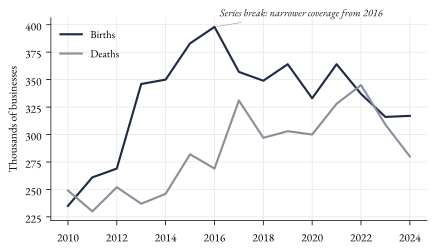
Three things stand out.
First, births climbed steeply in the early 2010s, from 235,000 in 2010 to 383,000 in 20152. Since 2017 they have stayed between 316,000 and 364,000 a year.
Second, deaths have risen too, and in some years they have overtaken births. In 2022, 345,000 businesses closed and 337,000 opened2.
Third, the latest year is fairly encouraging. In 2024 births were 11.1% of active businesses, while deaths fell to 9.8%, the lowest death rate since 2016. There were about 2.86 million active businesses1.
Watch out for the series break
If you look at Figure 1.1 without reading the small print, you may compare 2015 with 2017 and conclude that new business creation collapsed. Be careful. A series break is a point where a statistics office changes how it measures something, so numbers before and after are not like for like.
From its 2021 edition, ONS stopped counting enterprises that had a live company number but were registered for neither VAT nor PAYE, because they could distort the birth and death figures1. That change applies to data from 2016 onwards. The years 2010 to 2015 are still on the older, wider basis, which counts more businesses. To see the size of the effect: births in 2016 were 414,000 on the old basis but 398,000 on the new one2. The left-hand part of the chart is drawn with a slightly more generous ruler.
Whenever someone shows you a dramatic rise or fall, ask whether the method changed. The same habit will serve you when you read your own sales figures.
How long do new businesses last?
The number people most often quote about small businesses is the survival rate. A survival rate is the share of businesses born in a given year that are still trading a set number of years later. Businesses born in the same year are called a birth cohort.
The latest figures are these. Of UK businesses born in 2019, 38.4% were still active five years later. Of those born in 2023, 93.4% survived their first year13. Across the cohorts from 2008 to 2019, the five-year rate has ranged between 38.4% and 44.1%2.
The full path is just as telling. For businesses born in 2010, the share still trading after one, two, three, four and five years was 86.7%, 72.5%, 57.1%, 48.1% and 41.4%4. The biggest drops came in the second and third years. Between the end of year one and the end of year three, the cohort lost almost 30 percentage points.
Worked example. Picture 100 businesses that started in 2019. Using the ONS rate, about 38 of them (100 × 38.4% = 38.4) were still trading in 2024, and about 62 were not. Of 100 that started in 2023, about 93 (100 × 93.4%) made it through year one. Getting started is rarely what stops people. Years two and three are where most losses happen, and where much of this book’s attention goes.
What 38.4% really means
It is tempting to turn 38.4% into the headline “six in ten businesses fail”. That is not what the statistics say. Keep four points in mind.
- A “death” is not always a failure. ONS records that a business stopped trading and deregistered. It does not record why1. Some closures are painful failures. Others are owners who retire, take a good job, finish a project or close a side business on purpose. The statistics count them all the same way.
- Only registered businesses are included. The figures cover businesses registered for VAT or PAYE. Millions of small sole traders who are not registered for either do not appear at all, as the next section shows.
- Recent cohorts have done a little worse. Businesses born in 2015 to 2019 had five-year survival rates between 38.4% and 39.6%, compared with 41% to 44% for those born in 2010 to 20142. The 2019 cohort also met the pandemic in its first full year: in 2020 the UK economy shrank by 10.0%5.
- It is an average, not your fate. The figure mixes cafés, building firms, online shops, consultancies and much else. Your own odds depend far more on choices you control: how much you spend before you have customers, how you price, and how you manage cash.
How many businesses are there?
You may see two very different totals for the number of UK businesses. Both are correct; they measure different things.
The Department for Business and Trade (DBT) estimates that there were 5.6 million private sector businesses at the start of 2026. The detailed tables give 5,586,835, but this is an estimate with a margin of error of about 109,000 either way. That is 1.8%, or 104,000 businesses, fewer than a year earlier6. This business population has grown a great deal over time, from 3.47 million in 2000 to a peak of 5.98 million in 2020, although the early years were estimated using an older method7.
ONS, as we saw, counted about 2.86 million active businesses in 20241. Why the gap of nearly three million?
The answer is registration. ONS counts only businesses registered for VAT or PAYE. DBT adds an estimate of businesses that are registered for neither, mostly sole traders who have no employees and whose turnover is below the VAT threshold, which is £90,000 at the time of writing (2026/27 tax year)8. DBT says that 2.7 million businesses (48%) were registered and 2.9 million (52%) were trading without being registered for VAT or PAYE6. The two counts also differ in timing: DBT is a snapshot at the start of the year, while ONS counts any business active during the year.
So which should you use? DBT itself says its estimates cannot be used to count start-ups or closures6. Use DBT for the size and shape of the business world, and ONS for births, deaths and survival.
Table 1.1 shows the shape of that world.
| Size band (employees) | Businesses | Share of businesses | Share of employment | Share of turnover |
|---|---|---|---|---|
| No employees | 4,115,175 | 73.7% | 15.8% | 6.4% |
| Micro (1–9) | 1,198,870 | 21.5% | 15.1% | 12.7% |
| Small (10–49) | 225,215 | 4.0% | 15.6% | 13.6% |
| Medium (50–249) | 39,220 | 0.7% | 13.4% | 17.4% |
| Large (250+) | 8,355 | 0.15% | 40.1% | 49.9% |
| Total | 5,586,835 | 100% | 100% | 100% |
Table 1.1. UK private sector businesses by size, start of 2026. Shares calculated from the counts in DBT Table C; turnover excludes finance and insurance. “No employees” includes companies with one employee who is assumed to be the owner. Source: Department for Business and Trade, Business population estimates 20266.
Nearly three-quarters of UK businesses are one person, or a few partners, working for themselves. Small and medium-sized businesses make up 99.85% of the total and account for 60% of private sector employment and half of turnover6. If you start a business, you will almost certainly begin in that first row. You will be in good company.
The economy you are starting into
Three numbers describe the economic weather for a new business: growth, inflation and interest rates.
Growth: slow, but not shrinking
Gross domestic product (GDP) is the total value of everything produced in the economy. “Real” GDP growth strips out price rises, so it shows whether the economy is actually producing more. When GDP falls for two quarters in a row, that is usually called a recession.
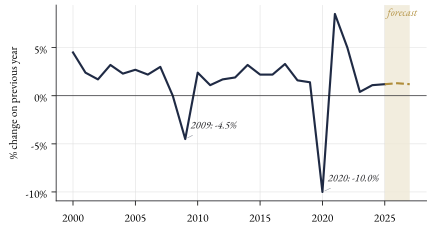
Figure 1.2 shows the two great shocks of this century. GDP fell 4.5% in 2009 and 10.0% in 2020. It then bounced back 8.5% in 20215. Since then growth has been modest: 1.1% in 2024 and 1.2% in 2025.
The International Monetary Fund’s (IMF) October 2026 World Economic Outlook forecasts UK growth of 1.3% in 2026, 1.2% in 2027 and 1.4% in 2031. For comparison, it expects the world economy to grow 3.1% in 2026 and 3.4% in 20279. The UK’s own Office for Budget Responsibility (OBR) is a little more cautious, forecasting growth of around 1.25% in 2026 and 1% in 202710.
What it means for you. Slow growth means the overall market is not expanding much. Most new businesses will win customers by serving them better than the alternatives, not by riding a boom. So be specific about whose problem you solve and why they would switch to you.
Inflation: above target, and the forecasters disagree
Inflation is the rate at which prices rise. The main UK measure is the Consumer Prices Index (CPI). The Bank of England’s job is to keep it at a target of 2%.
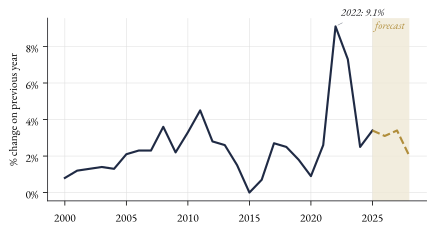
After years of low inflation, prices rose 9.1% in 2022 and 7.3% in 2023, then 2.5% in 2024 and 3.4% in 202511. In September 2026 the rate was 3.5%12.
The official outlooks now differ. The OBR, in October 2026, forecast CPI inflation of 3.1% in 2026 and 3.4% in 2027, falling to 2.0% in 202810. About a week later, in its November 2026 Monetary Policy Report, the Bank of England took a gloomier view. It projected inflation averaging 4.9% in the second quarter of 2027 and peaking at about 5%, before falling back towards 2%12. The Bank’s view is more recent, but nobody knows which will prove closer.
What it means for you. Inflation hits a new business twice. Your costs rise, and your customers have less to spend.
Worked example. Suppose your business has £1,500 a month of running costs: materials, phone, software, transport. If those costs rise in line with the OBR’s 3.4% forecast for 2027, you will pay £51 more a month (£1,500 × 3.4%), or £612 a year. If the Bank of England’s 4.9% is nearer the mark, it is £73.50 a month (£1,500 × 4.9%), or £882 a year. Either way, a price you set today will be worth less in a year unless you review it. Plan a price review at least once a year, and avoid long fixed-price deals unless you have priced in rising costs.
Interest rates: the price of borrowing
Bank Rate is the interest rate the Bank of England pays on money that banks hold with it. It is set by the Bank’s Monetary Policy Committee and strongly influences what banks charge for loans, overdrafts and mortgages.
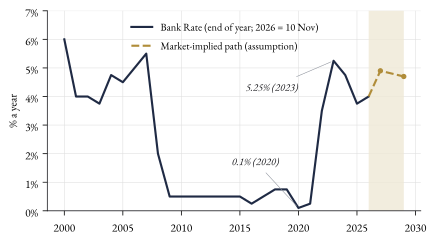
For most of the 2010s Bank Rate was close to zero. It sat at 0.5% from 2009 to 2015 and fell to 0.1% in 2020. It then rose quickly to 5.25% by the end of 2023 as the Bank fought inflation, and eased to 3.75% by the end of 202513. On 5 November 2026 the committee raised it to 4.00% by a vote of 8 to 1. The one dissenting member wanted 4.25%12.
What happens next? The Bank’s November report uses a market-implied path as an assumption: what financial markets were pricing in at the time. That path rises to about 4.9% at the end of 2027, then eases to about 4.7% by late 202912. The OBR’s own assumption is a little lower: just over 4¼% by mid-2027 and just over 4½% by the end of its forecast10. Neither is a promise. Both suggest that cheap money is not coming back soon.
What it means for you. Borrowing is dearer than it was for most of the last 15 years. At the time of writing, a government-backed Start Up Loan lends £500 to £25,000 to an individual over one to five years, at a fixed 7.5% a year14. That rate rose from 6% on 6 April 2026; it had been 6% since 201215. Check gov.uk for current terms before you apply. This is education, not financial advice.
Worked example. Borrow £10,000 over five years at 7.5% fixed. The monthly repayment is about £200.38, so you repay about £12,023 in total, of which about £2,023 is interest. At the old 6% rate, the same loan would have cost about £193.33 a month and about £1,600 in interest. The difference, roughly £7 a month, is small, but every pound you borrow must be repaid from profit, not turnover. A fixed rate also protects you if Bank Rate rises further; overdrafts and credit cards are usually variable and far more expensive.
Table 1.2 sums up.
| Indicator | Latest | Official outlook | What it means for a new owner |
|---|---|---|---|
| GDP growth | 1.2% (2025) | IMF: 1.3% (2026), 1.2% (2027) | Steady but slow demand; win customers by being better, not by riding a boom |
| CPI inflation | 3.5% (Sept 2026) | OBR: 3.4% (2027); Bank of England: about 4.9% in 2027 Q2 | Costs rise; review prices yearly; customers watch every pound |
| Bank Rate | 4.00% (from 5 Nov 2026) | Market-implied assumption: about 4.9% at end-2027 | Borrowing is costly; borrow little, fix the rate, start lean |
Table 1.2. The economy at a glance, November 2026. Sources: ONS; IMF World Economic Outlook, October 2026; OBR, October 2026; Bank of England, November 2026591012.
Starting in hard times
If the outlook sounds bleak, remember the last time things were genuinely bad. In the 2008–09 financial crisis, UK business births fell from 281,000 in 2007 to 236,000 in 2009, while deaths rose from 224,000 to 277,00016. (These figures use the older, wider basis.) Fewer people started businesses, and more closed. Yet some of the businesses started in those years went on to become household names.
Airbnb, 2007–2009
In 2007 Brian Chesky and Joe Gebbia, two unemployed designers in San Francisco, could not afford their rent. A design conference had filled the city’s hotels, so they put air mattresses on their living-room floor and rented them to visitors for $80 a night. Engineer Nathan Blecharczyk joined in early 2008 to build a proper website, and “AirBed & Breakfast” launched in August 2008, timed for the Democratic National Convention in Denver.
Then the financial crisis struck. Investor after investor turned them down; they could not see why anyone would sleep in a stranger’s home. Deep in credit-card debt, the founders designed election-themed cereal boxes, “Obama O’s” and “Cap’n McCain’s“, and sold them for $40 each, raising about $30,000.
The stunt impressed Paul Graham of the start-up programme Y Combinator, which invested $20,000 (Blecharczyk dates this to January 2009). Even then, revenue was stuck at about $200 a week. Looking at the New York listings, the founders saw that the photographs were poor. So they flew to New York, rented a camera and photographed hosts’ homes themselves, a fix that could never scale. Within a week, weekly revenue had doubled to $400, the first improvement in eight months. Within three months they had raised a $615,000 seed round.
The business faced a second shock in spring 2020, when about 80% of it disappeared within two weeks because of Covid-19. Airbnb cut a quarter of its 7,500 staff, then floated on the stock market in December 202017181920.
The lesson for you: Airbnb survived its worst year through effort, not brilliance. It raised cash with a cheap stunt, kept costs tiny, and fixed its product by hand after going to meet its customers. A recession made investors cautious, but it also gave people good reasons to want extra income and cheaper places to stay.
Airbnb is exceptional, and you should not expect to follow it. We have no reliable UK evidence that businesses started in downturns do better or worse than others, so this book will not claim either. But hard times teach good habits early: keep fixed costs low, test ideas cheaply, talk to customers instead of guessing, and treat cash as precious. These habits work in any economy, and later chapters show you how to build them.
Why new businesses fail
One useful study comes from CB Insights, a US research firm. In March 2026 it published an analysis of 431 venture-backed companies that had shut down since 2023, and identified the reasons for 385 of them. Each company could have more than one reason21.
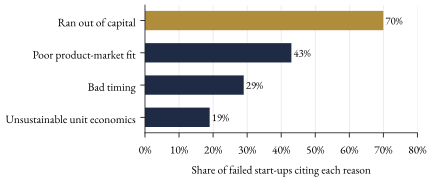
Seven in ten ran out of money. 43% had poor product-market fit, meaning not enough customers wanted the product enough to pay for it. 29% got the timing wrong, and 19% had unsustainable unit economics, meaning each sale cost more to deliver than it brought in21.
A caution: these are venture capital-backed companies. They raised money from professional investors in return for shares, often in technology, and aimed for very fast growth. They are not typical UK corner shops, trades or online sellers, and we could not find an equivalent UK survey of small businesses with verified percentages. Even so, the pattern makes sense for any business. Most closures come down to cash and customers: either the money ran out before the business could pay its way, or too few people wanted what it sold at a price that covered its costs.
The good news is that both can be checked early and cheaply. Chapter 4 shows you how to test demand before you spend. Chapter 5 shows you how to check that each sale makes money. Chapter 10 shows you how to see a cash shortage coming weeks before it arrives.
So, why start now?
An honest answer is that there is no perfect moment. Growth is slow. Inflation is above target and may rise. Borrowing costs more than it did for most of the past 15 years. Only about four in ten registered businesses are still trading after five years.
Yet the same data shows something else. In every year since 2013, more than 300,000 new businesses have been registered in the UK2, and in 2024 the death rate fell to its lowest level since 20161. More than 4 million UK businesses are run by people working for themselves, with no employees6. And most failures come from causes you can see coming and act on: running out of cash, and selling something too few people want at a price that works.
A tough economy rewards exactly the approach this book teaches. Start small. Keep your day job, or part of it, while you test. Spend little until customers prove the idea. Borrow carefully, if at all. Watch your cash every week. Founders who work this way are not betting their home on a dream; they are running small, affordable experiments, any one of which can become a business.
You do not need a boom to begin. You need a plan, and that is what the rest of this book is for.
- About 317,000 businesses were born in the UK in 2024 and 280,000 died; the 9.8% death rate was the lowest since 2016.
- 38.4% of businesses born in 2019 were still trading after five years, but a “death” in the statistics is not always a failure, and years two and three are the riskiest.
- The UK has 5.6 million businesses (DBT) but only about 2.9 million active businesses registered for VAT or PAYE (ONS); 73.7% have no employees.
- Official forecasts point to slow growth (about 1.2–1.3%), inflation above target (3.4% to nearly 5% in 2027) and Bank Rate staying around 4% or higher.
- Most closures come down to cash and customers, and both can be tested early and cheaply.
- Write down your monthly running costs today, then add 5% to see what a year of inflation could do.
- Decide now when you will review your prices each year, and put the date in your diary.
- Check the current Start Up Loan terms on gov.uk, and work out the monthly repayment on any sum you are thinking of borrowing.
- Look up the latest ONS Business demography release (the next one is due on 19 November 2026) and note the latest survival rates.
- Write one sentence describing whose problem your business will solve and why they would switch to you.
- Decide how many months you could test your idea part-time before needing it to pay you.
References for this sample
- Office for National Statistics (2025). Business demography, UK: 2024. Statistical bulletin, published 20 November 2025. ONS. https://www.ons.gov.uk/businessindustryandtrade/business/activitysizeandlocation/bulletins/businessdemography/2024 (accessed November 2026).
- Office for National Statistics (2016–2025). Business demography, UK: editions 2015 to 2024 (published 23 November 2016 to 20 November 2025), Table 1 'Business births, deaths and active businesses' and survival-rate tables; each year taken from the most recent edition reporting it. ONS. Latest edition and links to earlier editions: https://www.ons.gov.uk/businessindustryandtrade/business/activitysizeandlocation/bulletins/businessdemography/2024 (accessed November 2026).
- Welsh Government (2025). Business demography: 2024 (quoting ONS UK one-year survival rate for the 2023 cohort). First published 21 November 2025. Welsh Government. https://www.gov.wales/business-demography-2024-html (accessed November 2026).
- Office for National Statistics (2016). Business demography, UK: 2015, Table 4 'Survival rates of UK businesses by birth cohort, 2010 to 2014'. Published 23 November 2016. ONS. https://www.ons.gov.uk/businessindustryandtrade/business/activitysizeandlocation/bulletins/businessdemography/2015 (accessed November 2026).
- Office for National Statistics (2026). Gross Domestic Product: year on year growth, CVM SA % (series IHYP), UK Economic Accounts. Release of 30 September 2026. ONS. https://www.ons.gov.uk/economy/grossdomesticproductgdp/timeseries/ihyp/ukea (accessed November 2026).
- Department for Business and Trade (2026). Business population estimates for the UK and regions 2026: statistical release (including Table C). Published 5 November 2026. DBT. https://www.gov.uk/government/statistics/business-population-estimates-2026/business-population-estimates-for-the-uk-and-regions-2026-statistical-release (accessed November 2026).
- Department for Business and Trade and predecessor departments (2016–2026). Business population estimates for the UK and regions: 2016 edition (Table B), 2019 edition (Table B), 2022 edition (Table B) and 2026 edition (Table A). DBT/BEIS/BIS. https://assets.publishing.service.gov.uk/media/5a8164c6e5274a2e87dbd640/bpe_2016_statistical_release.pdf ; https://assets.publishing.service.gov.uk/media/5df8e119ed915d09343c187f/Business_Population_Estimates_for_the_UK_and_regions_-_2019_Statistical_Release.pdf ; https://www.gov.uk/government/statistics/business-population-estimates-2022/business-population-estimates-for-the-uk-and-regions-2022-statistical-release-html ; https://www.gov.uk/government/statistics/business-population-estimates-2026/business-population-estimates-for-the-uk-and-regions-2026-statistical-release (accessed November 2026).
- HM Revenue & Customs (2026). VAT Notice 700/11 supplement: VAT registration and deregistration thresholds. Updated 31 March 2026. GOV.UK. https://www.gov.uk/government/publications/vat-notice-70011-cancelling-your-registration/vat-notice-70011-supplement (accessed November 2026).
- International Monetary Fund (2026). World Economic Outlook, October 2026: Resilience Under Strain, Urgent Choices. Statistical Appendix, Tables A1 and A2. Published 13 October 2026. IMF. https://www.imf.org/-/media/files/publications/weo/2026/october/english/tablea.pdf (accessed November 2026).
- Office for Budget Responsibility (2026). Economic and fiscal outlook – October 2026. Presented 28 October 2026. OBR. https://assets.publishing.service.gov.uk/media/6ae4a7a9ec36e258a1998484/economic-and-fiscal-outlook-october-2026-web-accessible.pdf (accessed November 2026).
- Office for National Statistics (2026). CPI annual rate 00: all items 2015=100 (series D7G7), Consumer price inflation time series (MM23). Release of 21 October 2026. ONS. https://www.ons.gov.uk/economy/inflationandpriceindices/timeseries/d7g7 (accessed November 2026).
- Bank of England (2026). Monetary Policy Report – November 2026. Published 5 November 2026. Bank of England. https://www.bankofengland.co.uk/monetary-policy-report/2026/november-2026 (accessed November 2026).
- Bank of England (2026). Official Bank Rate history (database of changes in Bank Rate). Bank of England. https://www.bankofengland.co.uk/boeapps/database/Bank-Rate (accessed November 2026).
- GOV.UK (2026). Apply for a Start Up Loan for your business. Page updated 5 November 2026. GOV.UK. https://www.gov.uk/apply-start-up-loan (accessed November 2026).
- Start Up Loans / British Business Bank (2026). Changes to interest rate and eligibility (FAQ). Start Up Loans. https://www.startuploans.co.uk/support-and-guidance/frequently-asked-questions/changes-to-interest-rate-and-eligibility (accessed November 2026).
- Office for National Statistics (2014). Business demography, UK: 2013. Published 27 November 2014. ONS. https://www.ons.gov.uk/businessindustryandtrade/business/activitysizeandlocation/bulletins/businessdemography/2014-11-27 (accessed November 2026).
- Fortune (2023). Airbnb CEO: cereal box investors changed everything. 19 April 2023. Fortune. https://fortune.com/2023/04/19/airbnb-ceo-cereal-box-investors-changed-everything-billion-dollar-company/ (accessed November 2026).
- Polsky Center for Entrepreneurship and Innovation (2021). Fireside chat with Airbnb co-founder Nathan Blecharczyk. 24 May 2021. University of Chicago. https://polsky.uchicago.edu/2021/05/24/fireside-chat-polsky-airbnb-cofounder-nathan-blecharczyk/ (accessed November 2026).
- First Round Review (2015). How design thinking transformed Airbnb from failing startup to billion-dollar business. First Round Capital. https://review.firstround.com/how-design-thinking-transformed-airbnb-from-failing-startup-to-billion-dollar-business/ (accessed November 2026).
- Newsweek (2025). An $80 idea changed travel forever. Newsweek. https://www.newsweek.com/an-80-idea-changed-travel-forever-12283773 (accessed November 2026).
- CB Insights (2026). The top 9 reasons startups fail. Published 5 March 2026. CB Insights. https://www.cbinsights.com/blog/startup-failure-reasons-top/ (accessed November 2026).