
Introduction
Taking on your first employee is a big step. This book walks you through it, one stage at a time, with the real rules and the real numbers for the 2026/27 tax year.
Every chapter has worked examples, key takeaways and a checklist. Figures and rules change, especially every April, so always check GOV.UK, HMRC, Acas or The Pensions Regulator before you act. This book is education, not legal, tax or financial advice.
Are You Ready to Employ?
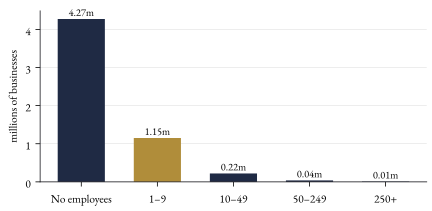
At the start of 2025 there were about 5.7 million private sector businesses in the UK. Three out of four of them, 4.27 million, had no employees at all: just the owner, or the owners, doing everything1. Only about 1.15 million businesses had between one and nine employees. The step from “just me” to “me and one other person” is one of the biggest a small business ever takes, and most never take it.
Plenty of owners think about it. In the government’s 2025 survey of small businesses, 16% of firms with no employees expected to take someone on within the next twelve months2. In cafés, restaurants and other food businesses the figure was 29%, and in shops and wholesale it was 23%2. Those are the businesses where one pair of hands runs out fastest: someone has to serve customers while someone else cooks, packs or answers the phone.
This book is for the owner standing at that step. You might run a café, a salon, a corner shop, a cleaning round, an online shop, a building or electrical business, or a small care service. You know your trade. What you may not know is what changes when you become an employer: the wages, the tax, the pension, the paperwork and the responsibility for another person’s working life.
This first chapter helps you decide whether you are ready. It looks at the signs that you need help, the alternatives to employing someone, and a first honest look at what an employee really costs. The rest of the book then takes you through every step, from the job advert to the first payslip and beyond.
Signs that you need help
Most owners do not wake up one morning and decide to employ someone. The need creeps up. These are the most common signs:
- You are turning work away. Customers ask for things you cannot fit in, or you have stopped answering enquiries because you know you cannot take them on.
- The important work never gets done. You spend all day serving, packing or travelling, and the marketing, the accounts and the planning slide to evenings and weekends, or never happen.
- Quality is slipping. Orders go out late, mistakes creep in, customers wait longer than they should.
- You cannot be ill or take a holiday. If you stop, the business stops. A week off means a week of no income.
- You are exhausted. Long hours for months on end are not a plan. Tired owners make expensive mistakes.
One or two of these signs are normal in any busy period. If most of them have been true for several months, and the work is steady rather than a one-off rush, it is time to take the question seriously.
A useful test: write down every task you did last week and roughly how long it took. Mark the tasks that only you can do (your skill, your relationships, your decisions) and the tasks someone else could learn in a few weeks. If the second list adds up to more than fifteen hours a week, you probably have a job to give someone.
The alternatives to employing someone
An employee is not the only way to get help. Before you advertise a job, look at the alternatives. Each has a place, and some owners use them for a year or two before taking on a first employee.
| Option | Best for | Main advantage | Main drawback |
|---|---|---|---|
| Doing it yourself, more efficiently | Owners losing time to admin | No extra cost | Only goes so far |
| Software and automation | Bookings, invoicing, stock, payroll | Cheap, always available | Cannot serve customers or make things |
| Freelancer or self-employed contractor | Specialist or occasional work (design, bookkeeping, deliveries) | Pay only for the work done | Must be genuinely self-employed (see Chapter 2) |
| Agency or temporary worker | Busy seasons, cover for absence | Agency handles payroll | Higher hourly cost |
| Apprentice | Training someone into your trade | Lower minimum wage in the first year | Needs time for training and an approved programme |
| Part-time employee | Steady but limited extra work | Lower cost, still committed | Fewer hours of cover |
| Full-time employee | Steady, full-time workload | Reliable, trained, part of the team | Highest cost and responsibility |
Source: author’s summary.
The choice between a freelancer and an employee is not just about what suits you. The law looks at how the person actually works: whether you control how, when and where they work, whether they must do it personally, and whether they are in business on their own account. Calling someone “self-employed” does not make them so. Chapter 2 explains the employment status rules in detail, because getting this wrong can mean back-dated tax, holiday pay and other claims.
A first look at the real cost
The biggest worry for most first-time employers is money. That worry is sensible. An employee costs more than their hourly wage, and the extras are not optional. Chapter 3 goes through every element in detail, but here is the shape of it.
From 1 April 2026, the National Living Wage for workers aged 21 and over is £12.71 an hour3. On top of the wage, an employer usually pays:
- Employer’s National Insurance: 15% of everything the employee earns above £5,000 a year4.
- Pension contributions: at least 3% of the employee’s qualifying earnings, the band of pay between £6,240 and £50,270 a year, if the employee is eligible for automatic enrolment56.
- Paid holiday: at least 5.6 weeks a year, which is already included if you budget for 52 weeks of pay7.
- Employers’ liability insurance: required by law from the first day you employ someone, with at least £5 million of cover8.
Many small employers can reduce the National Insurance bill with the Employment Allowance, which is worth up to £10,500 a year in 2026/274. Not every business can claim it. In particular, a company where the only employee paid above the threshold is a director cannot9. Chapter 3 explains the rules.
Worked example: a café assistant on 30 hours a week
Priya runs a small café. She wants to employ an assistant aged 25 for 30 hours a week at the National Living Wage of £12.71 an hour, for the 2026/27 tax year.
- Annual wage: 30 hours × £12.71 × 52 weeks = £19,827.60
- Employer’s National Insurance: (£19,827.60 − £5,000) × 15% = £2,224.14
- Minimum employer pension: (£19,827.60 − £6,240) × 3% = £407.63
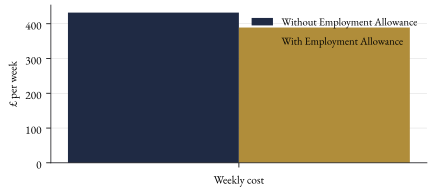
- Total before the Employment Allowance: £22,459.37 a year, about £432 a week
If Priya’s business can claim the Employment Allowance, the £2,224.14 of National Insurance is covered by the allowance, and the cost falls to £20,235.23 a year. Insurance, training, equipment and Priya’s own time in managing are extra.
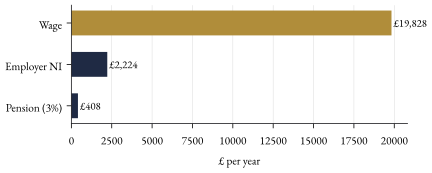
The key point is this: the wage is only part of the cost. In this example the extras add about 13% to the wage bill before the Employment Allowance. For better-paid staff the percentage is higher, because more of their pay sits above the National Insurance threshold.
Can the business afford it?
An employee needs to pay for themselves, either by bringing in more income or by freeing your time to earn more. A simple way to think about it:
- Work out the weekly cost. In the example above, about £432 a week before any allowance.
- Work out what the extra hours are worth. If the café can stay open two extra hours a day, or serve more customers at lunchtime, how much extra profit (not sales) does that bring in?
- Work out what your freed time is worth. If you spend ten hours a week on marketing, catering bookings or a second site instead of serving, what could that earn?
- Allow a settling-in period. A new employee takes weeks, sometimes months, to become fully useful. Budget for at least three months where the cost is higher than the benefit.
- Keep a cushion. Wages must be paid on time, every time, even in a quiet month. Many advisers suggest keeping at least two or three months of wage costs in reserve before you hire. That is a sensible rule of thumb rather than a legal requirement.
If the numbers do not work yet, that is useful information. You might start with fewer hours, a seasonal contract, or a freelancer for a specific task, and revisit the decision in six months.
What changes when you become an employer
Becoming an employer brings new duties. None of them is difficult on its own, but there are several, and they start from the first day. In brief:
| Duty | When | Where in this book |
|---|---|---|
| Check the person has the right to work in the UK | Before they start | Chapter 5 |
| Get employers’ liability insurance | From the first day | Chapter 10 |
| Give a written statement of terms | On or before the first day | Chapter 6 |
| Register as an employer with HMRC | Before the first payday | Chapter 7 |
| Run payroll and report pay to HMRC | On or before each payday | Chapter 7 |
| Pay at least the minimum wage | Always | Chapter 3 |
| Enrol eligible staff in a workplace pension | From their start date (postponement allowed) | Chapter 8 |
| Give paid holiday and statutory sick pay | Always | Chapter 9 |
| Keep the workplace safe | Always | Chapter 10 |
Sources: GOV.UK, Acas and The Pensions Regulator; see the chapters listed.
Employment law is also changing. The Employment Rights Act 2025 is being brought in step by step. From 6 April 2026, for example, Statutory Sick Pay became payable from the first day of sickness, and paternity leave became a day-one right10. From 1 January 2027 the period an employee must work before they can claim unfair dismissal falls from two years to six months10. This book explains the rules as they stand at the time of writing, and tells you where to check for changes.
Are you ready? A quick self-check
You are probably ready to employ if you can answer “yes” to most of these questions:
- The extra work has been steady for at least three months, and you expect it to continue.
- You know which tasks you would hand over, and you could write them down.
- The numbers work: the extra income or freed time covers the full cost, not just the wage.
- You have a cash cushion for wages in a quiet month.
- You have time to train and support someone in their first weeks.
- You are willing to learn the basic rules on pay, tax, pensions and fairness, or pay someone to help.
If you answered “no” to several, it may be better to start with an alternative from the table earlier in this chapter. There is no shame in waiting. Hiring too early can strain a business as much as hiring too late.
Common mistakes
- Hiring in a panic. A busy fortnight is not the same as a steady need. Hiring to solve a short rush can leave you with a cost you cannot cover when things go quiet.
- Costing only the wage. As the worked example showed, employer’s National Insurance and pension contributions add around 13% to a typical part-time wage before any allowance, and more for higher pay.
- Forgetting your own time. A new employee needs training, checking and support. In the first month you may spend several hours a week on this.
- Calling an employee “self-employed”. Status depends on how the work is done, not the label (Chapter 2).
- Leaving the paperwork until day one. Right to work checks, insurance, the written statement and HMRC registration all need to be ready before or on the first day.
Questions owners ask
“Can I employ a family member?” Yes. Family members can be employees and the same rules on pay, tax and pensions apply. If you only employ close family members, you may not need employers’ liability insurance8, but check the details in Chapter 10.
“What if I only need someone for a few hours a week?” A part-time employee is often the simplest answer. Chapter 3 costs a 16-hour role. For very occasional tasks, a genuine freelancer or an agency worker may suit better.
“Will the Employment Allowance cover all my National Insurance?” For one or two employees on modest pay, usually yes, because the allowance is up to £10,500 a year in 2026/274. But some businesses cannot claim it, including a company whose only employee paid above the threshold is a director9.
“How long does it all take?” Allow six to twelve weeks from deciding to hire to the first day: time to write the job, advertise, interview, check and set up payroll and pensions. Chapter 12 has a timeline.
- Three out of four UK businesses have no employees. Taking on the first person is a big step, and worth planning.
- Look for steady signs of need: turning work away, important tasks never done, slipping quality, no way to take time off.
- Consider alternatives first: software, freelancers, agencies, apprentices or part-time staff.
- An employee costs more than their wage: employer’s National Insurance, pension contributions, holiday and insurance all add up.
- Check the numbers, allow a settling-in period and keep a cash cushion before you hire.
- List the tasks you would hand over and how many hours a week they take.
- Decide whether you need an employee or one of the alternatives.
- Work out the full yearly cost using the rates in Chapter 3.
- Check whether your business can claim the Employment Allowance.
- Estimate the extra profit or freed time the role will bring.
- Put aside at least two to three months of wage costs as a cushion.
- Read Chapter 2 to make sure you understand employment status.
References for this sample
- Department for Business and Trade (2025). Business population estimates for the UK and regions 2025: statistical release. https://www.gov.uk/government/statistics/business-population-estimates-2025/business-population-estimates-for-the-uk-and-regions-2025-statistical-release (accessed November 2026).
- Department for Business and Trade (2026). Longitudinal Small Business Survey 2025: businesses with no employees. https://www.gov.uk/government/statistics/small-business-survey-2025-businesses-with-no-employees/longitudinal-small-business-survey-2025-businesses-with-no-employees (accessed November 2026).
- GOV.UK (2026). National Minimum Wage and National Living Wage rates. https://www.gov.uk/national-minimum-wage-rates (accessed November 2026).
- HM Revenue & Customs (2026). Rates and thresholds for employers 2026 to 2027. https://www.gov.uk/guidance/rates-and-thresholds-for-employers-2026-to-2027 (accessed November 2026).
- The Pensions Regulator (2026). Contributions and funding: minimum contributions for automatic enrolment. https://www.thepensionsregulator.gov.uk/employers/contributions-funding.aspx (accessed November 2026).
- Department for Work and Pensions (2026). Review of the automatic enrolment earnings trigger and qualifying earnings band for 2026/27. https://www.gov.uk/government/publications/review-of-the-automatic-enrolment-earnings-trigger-and-qualifying-earnings-band-for-202627 (accessed November 2026).
- GOV.UK (2026). Holiday entitlement. https://www.gov.uk/holiday-entitlement-rights (accessed November 2026).
- GOV.UK (2026). Employers' liability insurance. https://www.gov.uk/employers-liability-insurance (accessed November 2026).
- Xero (2026). Employment Allowance: what it is and who can claim. https://www.xero.com/uk/guides/employment-allowance/ (accessed November 2026).
- VinciWorks (2026). Employment Rights Act 2025 implementation timeline: updated July 2026. https://vinciworks.com/blog/employment-rights-act-2025-implementation-timeline-updated-july-2026/ (accessed November 2026).