 Fablewings
 › Sri Lankan history › Part 1
The Island Before Kings (prehistory to c. 500 BCE)
For tens of thousands of years before any king, people lived on the land we call Sri Lanka: rainforest hunters, coastal foragers, then iron-using farmers and potters. No year-by-year record exists for this era, so this part moves through dated phases, each with its margin of error. It also asks how we know anything at all: what the monk-chroniclers wrote, what the spade has found, and where the two disagree.
Read in the page-turning reader
How we know: chronicles, stones and spades
Sri Lanka is unusual in South Asia: it has long Pali chronicles that claim to tell its story from the Buddha's lifetime onward. Yet they were written many centuries after the events they describe. Historians weigh them against inscriptions, excavations and foreign texts.
4th century CE: the Dipavamsa
The oldest surviving chronicle is the Dipavamsa, the 'Island Chronicle', usually dated to the 4th century CE. It is short, repetitive and written in uneven Pali verse, which suggests it was stitched together from an older oral and commentarial tradition kept by monks.
Its author is unknown. It already contains the story of Prince Vijaya, in a simpler form than the version that became famous later.
5th–6th century CE: the Mahavamsa
The Mahavamsa, the 'Great Chronicle', is credited to a monk named Mahanama of the Mahavihara monastery at Anuradhapura. A later commentary, the Mahavamsa-tika, names him; little else is known.
It is usually placed in the reign of King Dhatusena in the 5th century CE, though some scholars prefer the 6th. Its first part runs from legendary beginnings to King Mahasena in the 4th century CE.
Why Mahanama wrote
Mahanama's preface says he wanted to remove the faults of an older work: its repetitions, gaps and excess length.
1837: the chronicle reaches Europe
George Turnour, a British civil servant in Ceylon, published the first printed edition and English translation of the Mahavamsa in 1837, covering its first 38 chapters.
L.C. Wijesinghe translated the remaining chapters and published a complete version in 1889. These colonial-era translations shaped how both British officials and Sri Lankan nationalists came to see the island's ancient past.
1912: Geiger's edition
The German scholar Wilhelm Geiger published his translation of the Mahavamsa in 1912. Mabel Haynes Bode translated it into English and Geiger revised her version; his English Culavamsa, made with C. Mabel Rickmers, followed in 1929–1930.
Geiger's critical work made the chronicle usable as a historical source. It also fixed a chronology, discussed below, that many textbooks still follow.
Do the chronicles stand up?
Some outside evidence supports the chronicle's broad picture of the Mauryan age.
The sceptics
Western scholars around 1900 were often harsh judges of the early chapters.
Inscriptions: the island's own documents
Thousands of short stone inscriptions in Brahmi script, many recording gifts of caves to monks, are the best written evidence for early Sri Lanka. They are contemporary with what they describe, unlike the chronicles.
Brahmi letters scratched on pottery at Anuradhapura are even older. Their dating, discussed in section 01.4, has changed the debate about when writing reached South Asia.
Archaeology and its dates
Most dates in this part come from radiocarbon tests on charcoal, bone or shell. Results are given as years 'BP' (before present, meaning before 1950) or converted to calendar years.
Foreign eyes
Outside accounts help check the chronicles, though most come after this era. Ashoka's edicts of the 3rd century BCE name the island's southern neighbours. The Chinese monk Faxian arrived in 411 CE.
The 7th-century pilgrim Xuanzang recorded a different version of the island's origin myth, with no mention of the Indian kingdoms the Mahavamsa names, showing that several versions of the story circulated.
The Buddha's death and the island's clock
The chronicles date everything from the Buddha's death, the parinibbana. Their tradition places it in 544/543 BCE, the basis of the Buddhist era still used in Sri Lanka.
Geiger's chronology: c. 483 BCE
Geiger and many 20th-century scholars accepted a 'corrected' date of about 483 BCE, linked to J.F. Fleet's work of 1906–1909, with nearby variants of 487–486 BCE.
1988: the Göttingen symposium
In 1988 Heinz Bechert gathered experts at Göttingen to re-examine the question. The papers were published in several volumes, and a summary book followed in 1995.
Why the date matters
The Mahavamsa says Vijaya landed on the very day the Buddha died.
The chronicle in modern politics
The Mahavamsa is not only a historical source; it became a symbol.
The land and the bridge
Sri Lanka's shape, climate and links to India set the terms for everything that followed. The island has been joined to the mainland and cut off from it several times as sea levels rose and fell.
Ice ages: a walkable strait
During the last glacial period global sea levels fell by up to about 120 metres. The shallow Palk Strait and Gulf of Mannar shelf became dry land, and people and animals could walk between India and Sri Lanka.
This helps explain why the island's plants and animals are closely related to those of the Western Ghats in south India.
c. 14,000–7,000 years ago: becoming an island
As the ice melted, the sea rose. Archaeologist Kavan Ratnatunga summarises that about 14,000 years ago the island was still joined to the peninsula, and that over the next 7,000 years the sea rose to roughly its present level.
By about 7,000 years ago, rising Holocene seas had flooded the strait. Sri Lanka has been an island, in human terms, ever since.
Adam's Bridge: the sandbank chain
The chain of shoals between Dhanushkodi in India and Talaimannar in Sri Lanka is called Adam's Bridge or Rama Setu. Reporting on a study by India's National Remote Sensing Centre gives a length of 29 km; other sources give about 48 km.
Was the bridge walkable until 1480?
A popular claim says people could walk across until the 15th century.
The first people: the Stone Age
Sri Lanka holds some of the oldest securely dated evidence for modern humans in South Asia. Almost all of it was found by the island's own archaeologists, above all Siran Deraniyagala, later working with international teams.
c. 125,000–75,000 BP: Patirajawela, Bundala
The oldest evidence of human activity comes from coastal gravel deposits near Bundala in the south. Deraniyagala dated a small-flake stone industry at Patirajawela to about 125,000–75,000 years ago.
c. 48,000–45,000 BP: Fa-Hien Lena
Fa-Hien Lena, a cave in Kalutara District in the south-west, has the island's longest record of rainforest life. A 2019 study led by Oshan Wedage in Nature Communications showed people there hunting monkeys and squirrels by at least 45,000 years ago.
This was specialised forest hunting, not opportunistic scavenging, and it challenged the idea that early humans avoided tropical forests.
c. 48,000 BP: the earliest bows outside Africa
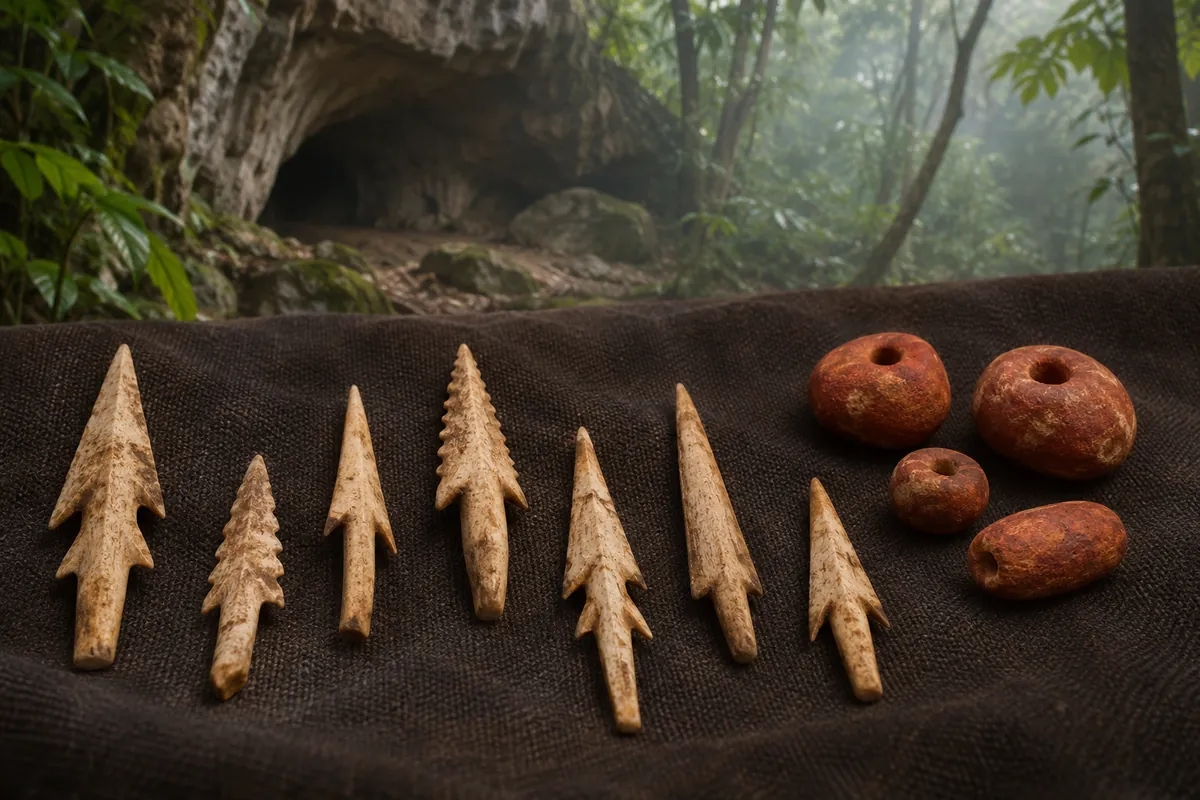
In 2020 a team led by Michelle Langley reported in Science Advances 130 bone projectile points from Fa-Hien Lena, about 48,000 years old.
Their size, shape and damage suggest arrow tips used against small, quick tree-dwelling animals. The authors called them the earliest known bow-and-arrow technology outside Africa. The team also found bone tools that may have been used for making nets or working skins.
How old is Fa-Hien Lena really?
Published dates for the cave have moved over time.
c. 30,000 BP: the oldest human remains
The oldest human remains from Fa-Hien Lena, of three children and an adult woman, have been dated to about 30,000 years ago.
It is among the oldest reliably dated remains of anatomically modern humans in South Asia. The cave also has burials from about 6,850 and 4,750 years ago, showing use over a vast span of time.
Pahiyangala and the name of Faxian
Both Fa-Hien Lena and nearby Pahiyangala, a huge rock-shelter temple in the Bulathsinhala area, take their names from the Chinese monk Faxian.
c. 31,000–28,500 BP: Batadombalena
Batadombalena, a cave near Kuruwita in the foothills of Sri Pada (Adam's Peak), was first dug in 1938 and again in 1979–1981. Its lower layers yielded geometric microliths, tiny shaped stone blades set into handles.
1955–1989: naming 'Balangoda Man'
The name comes from sites near Balangoda where the culture was first identified. In 1955 the zoologist P.E.P. Deraniyagala proposed a separate subspecies name, Homo sapiens balangodensis.
Later work by his son Siran Deraniyagala and the American anthropologist Kenneth Kennedy described the remains as fully modern humans. Their 1989 paper in Current Anthropology spoke of fossil remains of 28,000-year-old hominids from Sri Lanka.
Microliths: earlier than Europe
Sri Lanka's geometric microliths appear about 19,000 years before similar tools in Europe.
c. 31,000–7,880 BP: Beli-lena, Kitulgala
Beli-lena, a rock shelter near Kitulgala, was used by microlith-making hunter-gatherers from about 31,000 to 7,880 years ago, according to a 2009 study by Nikos Kourampas and colleagues, including Deraniyagala.
Remains at the site have been read as signs that salt was carried up from the coast. Human skeletal fragments were also found; summaries give differing dates for them.
How they lived
Deraniyagala's synthesis describes small bands whose camps rarely exceeded 50 square metres.
They hunted monkeys, deer and smaller animals, collected snails and plant foods, and buried their dead in the camp floor, often as secondary burials after the flesh had gone. Red ochre was used in burials at Fa-Hien Lena and Ravanalla cave. In some samples men averaged about 174 cm in height and women about 166 cm.
Farming on Horton Plains?
Pollen cores from Horton Plains, studied by T.R. Premathilake, have been read as evidence of very early herding and plant management.
No Neolithic phase
In much of the world, farming villages with polished stone tools came between foragers and metal users.
Fa-Hien Lena's bone arrowheads
Tiny bone points from Fa-Hien Lena, about 48,000 years old, are the earliest known arrow tips outside Africa, according to a 2020 study.
Iron, rice and the first town
Between about 1000 and 500 BCE, Sri Lanka changed fast. Iron tools, rice farming, cattle, horses, fine pottery and burial monuments appeared, and Anuradhapura grew from a village into a town. Deraniyagala calls this the protohistoric Early Iron Age.
c. 1000–800 BCE: the earliest Iron Age dates
Deraniyagala placed the earliest Sri Lankan Iron Age dates at about 1000–800 BCE, at Anuradhapura and at the Aligala rock shelter near Sigiriya.
c. 900 BCE: Anuradhapura begins
In 1988 Deraniyagala excavated deep in the Citadel of Anuradhapura, reaching layers almost 9 metres down. The lowest settlement was radiocarbon dated to about 900 BCE.
It covered an estimated 35–65 acres, a large village. The people used iron tools, grew rice, made high-quality pottery and kept cattle and horses. This was centuries before the date the chronicles give for Vijaya.
c. 800–600 BCE: a growing settlement
Deraniyagala estimated the settlement exceeded 10 hectares by about 800 BCE and reached at least 50 hectares by about 700–600 BCE.
Archaeology versus the chronicle
The Mahavamsa says Anuradhapura was founded by a minister of Vijaya named Anuradha, and later made a capital.
The 'megalithic' label
Large stone burial monuments of this period closely resemble those of peninsular India, and are usually called 'megalithic'.
c. 750–400 BCE: the Ibbankatuwa tombs
Ibbankatuwa, about 5 km south-west of Dambulla town, was identified in 1970 and excavated in 1983–1984 and 1988–1990. Deraniyagala called it Sri Lanka's only radiocarbon-dated megalithic cemetery, at about 750–400 BCE.
What the Ibbankatuwa dead took with them
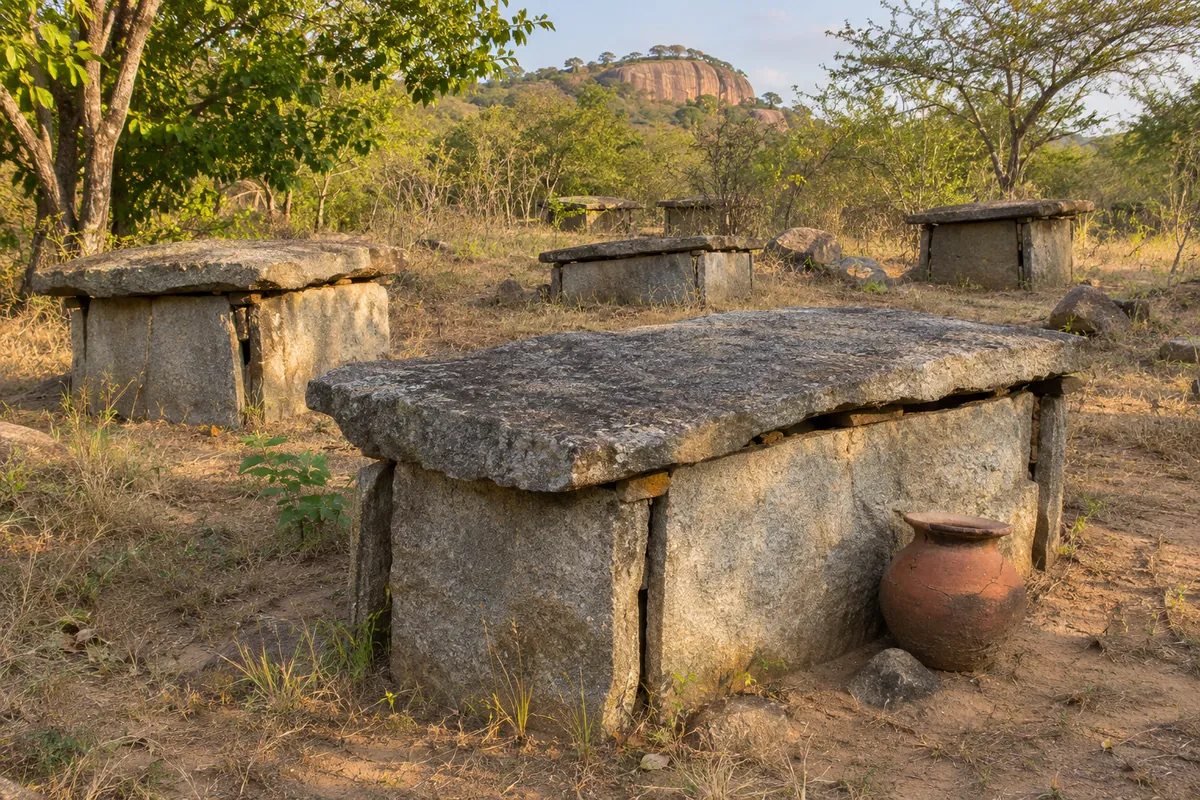
Each cist tomb was made of four stone slabs with a fifth as a lid. Inside or beside them were clay urns holding cremated remains, along with grave goods.
Finds include pottery, iron, copper and gold objects, and beads of carnelian, onyx and agate. Some gemstones do not occur naturally on the island, suggesting long-distance trade, possibly through India.
1970: the Pennsylvania excavations
In 1966 Vimala Begley of the University of Pennsylvania Museum surveyed northern Ceylon for sites of the pre-Buddhist past. In 1970 a Penn team, with Bennet Bronson as field director, Begley as assistant field director and Mohamad Mauroof, excavated at Pomparippu and at Kantarodai in the Jaffna Peninsula.
Pomparippu had been found by A.M. Hocart in 1923–1924 and partly dug by Raja de Silva in 1956. Begley estimated it held about 8,000 urn burials, or 10,000–12,000 individuals.
Dating Pomparippu
Pomparippu remains hard to date.
Who were the urn-burial people?
The burial urns and black-and-red pottery are closely related to south Indian Iron Age burials.
c. 600–500 BCE: letters on pots?
Deraniyagala reported potsherds from seven vessels at the Anuradhapura Citadel scratched with early Brahmi letters, dating them to about 600–500 BCE.
He suggested that some of the names might match figures in the chronicles, including Anuradha. If correct, this would make Anuradhapura one of the first places in South Asia where writing was used.
Who wrote first?
The early Brahmi dates are hotly debated.
The Ibbankatuwa stone tombs
Slab-built cist tombs at Ibbankatuwa near Dambulla held urns of ashes, beads and iron tools, about 750–400 BCE.
Peoples and legends
The chronicles fill this era with yakkhas, nagas, a lion-born prince and the Buddha's magical visits. These stories matter because generations of Sri Lankans have understood their origins through them. This section sets each legend beside what scholars make of it.
The Buddha's three visits (legend)
The Mahavamsa's opening chapters say the Buddha visited the island three times. First he came to Mahiyangana and drove out the yakkhas; then to Nagadipa to settle a quarrel between two naga kings; and finally to Kelaniya.
Yakkhas and nagas: who were they?
In the chronicles, yakkhas are demon-like beings and nagas are serpent beings. Both lived on the island before Vijaya.
The lion's grandson (legend)
The Mahavamsa tells how a princess of Vanga (Bengal) ran off and was carried away by a lion. Their son Sinhabahu killed his father and founded the city of Sinhapura in Lala.
Sinhabahu married his sister Sinhasivali. Their eldest son was Vijaya. The name Sinhala, 'of the lion', is traced in the story to this lion ancestor.
c. 543 BCE (chronicle date): Vijaya lands
The chronicles say Vijaya was banished for violent behaviour and sent to sea with 700 followers. After touching at Supparaka, usually identified with Sopara on India's west coast, they landed at Tambapanni.
The Mahavamsa says they arrived on the very day of the Buddha's death, and that the dying Buddha asked the god Sakka to protect Vijaya and Lanka.
Kuveni (legend)
In the Mahavamsa, Vijaya meets the yakkhini Kuveni, who helps him defeat the yakkhas of Sirisavatthu. They have two children, Jivahata and Disala.
When Vijaya needs a queen of royal birth, he sends Kuveni away, and she is killed by her own people. The chronicle says her children fled and became ancestors of the Pulindas, whom many later writers identify with the Veddas.
Two versions of the founding
The Dipavamsa and Mahavamsa tell the story differently.
Where was Sinhapura?
Scholars have searched widely for Vijaya's homeland.
Is Vijaya history?
There is no archaeological evidence for Vijaya himself.
The politics of origins
The Vijaya story has been used in modern identity politics.
Lanka in the Ramayana (legend)
The Sanskrit epic Ramayana tells of Ravana, king of Lanka, who seized Sita, and of the bridge Rama's army built across the sea. Many Hindus and many Sri Lankans identify that Lanka with Sri Lanka and Adam's Bridge with Rama's bridge.
Sites linked to the epic, such as places associated with Ravana and Sita, are now pilgrimage and tourist destinations on the island.
Legend, place and evidence
The Ramayana belongs to sacred literature, not to dated history.
Early Tamil presence
Questions about who lived in the north and east before the chronicles' kings remain politically charged.
Competing readings
Rival nationalist histories have both used this era.
The Veddas
The Veddas, or Wanniyala-aetto, are the island's indigenous people, traditionally forest hunter-gatherers. Their language is often described as an isolate with no close relatives, though it has been heavily influenced by Sinhala.
Many writers link them with the Stone Age hunters of the caves and with the Pulindas of the Mahavamsa. Both links are plausible but hard to prove directly.
What genetics says about the Veddas
A study published in the journal Mitochondrion in 2024, led by Ruwandi Ranasinghe of Colombo University with K. Thangaraj of CSIR-CCMB, analysed Vedda genomes.
Looking back: The Island Before Kings
Historians now see this era chiefly through archaeology. Sri Lanka has some of South Asia's earliest evidence for modern humans, rainforest hunting and microliths, and an Iron Age town at Anuradhapura by about 900 BCE.
The chronicles' yakkhas, nagas and Vijaya are read as later monastic and royal myth. Most scholars stress gradual, two-way contact with India and shared ancestry, while dates for the Buddha, Brahmi writing and the cave layers continue to be revised.