 Fablewings
 › Sri Lankan history › Part 2
Anuradhapura Rises (c. 500 BCE – 77 BCE)
In these four centuries a cluster of chiefdoms in the northern dry zone became a kingdom centred on Anuradhapura. Buddhism arrived from Ashoka's India, writing appeared on pots and cave walls, and the first tanks were dug. The era ends with Dutugemunu, whose war with Elara became one of the most retold, and most argued-over, stories in Sri Lankan history.
Read in the page-turning reader
Two clocks for one history
Almost every date in this era comes from the Pali chronicles, which count years from the Buddha's death. Because scholars disagree about when that was, each reign below carries two dates: the chronicle (traditional) reckoning and the corrected modern one.
The 60-year gap
The traditional Sri Lankan Buddhist era places the Buddha's death in 544/543 BCE. Wilhelm Geiger, translator of the Mahavamsa (1912), recalculated it to about 483 BCE, so every early reign shifts roughly 60 years later.
The chronicles behind the dates
The Dipavamsa (4th–5th century CE) and the Mahavamsa (5th–6th century CE, attributed to the monk Mahanama) were written by monks of the Mahavihara at Anuradhapura, centuries after the events of this era.
Anuradhapura before its kings
Excavations in the Anuradhapura citadel by Siran Deraniyagala (1988) and by a British–Sri Lankan team under F.R. Allchin and Robin Coningham (from 1989) found a settlement far older than the chronicle's founding story.
Vijaya's successors
The chronicle's first kings ruled from Upatissagama, not Anuradhapura. Their stories are legend wrapped round what may be memories of early chiefly families competing for land and followers.
c. 445 BCE (chronicle 505 BCE): a year without a king
The Mahavamsa says the childless Vijaya, in his last year, sent for his brother Sumitta in India to succeed him, and died soon after. Ministers governed from Upatissagama and Lanka was kingless for a year.
Reign of Panduvasudeva (c. 444–414 BCE; chronicle 504–474 BCE)
Vijaya's nephew Panduvasudeva, the Mahavamsa says, sailed from India with 32 companions disguised as mendicants and was given the kingship. His queen was the Sakyan princess Bhaddakaccana, set adrift on the Ganges with 32 companions. He reigned thirty years and had ten sons and a daughter.
Settlements named after princes
Later, the chronicle says, Bhaddakaccana's brothers followed her. Each founded a settlement: Rama, Uruvela, Anuradha, Vijita, Dighayu and Rohana. Anuradha built a tank and a palace there, giving his name to the place that became Anuradhapura.
Reign of Abhaya (c. 414–394 BCE; chronicle 474–454 BCE)
The eldest son, Abhaya, had been vice-regent in his father's lifetime and was consecrated after his death. He reigned twenty years at Upatissagama, according to the chronicle.
Birth of Pandukabhaya
Brahmans foretold that the son of Abhaya's sister Citta, called 'Ummada' (maddening) Citta for her beauty, would kill his uncles. Shut in a one-pillared chamber, she secretly married Digha-gamani; when she bore a son, she swapped him for a baby girl. He was named Pandukabhaya.
A hunted childhood
The Mahavamsa says the boy was raised among herdsmen, twice escaping his uncles' killers. At sixteen he was taught statecraft by the brahman Pandula, who predicted his queen: Pali, daughter of his uncle Girikandasiva, renamed Suvannapali. Years of fighting followed, from Dola mountain to Arittha (Ritigala).
The mare-spirit Cetiya
The Mahavamsa says Pandukabhaya captured the yakkhini Cetiya, who took the form of a mare, and she promised to win him the kingdom. With her help his men attacked his uncles' camp after a false embassy, and he killed eight uncles.
c. 377 BCE (chronicle 437 BCE): Anuradhapura founded
After his victory he went to the dwelling of his great-uncle Anuradha, who gave him his palace. A soothsayer chose the site. He consecrated himself with water from a pond there and made Suvannapali his queen and Pandula's son Canda his chaplain.
Mercy for two uncles
Pandukabhaya spared his eldest uncle, the former king Abhaya, and gave him rule 'for the night' as Nagaraguttika, guardian of the city. The chronicle says the office survived in the capital. He also left Girikandasiva his district of Girikanda.
Planning a city
The Mahavamsa credits Pandukabhaya with four suburbs, a common cemetery, a place of execution, shrines to local deities, a hall for the sick and a lying-in house. Candala workers were assigned street-sweeping, sewer-cleaning and carrying the dead, and housed outside the centre.
A city of many faiths
Before Buddhism arrived, the chronicle's Anuradhapura housed Jain ascetics, Ajivikas, wandering mendicants and brahmans, and Pandukabhaya set aside ground for the Yonas near the west gate, which Merlin Peris reads as a settlement of western foreigners.
The first city tanks
The Mahavamsa says Pandukabhaya deepened the consecration pond into Jayavapi, the 'tank of victory', laid out the Abhaya tank himself, and mentions a Gamani tank. Abhaya tank is usually identified with today's Basawakkulama.
Reign of Pandukabhaya (c. 377–307 BCE; chronicle 437–367 BCE)
The Mahavamsa says he took power at 37 and ruled seventy years in Anuradhapura, which would make him 107 at death.
What kind of kingdom?
Chronicle language makes Pandukabhaya a king of all Lanka. Modern historians are more cautious.
Reign of Mutasiva (c. 307–247 BCE; chronicle 367–307 BCE)
Pandukabhaya's son Mutasiva, the chronicle says, inherited a peaceful kingdom and reigned sixty years. He laid out the Mahameghavana garden, named after a cloud that brought unseasonal rain when the site was chosen. It would become the ground of the Mahavihara.
Devanampiya Tissa and the Ashokan mission
The reign of Devanampiya Tissa is the turning point of the chronicles. Through an alliance with Ashoka's Mauryan empire, the Anuradhapura ruler gained new regalia, a new religion and a monastic order.
c. 247 BCE (chronicle 307 BCE): Tissa becomes king
Mutasiva's second son, Tissa, succeeded him. The Dipavamsa dates his consecration 236 years after the Buddha's death: 247 BCE on Geiger's reckoning, about 307 BCE on the traditional one. The first consecration fell in the month of Maggasira.
The embassy to Pataliputra
Tissa sent gems and pearls to his friend Ashoka. Four envoys, led by his nephew Maha Arittha, embarked at Jambukola, reached the port of Tamalitti in seven days and Pataliputra in seven more. After five months they returned with royal regalia, Ganges water and 'the gift of the Dhamma'. Tissa was consecrated again on the full moon of Vesakha.
'Beloved of the gods'
Tissa now bore the title Devanampiya, 'beloved of the gods', which Ashoka himself used.
The missions after the Third Council
The Mahavamsa says that after the Third Buddhist Council the elder Moggaliputta Tissa sent missionaries abroad: to Kashmir and Gandhara, the Yona country, the Himalaya, Suvannabhumi and elsewhere. Mahinda was sent to Lanka with four monks: Itthiya, Uttiya, Sambala and Bhaddasala.
Who was Mahinda?
The chronicles make Mahinda Ashoka's son by Devi of Vedisa (near Sanchi). Before sailing he spent a month at the Vedisagiri monastery with his mother. With him went the novice Sumana and the lay disciple Bhanduka.
c. 247 BCE: Mahinda meets the king at Missaka
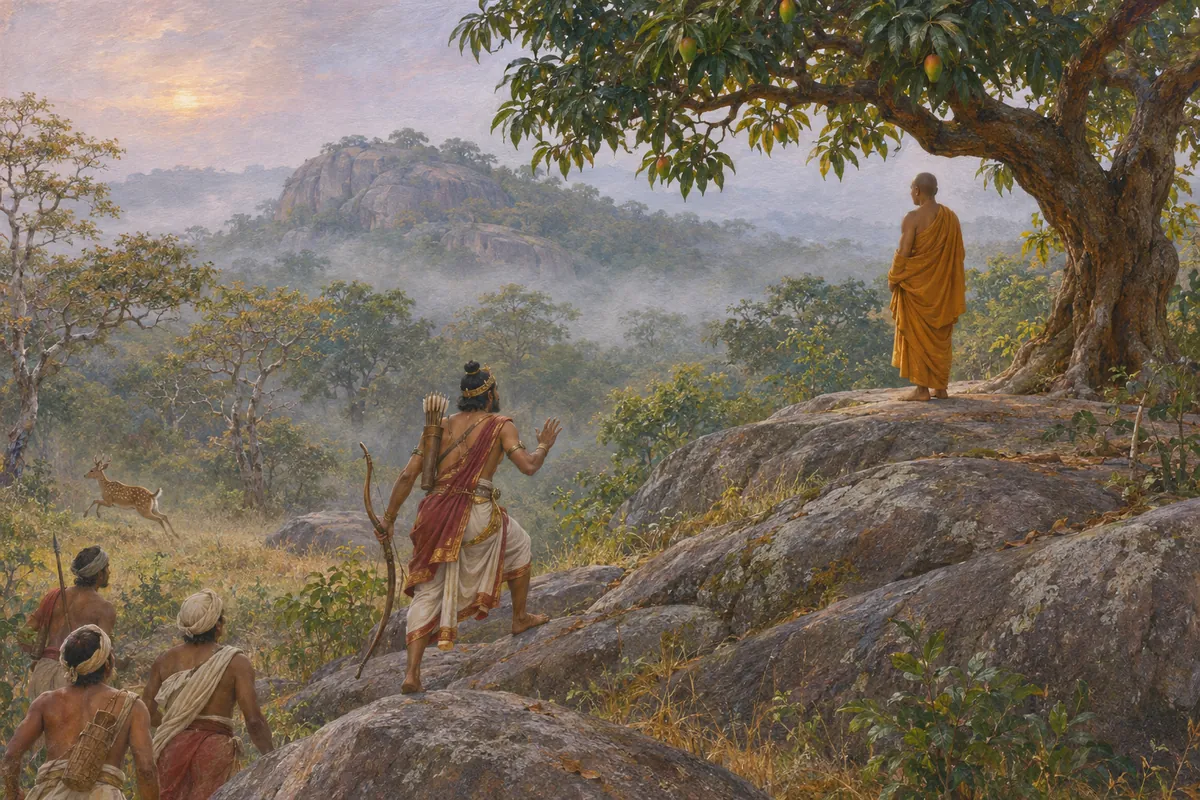
On the full moon of Jettha (June), says the Mahavamsa, Mahinda alighted on Missaka mountain (Mihintale), about 12 km (8 miles) east of Anuradhapura. King Tissa, out hunting, was led to him by a deity in stag form. After testing the king with a riddle about mango trees, Mahinda preached and the court took refuge. Buddhists mark this as Poson.
Mahinda meets the king
The chronicle's founding scene: the monk Mahinda meets King Tissa, out hunting, on the mountain now called Mihintale. Every Poson full moon pilgrims climb its steps to remember it.
The Mahavihara is founded
Tissa gave the Mahameghavana park to the monks and ploughed a furrow marking the sacred boundary. There rose the Mahavihara, the Great Monastery, centre of Theravada learning, whose monks later wrote the chronicles. Tissa also built the Thuparama, held to be the island's first stupa.
Caves for the monks at Mihintale
Tissa gave Missaka mountain to the monks, who renamed it Cetiya-pabbata, and had 68 caves cleared for them. Mahinda spent the first rains retreat there.
Sanghamitta and the Bodhi branch
Queen Anula and her women wished to become nuns, which only a nun could arrange. Tissa asked Ashoka to send Mahinda's sister Sanghamitta. She sailed with eleven nuns and a branch of the Bodhi tree of Bodh Gaya, landing at Jambukola; the king waded in to receive it.
The planting of the Sri Maha Bodhi
The branch was planted in the Mahameghavana; the chronicle says eight saplings went to Jambukola, the Thuparama, Kataragama and elsewhere, then thirty-two more. Families of craftsmen and guilds were sent to tend it.
The first order of nuns
Sanghamitta ordained Queen Anula and her followers, founding the bhikkhuni order. The king built the Hatthalhaka and Upasika nunneries for them. Prince Arittha and 500 men also entered the order.
Reign of Devanampiya Tissa (c. 247–207 BCE; chronicle 307–267 BCE)
Tissa ruled forty years; the chronicle also credits him with the Tissa tank and the Vessagiri monastery. His younger brother Uttiya succeeded.
How much changed?
The chronicle presents a whole people converting within days.
Reign of Uttiya (c. 207–197 BCE; chronicle 267–257 BCE)
Uttiya ruled ten years. In his eighth year Mahinda died, aged sixty, on Cetiya-pabbata during the rains; a week of funeral honours followed. In the ninth year Sanghamitta died at 59 in her convent.
Reigns of Mahasiva and Suratissa (c. 197–177 BCE; chronicle 257–237 BCE)
Mahasiva reigned ten years and built the Nagarangana monastery. His brother Suratissa, also ten years, is credited with some 500 monasteries.
Writing on stone and pot: the Brahmi evidence
Alongside the chronicles stands a second, older body of evidence: short Brahmi inscriptions on potsherds and above cave entrances. They were written by or for the people they name, not by later monks.
Brahmi at Anuradhapura: how early?
Coningham, Allchin, Batt and Lucy (Cambridge Archaeological Journal, 1996) reported Brahmi-inscribed sherds from Anuradhapura dated to the start of the 4th century BCE, then the earliest dated Brahmi anywhere in South Asia.
The cave inscriptions
From roughly the 3rd century BCE onward, hundreds of caves were given to monks, each with a short Brahmi label naming the donor. Senarat Paranavitana's Inscriptions of Ceylon, vol. 1 (1970), remains the standard collection.
Chiefs and village heads
Many donors bear titles. The commonest high title is usually read parumaka, a chief; others include gamika, a village head, and later ratika for district heads.
The 'Damela' householders
Five early Prakrit inscriptions are often cited as referring to Dameda or Damela people, the Prakrit word for Tamils: two at Periya Puliyankulam (Vavuniya), one at Seruvila (Trincomalee), one at Kuduvil (Ampara) and one at Anuradhapura. They mention a Tamil merchant, a terrace of Tamil householders and a mariner named Karava.
Tamil-Brahmi and southern trade
Potsherds with early Tamil-Brahmi writing, some claimed to date as early as the 5th century BCE, have been reported from Poonakari in the north to Tissamaharama in the south, some with clan names such as Vela. Coins with Tamil-Brahmi legends, dated about 200 BCE–200 CE, turn up at Tissamaharama.
A word that is missing
Gunawardana listed group names in the early Brahmi records: Dameda, Kabojha, Milaka and others.
South Indian rulers at Anuradhapura
Twice in the 2nd century BCE (corrected dates) men from South India took the Anuradhapura throne. The chronicle names them Damilas, and its account of them is shaped by what came after.
Reign of Sena and Guttika (c. 177–155 BCE; chronicle 237–215 BCE)
Two Damila brothers, sons of a horse-dealer, overthrew Suratissa with a large army and reigned jointly for twenty-two years. The Mahavamsa itself says they ruled justly.
c. 145 BCE (chronicle 205 BCE): Elara takes Anuradhapura
Asela, a son of Mutasiva, overthrew Sena and Guttika and ruled ten years (c. 155–145 BCE). Then Elara, a Damila 'of noble descent' from the Chola country, defeated him and ruled forty-four years.
The bell of justice
The Mahavamsa says Elara hung a bell by his bed for anyone seeking judgement. When his only son's chariot killed a calf, the grieving cow rang it, and Elara had his son executed under the same wheel. Even a bird whose young a snake ate was given justice.
Rohana: a second royal line
Meanwhile in the south-east, the chronicle says, Tissa's brother Mahanaga had fled to Rohana, and his descendants ruled from Mahagama (near Tissamaharama). The devout Kakavannatissa (Kavan Tissa) ruled there in Elara's time.
'Damilas beyond the river'
Kakavannatissa's queen Viharadevi, by legend a Kalaniya princess set adrift at sea, bore Gamani and Tissa. The Mahavamsa's famous scene: the boy Gamani lies curled in bed because, he says, the Damilas are beyond the river and the ocean on this side.
Dutugemunu and Elara: the war
The Mahavamsa devotes eleven of its first 37 chapters to Dutugemunu (Dutthagamani). His war with Elara is the climax of its early history, told as an epic.
The angry prince
Gamani wished to fight the Damilas; three times his father forbade it, saying the land this side of the river was enough. Gamani sent him a woman's ornament as an insult and fled to the hills of Malaya. The chronicle says he was therefore called Duttha-gamani, 'angry' or 'wicked' Gamani.
The war of the two brothers
When Kakavannatissa died, Tissa fled with their mother and the state elephant Kandula. Gamani was crowned at Mahagama and fought him at Culanganiyapitthi, where the chronicle says thousands died. After further fighting, monks brokered peace and Tissa was put in charge of the harvest.
The campaign begins
Gamani had a relic set in his spear and asked for monks to march with his army. The chronicle has him declare that he fought not for the joy of kingship but to establish the Buddha's teaching.
The siege of Vijitapura
After defeating Chatta at Mahiyangana and seven princes in one day, Gamani besieged Vijitapura, a fortress with three moats and an iron gate. After four months, the chronicle says, Kandula broke the gate.
Thirty-two kings, not one
The chronicle says Gamani overthrew 32 Damila kings before reaching Elara.
c. 101 BCE (chronicle 161 BCE): the duel at the south gate
Elara came out on his elephant Mahapabbata. Gamani proclaimed that none but he should kill the king, pursued him to the south gate of Anuradhapura and slew him with a dart as their elephants clashed. The chronicle says Lanka was now under one rule.
Honours for a fallen enemy
Dutugemunu cremated Elara where he fell, built a monument and ordered it honoured. The chronicle adds that Lanka's princes still silenced their music when passing it.
'One and a half men'
After victory, the chronicle says, Gamani grieved over the death of 'millions'. Eight arahants consoled him: only one and a half true persons had died, one a refuge-taker and one keeping precepts. The rest, they said, were no more than beasts.
Reading the war: four historians
Modern scholarship has steadily reframed the story.
A Tamil perspective
Tamil historians have long read Elara differently.
Reign of Dutugemunu (c. 101–77 BCE; chronicle 161–137 BCE)
Britannica gives his reign as 101–77 BCE or 161–137 BCE, noting how far his life has merged with myth. The chronicle has him say he was patron of the sangha for twenty-four years.
The Lohapasada, or Brazen Palace
The chronicle's Lohapasada was a nine-storey uposatha house for monks, roofed in copper plates. Dutugemunu also built Mirisawetiya over the spear that held his relic. The site today has 1,600 stone pillars in 40 rows of 40.
c. 140 BCE (traditional): the Great Stupa begun
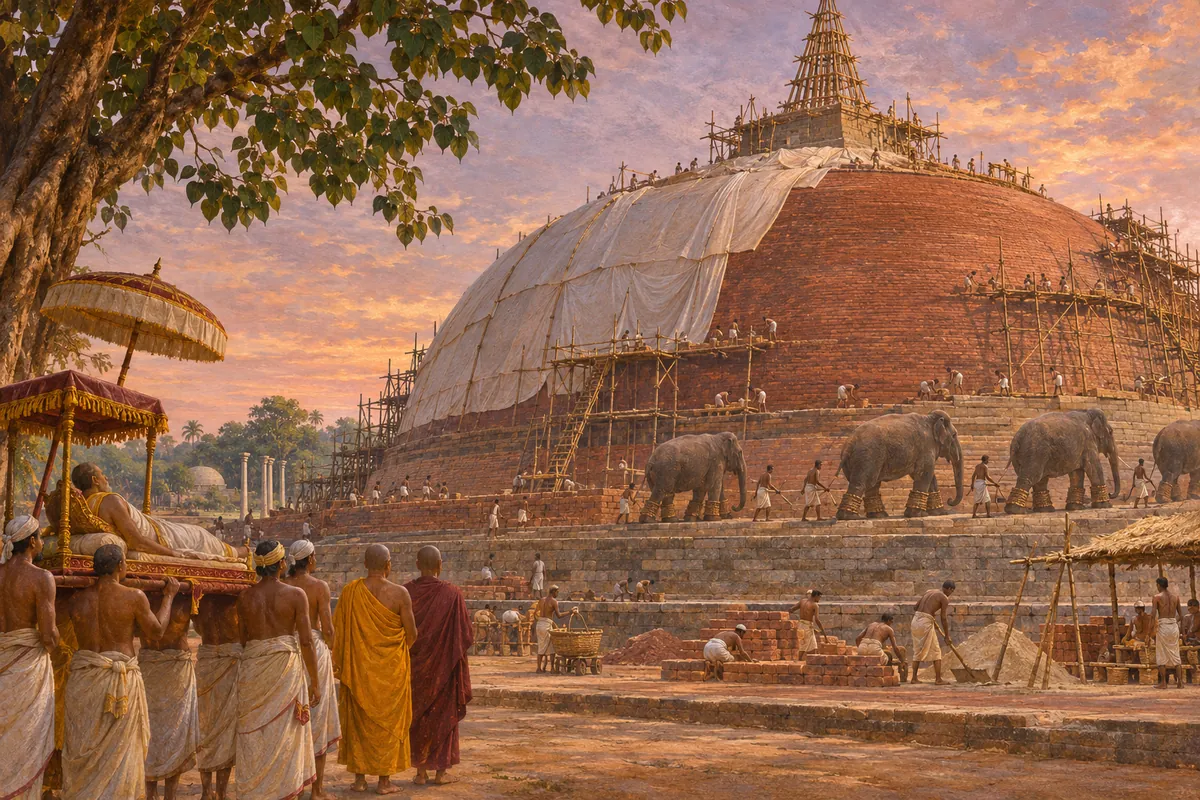
Dutugemunu began the Mahathupa, now Ruwanwelisaya, on Vesakha full moon. Elephants with leather-bound feet tramped the foundations. It was to hold relics, including by tradition the Buddha's bowl.
A death before completion
Falling ill, Dutugemunu asked his brother to finish the stupa. Tissa draped the unfinished dome in white cloth and set a bamboo spire on it so the dying king could see it 'complete'. He had his book of merits read aloud and died within sight of it.
Ruwanweli rising
The Great Stupa under construction, as the chronicle imagined it: elephants pounding the foundation and a dying king watching from his litter.
Reign of Saddhatissa (c. 77–59 BCE; chronicle 137–119 BCE)
Saddhatissa reigned eighteen years. He completed the Great Stupa, rebuilt the Lohapasada seven storeys high after a fire, and founded the Dighavapi stupa. After him came Thulathana, Lanjatissa, Khallatanaga and Vattagamani, whose reign opens the next era.
The early sangha
By the end of this era the sangha lived mainly in donated caves and in monasteries such as the Mahavihara, supported by kings, chiefs and householders.
The beginnings of irrigation
Rain-fed farming in the dry zone depended on storing monsoon water. Small village tanks came first; Pandukabhaya's Abhaya tank (Basawakkulama) and Tissa's Tissa Wewa were early medium-scale works near the capital.
A story for the 20th century
Few ancient episodes have mattered more in modern Sri Lanka than Dutugemunu's war. How it was read changed with politics.
The chronicle as ideology
Michael Roberts (1993) describes how the Mahavamsa presents Lanka as destined by the Buddha to preserve the Dhamma, with its people chosen guardians and its king sacred.
Colonial race theory and the Aryan Sinhalese
Gunawardana traced how 19th-century European theories of 'Aryan' race reshaped Sinhala identity.
1956 and after
Walpola Rahula's History of Buddhism in Ceylon appeared in 1956, a pivotal election year.
The People of the Lion (1979)
R.A.L.H. Gunawardana's essay in the Sri Lanka Journal of the Humanities argued that Sinhala identity was not fixed from Vijaya's day.
Critics of the critic
Gunawardana's thesis itself became a debate.
Looking back: Anuradhapura Rises
Historians now see this era less as the reigns of great kings than as the slow growth of a state from rival chiefdoms, visible in Brahmi records and excavated layers. The chronicles' dates sit about 60 years too early, and their Dutugemunu is an epic hero shaped by 5th-century monks and re-read by 20th-century nationalists. What remains secure is a literate, Buddhist, multi-ethnic island centred on Anuradhapura.