 Fablewings
 › Sri Lankan history › Part 3
Kings, Monks and Tanks (77 BCE – c. 600 CE)
For nearly seven centuries Anuradhapura was ruled by kings whose power rested on two pillars: the great Buddhist monasteries and the reservoirs that fed the rice fields. Rival monastic orders, rival royal clans and repeated South Indian invasions shaped politics, while Lanka became a hub of Indian Ocean trade. Most of what we know comes from monk-written chronicles, tested against inscriptions, foreign travellers and archaeology.
Read in the page-turning reader
A note on dates
Exact years for this era are rarely secure. King-lists are rebuilt from chronicle reign lengths, and scholars reach different results.
Exile and return: Vattagamani Abhaya
The era opens with a king who lost his throne, hid in the hills for fourteen years and came back to found a monastery that would rival the old Buddhist establishment for a thousand years.
c. 103 BCE: a short first reign
Vattagamani Abhaya (Valagamba) was crowned at Anuradhapura. Within five months, the chronicle says, a Brahmin named Tissa rebelled in Rohana, and an army led by seven Tamil chiefs landed at Mahatittha (later Mantai).
The invaders defeated the king at Kolambalaka. As he fled, a Jain named Giri jeered at him, and he vowed to build a Buddhist monastery on that spot if he returned.
c. 103–89 BCE: the five Dravidian rulers
Five rulers from South India held Anuradhapura in turn: Pulahatta, Bahiya, Panayamara, Pilayamara and Dathika. Each, the chronicle says, was killed or overthrown by the next.
Together they ruled for about fourteen years, while Vattagamani gathered support in the hill country.
Reading the invasion stories
The chronicles frame such episodes as Buddhist kings against foreign usurpers. That frame suited monk authors, but it can hide a more mixed reality.
c. 89 BCE: restoration
Having raised an army, Vattagamani defeated the last of the five rulers, Dathika, and regained Anuradhapura. He then reigned for about twelve more years.
Most king-lists date this second reign to 89–77 BCE, which is why this era begins in 77 BCE, the year of his death.
Abhayagiri is founded
True to his vow, the king built a stupa and monastery where Giri's Jain hermitage had stood, on the city's northern side, naming it Abhayagiri after himself (Abhaya) and Giri.
Its great stupa eventually stood about 70 metres tall. Tradition also links his years in hiding to the Dambulla caves, which he made into a temple.
The first schism
The king gave the new monastery to the monk Mahatissa, who had helped him in exile. The monks of the old Mahavihara, founded under Devanampiya Tissa, objected, and accused Mahatissa of mixing with laypeople.
1st century BCE: the Tipitaka written down
Until now the Buddha's teachings had been passed on orally. The Mahavamsa says monks, seeing people falling away from the faith, feared the teaching might not survive; later tradition links this to the war years and the great famine remembered as the Beminitiya Seya.
Monks therefore committed the Pali canon and its commentaries to writing, traditionally on palm leaves at Aluvihare near Matale.
Aluvihare: what we really know
The writing down of the canon is one of the most cited events in Sri Lankan history, and also one of the least documented.
Poison and piety: the kings after Valagamba
The century after Vattagamani is told in the Mahavamsa as a parade of pious builders and violent intrigues, ending with the rise of a powerful new clan, the Lambakannas.
Reigns of Mahaculi Mahatissa (14 years), Coranaga (12) and Tissa (3)
Vattagamani's successor Mahaculi appears in the Mahavamsa as a model of piety who worked for wages in the harvest and gave them as alms.
Coranaga, Vattagamani's son, destroyed eighteen monasteries that had refused him refuge as a rebel. His consort Anula poisoned him, and then, the chronicle says, his successor Tissa too.
c. 48–44 BCE: Anula, the first queen to rule
Anula is the first woman known to have ruled Lanka in her own right. The Mahavamsa says she raised a series of lovers to the throne and poisoned each: Siva, a palace guard; Vatuka; Tissa, a wood-carrier; and Niliya, a Brahmin priest.
She then ruled alone for about four months.
Reading Anula
Anula is remembered as one of the villains of Sri Lankan history. Historians are more cautious.
Reign of Kutakanna Tissa (22 years)
A son of Mahaculi who had fled Anula's court, Kutakanna Tissa returned with an army, captured the queen in her palace and, the chronicle says, had her burned.
He built a wall around Anuradhapura, works on Mihintale, and a nunnery for his mother, who had become a nun.
Bhatikabhaya (28 years) and envoys to Rome
Bhatikabhaya adorned the Mahathupa with nets of coral and pearls. Pliny the Elder records that under Emperor Claudius (41–54 CE) a Roman freedman was blown off course to Taprobane, and the king sent four envoys to Rome.
c. 33–43 CE: Ilanaga and the Lambakannas
In his first year Ilanaga offended the Lambakannas, a powerful noble clan whose members served at court. They deposed and imprisoned him.
The Mahavamsa says his state elephant helped free him and he fled to Rohana, where he built the Tissa and Dura tanks while gathering an army.
Ilanaga's revenge
About three years later Ilanaga returned, defeated the Lambakannas at Kapallakkhanda and, the chronicle says, mutilated the survivors' noses and toes as punishment.
Dates for Ilanaga vary between king-lists; most place his reign in the 30s and 40s CE.
The tank builders and Gajabahu
With the Lambakanna clan on the throne from 67 CE, the chronicles celebrate kings who built reservoirs and canals on a new scale. Their reputation, and their South Indian connections, still spark debate.
67 CE: Vasabha seizes the throne
King Subharaja, warned by soothsayers that a man named Vasabha would overthrow him, ordered everyone of that name killed. A young Lambakanna called Vasabha was warned by his aunt Pottha, hid, raised an army and killed the king.
His accession is taken as the start of the first Lambakanna dynasty.
Reign of Vasabha (67–111 CE)
Vasabha reigned for about 44 years. He fortified Anuradhapura with walls and gatehouses and married his aunt Pottha.
The Mahavamsa credits him with eleven reservoirs and twelve canals. Mahavilachchiya and Nochchipotana are among the tanks attributed to him.
The Elahara canal
Vasabha's best-known work is the Elahara (Alisara) canal, which dammed the Amban Ganga and carried water westward, by modern estimates for some 48–50 kilometres at first.
Later kings repaired and extended it. Canals like this let water from wetter hills reach the dry northern plain.
The Vallipuram gold plate
A gold plate found at Vallipuram near Point Pedro in the Jaffna peninsula records that, in Vasabha's reign, a minister named Isigiraya governed Nakadiva (the Jaffna region).
Reign of Gajabahu I (c. 113–135 CE)
Gajabahu (Gajabahuka Gamani) was a major patron of Abhayagiri, which, according to Britannica, grew in prestige and wealth under him. Lists give his reign as 113–135 or 114–136 CE.
The Gajabahu invasion story
The 17th-century Rajavaliya tells that 12,000 Sinhalese had been carried off by the Cholas. Gajabahu crossed to the Chola country, demanded their return plus 12,000 more, and came home with 24,000, together with the anklet of the goddess Pattini.
The Gajabahu synchronism
The Tamil epic Silappatikaram describes a Lankan king, 'Kayavaku', attending the consecration of a temple to the goddess Kannaki (Pattini) built by the Chera king Senguttuvan.
In 1904 V. Kanakasabhai Pillai identified Kayavaku with Gajabahu I, giving a date in the early 2nd century CE.
A sheet anchor or a circle?
The identification matters because it has been used to date the whole of early Tamil (Sangam) literature.
2nd century CE: Ptolemy's map
The Alexandrian geographer Ptolemy (c. 150 CE) drew Taprobane with a fair idea of its shape. He named Anourogrammon (Anuradhapura) and Maagrammon inland, and markets including Modouttou, often identified with Mantai.
Heresy and the Great Monastery
In the 3rd century the rivalry between the monasteries turned into open conflict. New Mahayana ideas, called Vaitulya by their critics, divided kings, ministers and monks, and climaxed under Mahasena.
3rd century: Voharika Tissa
Voharika Tissa, son of Sirinaga, earned his title ('the lawgiver') for his knowledge of law. The chronicle says he abolished punishments by bodily mutilation, built and repaired monasteries, and gave alms islandwide.
With his minister Kapila he suppressed the Vetulla (Vaitulya) doctrine. He was later killed by his brother Abhayanaga.
What was Vaitulya?
Vaitulyavada (Vetullavada) is the Mahavihara's name for teachings it considered heretical, linked to Abhayagiri.
Reign of Gothabhaya (c. 249–262 CE)
Gothabhaya came to power by deposing King Sanghabodhi, who is remembered as a saintly king who chose to withdraw rather than fight.
Gothabhaya again acted against the Vaitulyans, banishing sixty monks of Abhayagiri. Lists also give his dates as 253–266 CE.
Sanghamitta, the monk from India
Among those drawn into the dispute was Sanghamitta, a South Indian monk sympathetic to the banished monks. He won Gothabhaya's trust and became tutor to the king's sons, Jettha Tissa and Mahasena.
Mahasena became his devoted pupil and adopted his views.
c. 274 CE: Mahasena starves the Mahavihara
Mahasena, consecrated by Sanghamitta, reigned 27 years (dated 273–301, 274–301 or 276–303). He fined anyone who fed the Mahavihara monks a hundred pieces; they fled to Rohana and the hills, and the Great Monastery stood empty for nine years. Sona and Sanghamitta pulled down the seven-storey Lohapasada and carried its materials to Abhayagiri.
Meghavannabhaya's revolt
The king's friend and minister Meghavannabhaya rebelled in protest and raised an army. Before battle he and the king shared a meal and were reconciled. Mahasena promised to rebuild what he had destroyed.
Soon afterwards one of the king's wives had Sanghamitta and Sona killed.
The Jetavana
Mahasena then built the Jetavana monastery for a monk named Tissa, on land inside the Mahavihara's boundaries, provoking a new quarrel.
Its stupa reached about 122 metres, built of an estimated 93 million bricks; it is often called the third-tallest structure of the ancient world, after the two largest pyramids at Giza.
Minneriya and the sixteen tanks
The Mahavamsa credits Mahasena with sixteen tanks and a canal, the Pabbatanta. Among the tanks is Manihira, usually identified with the great Minneriya reservoir near Polonnaruwa, still in use.
Farmers came to honour him as Minneri Deviyo, the god of Minneriya, with a shrine near the tank.
A villain and a god
Mahasena is the most divided figure of the era: a destroyer in the monastic chronicle, a benefactor in popular memory.
Where the Mahavamsa ends
The original Mahavamsa ends with Mahasena. Later monks continued the story in a sequel usually called the Culavamsa ('lesser chronicle'), written in stages over many centuries.
The Tooth and the pilgrim
The 4th and 5th centuries brought the island's most precious relic, a famous Chinese visitor, and the great commentator Buddhaghosa, whose work secured the Mahavihara's place in the Theravada world.
Reign of Sirimeghavanna (c. 303–331 CE): the Tooth arrives
Mahasena's son Sirimeghavanna restored Mahavihara buildings and completed the Jetavana stupa. In his ninth year the Buddha's Tooth Relic was brought from Kalinga in eastern India.
He housed it in the Dhammacakka building near the palace and ordered a yearly procession to Abhayagiri.
Hemamala and Dantha
The best-known version says King Guhasiva of Kalinga, facing attack, entrusted the relic to his daughter Hemamala and her husband Prince Dantha. Disguised as Brahmins, they reached Lanka with the tooth hidden in the princess's hair.
A relic becomes a crown
In later centuries whoever held the Tooth Relic was seen as the rightful ruler of Lanka, and it moved with each new capital, finally to Kandy.
Reign of Buddhadasa (c. 337–365 CE): the physician king
Buddhadasa, son of Jetthatissa II, appears in the Culavamsa as a healer of people and animals, said even to have cured a cobra. It credits him with appointing a physician for every ten villages and building refuges for the sick, the crippled and the blind.
Other lists date him 341–370.
4th–5th centuries: Roman coins
Large numbers of small Roman copper coins, from Constantine the Great (early 4th century) to Arcadius and Honorius (c. 400), have been found in Sri Lanka, along with local imitations.
c. 410–412: Faxian at Abhayagiri
The Chinese monk Faxian (Fa-Hien) sailed to Lanka on a merchant ship and stayed about two years, leaving the earliest detailed foreign eyewitness account.
At Abhayagiri he counted 5,000 monks and a green jade Buddha over twenty cubits tall. Seeing a merchant offer a Chinese silk fan there, he wept with homesickness.
Faxian sees the Tooth festival
Faxian described the Tooth Relic's yearly festival. A herald on a royal elephant announced it ten days ahead; the king lined the road with 500 painted scenes of the Buddha's past lives.
The tooth was carried to Abhayagiri and honoured for ninety days before returning to its shrine in the city.
Faxian's numbers
Faxian heard that the kingdom had about 60,000 monks fed from common stores, with the king supplying food for five or six thousand more. On a hill vihara, probably Mihintale, he found about 2,000 monks.
He also noted wealthy merchant houses, including Sabaean (Arab) traders.
What Faxian did not see
Faxian's account is precious but selective.
Reign of Mahanama (5th century)
Mahanama's reign is placed in the early 5th century (406–428 or 412–434 in different lists). Chinese annals record a letter and gifts he sent to the imperial court in 428.
Lankan nuns reached Nanjing in the 420s and 430s, and in 434 China held its first full ordination of nuns, probably with their help.
Buddhaghosa comes to Anuradhapura
During Mahanama's reign the Indian scholar-monk Buddhaghosa arrived to study at the Mahavihara. He wrote the Visuddhimagga ('Path of Purification'), a summary of Theravada teaching under three heads: morality, concentration and wisdom.
He then translated the old Sinhala commentaries on the canon into Pali.
Buddhaghosa's legacy
Buddhaghosa's commentaries became the standard way of reading the Pali canon across Theravada Asia.
Invasion and recovery
The middle of the 5th century saw Anuradhapura ruled by a line of Pandyan kings from South India, before a prince raised as a monk drove them out and founded a new royal house.
c. 429–436: Pandu invades
After a run of short, troubled reigns following Mahanama, an invader called Pandu, apparently from the Pandyan country of South India, killed King Mittasena and took Anuradhapura.
For about a quarter of a century the north was ruled by Pandu and his successors, while Sinhala princes resisted from Rohana and the hills.
The six Pandyan rulers
The Culavamsa names six rulers: Pandu, his son Parinda, Parinda's brother Khudda Parinda, Tiritara, Dathiya and Pithiya. Several were killed in fighting with Sinhala princes or with one another.
Buddhist 'invaders'
The Pandyan rulers did not destroy Buddhism. They appear to have been Buddhists themselves.
c. 455/459 CE: Dhatusena's victory
Dhatusena, of the Moriya clan, had been hidden from the invaders by his uncle Mahanama, a monk, who ordained him. He later raised an army, defeated Pithiya, the last Pandyan ruler, and was crowned.
He founded the Moriya dynasty. His reign is dated 455–473 or 459–477 CE.
Kala Wewa and the Yoda Ela
Dhatusena's greatest work was Kala Wewa, a huge reservoir covering some 18 square kilometres when full (estimates vary). From it the Yoda Ela ('giant's canal', also Jaya Ganga) ran about 87 kilometres to feed Anuradhapura's Tissa Wewa.
The canal falls very gently, about 10 centimetres per kilometre, a remarkable feat of surveying.
Dhatusena and the chronicle
Dhatusena also rebuilt monasteries damaged in the wars and supported the Mahavihara.
c. 473/477 CE: the coup
Dhatusena's nephew and commander Migara had flogged the king's daughter, his wife; the king had Migara's mother burned alive. In revenge Migara backed Kashyapa, the king's son by a non-royal consort.
Kashyapa seized the throne and imprisoned his father. The heir Moggallana fled to South India.
Sigiriya
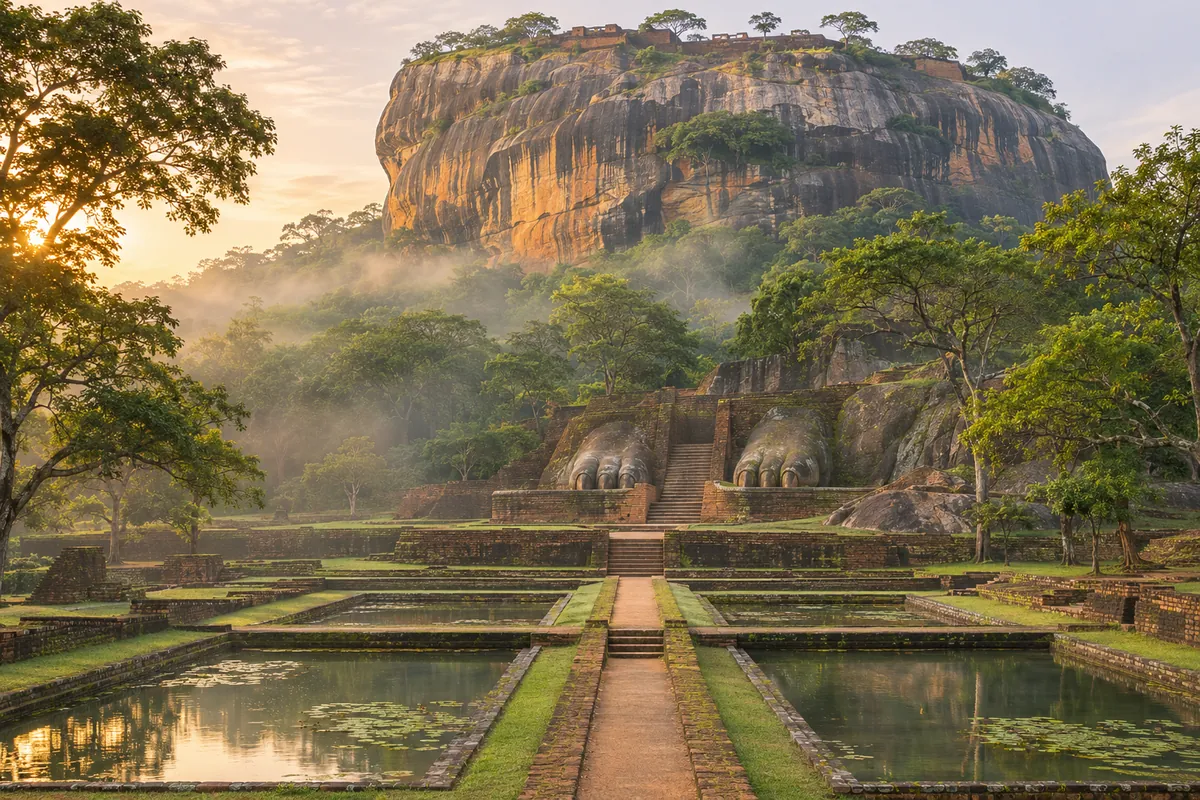
Kashyapa I's reign produced Sri Lanka's most famous monument, the rock citadel of Sigiriya. The chronicle story of a patricide king is vivid, but archaeologists have long argued about what the site really was.
The treasure of Kala Wewa
Kashyapa demanded his father's hidden treasure. Dhatusena led his captors to Kala Wewa, took the water in his hands and said this was all the treasure he had.
Enraged, Kashyapa had him killed. He became known as Kashyapa the patricide.
A capital on a rock
Fearing Moggallana, Kashyapa moved his court from Anuradhapura to Sigiriya, a towering granite rock rising sheer from the plain.
On its summit he built a palace; around its base, walls, moats and elaborate water gardens.
495 CE: the battle near Sigiriya
Moggallana returned with an army from South India. Kashyapa came down from his rock to meet him on the plain.
According to the Culavamsa, his elephant turned aside; his troops took this for retreat and fled. Alone, Kashyapa took his own life with his blade.
Picture: Sigiriya
The rock citadel of Sigiriya rising above its water gardens. The chronicle makes it a king's fortress-palace; some archaeologists see a monastery. UNESCO listed it in 1982.
Paranavitana's Sigiriya
The archaeologist Senarath Paranavitana, Ceylon's Archaeological Commissioner, gave the classic interpretation of the site as Kashyapa's palace.
Raja de Silva's monastery
Raja de Silva, a later Archaeological Commissioner, argued that Sigiriya was mainly a Mahayana Buddhist monastery built over centuries, not a palace.
A long Buddhist history
Most specialists agree that Sigiriya was a Buddhist site long before and after Kashyapa.
The Mirror Wall
A polished plaster wall along the gallery carries hundreds of verses scratched by visitors, mostly from the 8th to 10th centuries, praising the painted women and the site.
The politics of Sigiriya
Why did Kashyapa build here?
Trade, sects and succession in the 6th century
After Kashyapa, Moriya and Lambakanna princes fought over the throne, while Lanka's ports became a meeting-point for ships from Persia, Ethiopia, India and China.
Reign of Moggallana I (c. 495–512 CE)
Moggallana returned the capital to Anuradhapura. The Culavamsa says he gave monasteries at Sigiriya to the Dhammaruci and Sagalika monks and built a nunnery, Rajini, for Sagalika nuns.
Geiger dates his reign 496–513 CE.
Reign of Silakala (c. 518/522–531 CE)
Silakala, a Lambakanna, had fled to India for fear of Kashyapa and become a novice monk, hence his nickname Ambasamanera. Back home, he restored his clan to the throne. In his twelfth year a merchant brought a Mahayana text, the Dhammadhatu, from Varanasi; he enshrined it at Jetavana.
531 CE: the war of the three brothers
Silakala's second son Dathappabhuti seized the throne from the heir Moggallana and killed the youngest brother, Upatissa. Moggallana marched from the east; the brothers fought a duel on elephants, and Dathappabhuti took his own life.
Moggallana II then reigned to about 551 CE.
Reign of Kittisirimegha (c. 551/555–573 CE)
Moggallana II's son Kittisirimegha succeeded him. The Culavamsa says his mother had cleared his way by poisoning royal relatives.
Meanwhile Mahanaga, a Moriya who had risen from banditry to high command, built an independent power base in Rohana.
c. 550 CE: Cosmas describes the island
The merchant Cosmas Indicopleustes, writing his Christian Topography around 550 CE, described Taprobane as a meeting-point for ships from India, Persia and Ethiopia and for goods from China. He also reports a church of Persian Christians, with a priest from Persia.
Sopatros and the coins
Cosmas tells how a Roman merchant, Sopatros, and a Persian envoy appeared before a Lankan king, each claiming his emperor was greater. Sopatros showed a gold coin; the Persian a silver one. The king judged Rome superior and had Sopatros paraded on an elephant.
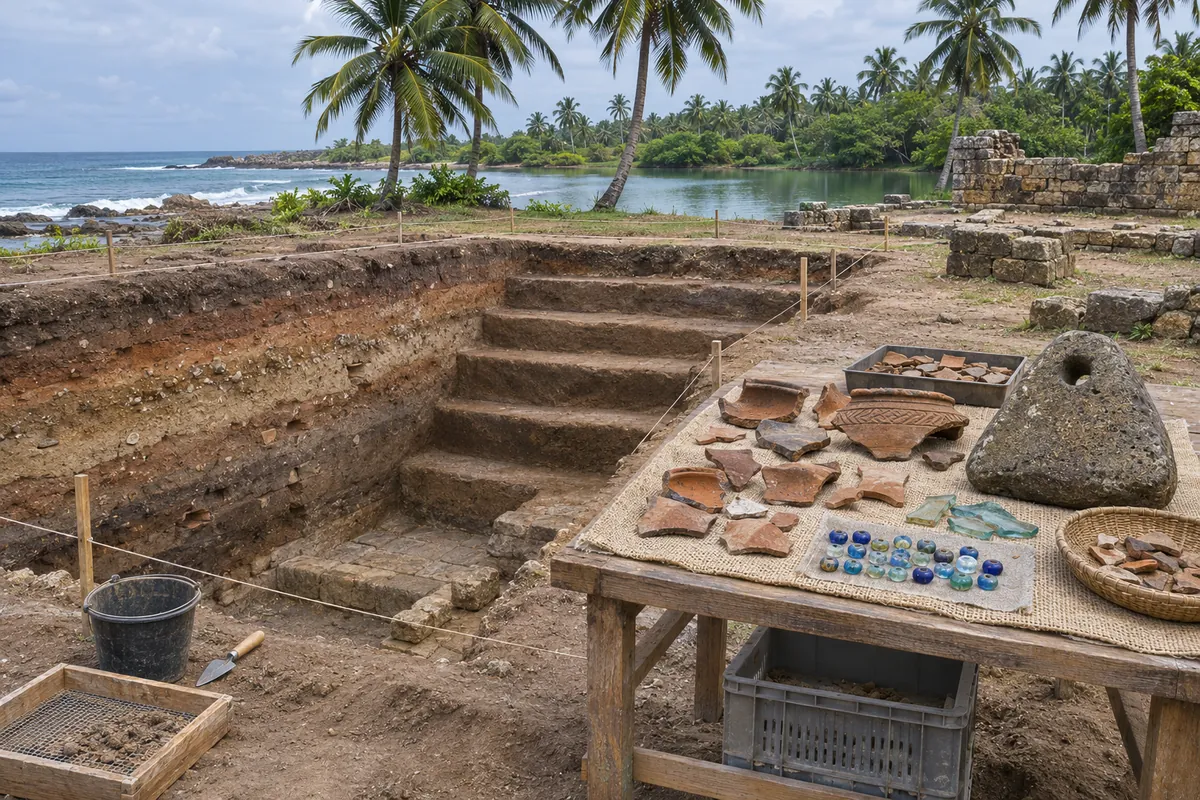
Picture: the port of Mantai
Excavations at Mantai, near Mannar, the great port of the Anuradhapura kingdom, where ships from the Middle East, India and beyond unloaded goods.
Mantai: the archaeology
Mantai (ancient Mahatittha) was Anuradhapura's main gateway to the sea for nearly two thousand years.
What the ships carried
Finds at Mantai include imported pottery from the Middle East, India and later China, and evidence of a large glass-bead industry, about nine-tenths of the beads being made locally.
Black pepper and imported wheat point to trade in food and spice; cloves and dried grapes appear later. The team suggests Roman-linked traders may have lived there by about 200 CE.
c. 573–608 CE: Mahanaga and Aggabodhi I
Mahanaga marched from Rohana, killed Kittisirimegha and reigned about two years. His cousin Aggabodhi I, of the Moriya house, then reigned for over thirty years (c. 575–608), a rare stretch of stability that closes this era.
Looking back: Kings, Monks and Tanks
Historians now see this era less as a simple story of Buddhist kings defending the island, as the chronicles tell it, and more as a contest of royal clans, rival monasteries and trading networks. The Mahavamsa's Mahavihara viewpoint is read critically; inscriptions, Faxian, Cosmas and Mantai's archaeology fill in what monks left out.
Its lasting legacies are the tanks, the stupas and the written Pali canon.