 Fablewings
 › Sri Lankan history › Part 4
The Long Twilight of Anuradhapura (c. 600–1070)
For four and a half centuries the old capital survived civil wars, South Indian alliances and invasions, a Pandyan sack and a brief counter-strike on Madurai. Monks, merchants and mercenaries from across the Indian Ocean shaped its religion and trade. The era ends with the Chola conquest, seventy-odd years of Chola rule from Polonnaruwa, and Vijayabahu I's war of liberation.
Read in the page-turning reader
A note on dates in this Part
Almost every reign date here is worked out backwards by adding up the Culavamsa's regnal years, so dates are approximate.
Civil war and the Pallava connection (c. 598–718)
The 7th century was the most unstable in Anuradhapura's history. Rival royal lines fought for the throne, hired South Indian troops, and fled to India when they lost. A prince who spent years at the Pallava court finally ended the cycle.
Reign of Aggabodhi II (c. 598–608)
Nephew and son-in-law of Aggabodhi I, he is remembered for irrigation: Codrington credits him with fourteen tanks, among them Kantalai and Giritale. The Culavamsa also says an exiled king of Kalinga came to Lanka in his time and became a monk; Codrington links this to the Chalukya king Pulakesin II's wars (c. 609).
c. 623–650: Aggabodhi III against Dathopatissa I
Silameghavanna's son Aggabodhi III and the general Dathopatissa I (Hatthadatha) fought a long war for the throne. Both were driven into exile in India more than once and came back with Tamil mercenaries.
c. 650: Kassapa II takes the throne
Aggabodhi III's brother Kassapa II defeated and killed Dathopatissa I in battle, around 650 (or 652 in other tables). His reign of about nine years brought a pause, but his family's hold was weak. His son Manavamma would later become the key figure of the century.
c. 659–667: Dappula I and Dathopatissa II
After Kassapa II, Dappula I and his son Prince Mana tried to expel the Tamil mercenaries. The mercenaries secretly recalled Hatthadatha, nephew of Dathopatissa I, who took the capital and ruled as Dathopatissa II. Dappula fled to Rohana.
Manavamma flees to the Pallavas
When his family was overthrown, Kassapa II's son Manavamma escaped with his wife Samghamana, first to the north and then across the sea to the Pallava kingdom of Kanchipuram. There he served King Narasimhavarman I as a soldier.
Manavamma's first invasion fails
With a Pallava army, Manavamma landed and drove Dathopatissa II from Anuradhapura. But news came that his patron was gravely ill, and most of the Pallava troops went home. Dathopatissa returned with fresh forces and Manavamma fell back to India, where he waited about twenty years.
Did the Pallavas rule Lanka?
Pallava court poetry boasts of conquering Lanka, and Codrington notes a claim that Narasimhavarman's grandfather Simhavishnu defeated a Sinhala king (c. 575–600).
Reign of Aggabodhi IV (c. 667–683)
Aggabodhi IV, a younger brother of Dathopatissa II, ruled for about sixteen years. Codrington notes two details: Polonnaruwa is first mentioned as a royal residence in his reign, and one tradition credits him with founding the temple at Dondra in the far south.
c. 684: the kingmaker Potthakuttha
After Aggabodhi IV, real power lay with a wealthy Tamil officer, Potthakuttha. He placed a puppet, Unhanagara Hatthadatha, on the throne. The chronicle's portrait of Potthakuttha is hostile; it says he later fled and died of poison.
c. 684 (or 691): Manavamma returns
A second Pallava expedition landed in the north, subdued Uttaradesa and marched on Anuradhapura. Hatthadatha was killed and the capital fell. The Culavamsa tells how the Pallava king gave Manavamma royal dress, because the soldiers would follow only their own king.
Pallava art at Isurumuniya?
The rock carvings at Isurumuniya, Anuradhapura, look strikingly like Pallava work at Mamallapuram.
Reign of Manavamma (c. 684–718)
Manavamma founded the dynasty modern historians call the Second Lambakanna. Tamil mercenaries largely vanish from the chronicle after his accession, which suggests he purged or replaced them. He repaired monasteries and granted villages for their upkeep. His three sons, born in exile, ruled after him in turn.
The Second Lambakanna kings (718–833)
From Manavamma's sons to Dappula III, the throne passed mostly between brothers, sons and nephews of one family. This century is thinly recorded, but it was largely free of foreign invasion and saw steady temple-building and irrigation.
718–741: Manavamma's sons
Manavamma's sons Aggabodhi V, Kassapa III and Mahinda I reigned one after another. The chronicle's leaves for parts of this period are damaged or brief, so little more than building works and gifts to monks survive.
c. 741–746: Amoghavajra in Lanka
The Indian tantric master Amoghavajra came to collect esoteric texts for China. Rangama Chandawimala (2017) places his arrival under Aggabodhi VI and says he gathered over 500 sutras and commentaries, studying under a teacher named Samantabhadra, probably at Abhayagiri. He returned to China in 746.
8th century: Vajrabodhi and the sea route
Amoghavajra's teacher Vajrabodhi, another founder of Chinese esoteric Buddhism, also stayed in Lanka. Chinese records say he lived about six months at Abhayagiri and visited Rohana, then sailed on with Persian merchants. His journey shows how monks travelled on trading ships.
c. 790: Vishnu comes to Dondra
Codrington, citing a Sanskrit verse, dates the arrival of a Vishnu image at Dondra (Devinuwara) to 790, in the reign of a ruler called Dapulu Sen, to whom the shrine's foundation is credited.
807–833: Dappula II to Dappula III
Dappula II, Mahinda III, Aggabodhi VIII and Dappula III reigned in turn. One of Mahinda III's sons, also called Mahinda, was passed over and fled to India. Sena I would later have him killed there.
Mahayana, Tantra and the Bodhisattvas
The chronicles were written by monks of the Mahavihara and say little about rival schools. Inscriptions, statues and foreign records show a much more varied Buddhism, in which Mahayana and tantric ideas flourished, especially around the Abhayagiri monastery.
7th century: 'Mahayana Sthaviras'
The Chinese pilgrim Xuanzang, reporting what he learned about Lanka, distinguished the Mahavihara monks, whom he called Hinayana Sthaviras, from the Abhayagiri monks, Mahayana Sthaviras who studied both traditions.
7th–8th centuries: the sailors' Bodhisattva
Avalokitesvara, with the goddess Tara, became popular as a protector of seafarers. At Thiriyai near Trincomalee, a Sanskrit inscription in Grantha-type script of the 7th or 8th century records a shrine linked with seafaring merchants. A hoard found there in 1983 included Buddha, Bodhisattva and Tara images.
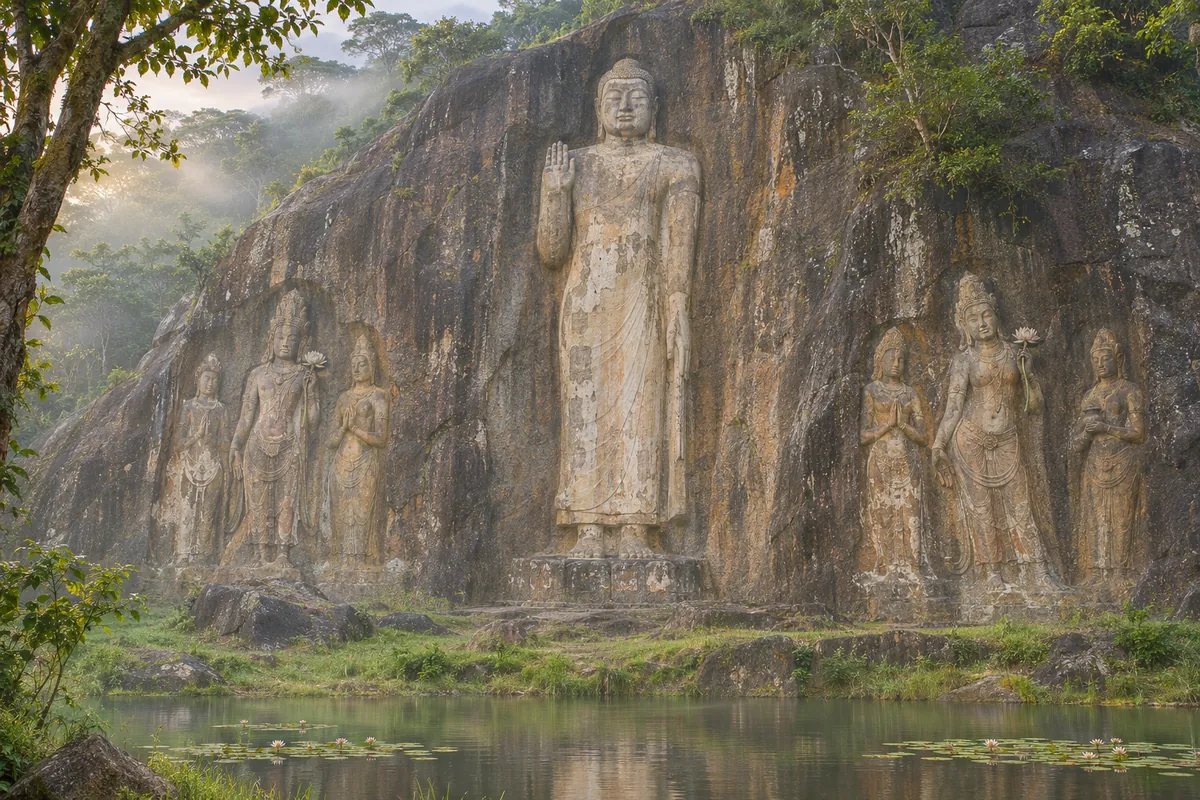
Buduruvagala (9th–10th century)
Seven giant figures cut into rock: a standing Buddha flanked by two groups of three. One group is usually identified as Avalokitesvara with Tara and an attendant. It is among the clearest Mahayana monuments on the island.
c. 833–853: Sena I and the 'Vajiriyavada'
The Nikaya Sangrahaya says a sect called Vajiriyavada, from Vajraparvata in India, arrived under King Matvalasen, usually identified as Sena I. Chandawimala reads this as Vajrayana.
Merchants of the western sea
Lanka sat on the sea road between the Persian Gulf, India, Southeast Asia and China. Arab and Persian ships, Tamil merchant guilds and Buddhist pilgrims all passed through its ports, above all Mahatittha (Mantai) near Mannar.
c. 708–711: a ship from Lanka sparks a war
The historian al-Baladhuri (d. 892) says the king of the 'Isle of Rubies' sent al-Hajjaj, governor of Iraq, a ship carrying orphaned daughters of Muslim merchants who had died in Lanka. Pirates (the Meds of Daybul, in Sind) seized it, and Dahir of Sind replied that he had no authority over them.
851: Sulaiman the merchant
An Arab account of 851, attributed to the merchant Sulaiman, describes Serendib and is among the earliest Muslim records of Adam's Peak, which it calls al-Rohoun. Writers such as Uditha Devapriya link the name to Ruhuna, the southern province.
10th century: the first mosques?
Muslim traders became important brokers of the island's foreign trade from the 10th century. Tradition dates mosques such as al-Abrar in the south-west to this time.
The Pandyan sack and Sena II's revenge (c. 833–887)
In the 9th century the Pandyas of Madurai became Lanka's main rivals. They sacked Anuradhapura; a generation later a Lankan army sacked Madurai. The two sides tell this story very differently.
The Pandyan invasion
The Pandyan king Srimara Srivallabha (c. 815–862) landed in the north. The Culavamsa says local Tamils in Uttaradesa joined him. Sena's army was routed at Mahatalita. The heir Mahinda took his own life rather than be captured, and prince Kassapa was later killed. Sena withdrew to the hill country.
Anuradhapura plundered
The invaders looted the palace and monasteries, carrying off golden images from the Ratnaprasada and Thuparama.
Peace terms
The Pandyan king sent an envoy, made a treaty and withdrew. The Library of Congress study says the Pandyas demanded an indemnity as the price of leaving. Sena I returned to rule; Codrington says he later moved to Polonnaruwa, where he died.
c. 862: the sack of Madurai
A Pandyan prince, identified with Varaguna II, came to Lanka seeking help against Srimara. In Sena II's ninth year his general Kutthaka landed, took Madurai and plundered it. The Culavamsa says Srimara died of wounds and Kutthaka crowned the prince, then brought back the golden images and treasures taken from Anuradhapura.
Who won in 862?
Indian and Lankan records cannot both be true as they stand.
Madhura-dunu: 'Conqueror of Madurai'
The Iluppakaniya pillar inscription gives Sena II the title Madhura-dunu. Inscriptions also confirm Kutthaka (Senevirad Kuttha) as a real general: the Nidinegama pillar shows him still in office in Udaya I's third year, c. 889.
Between Pandyas and Cholas (c. 887–982)
By about 900 the Cholas of Thanjavur were the rising power of South India. Lankan kings sided with the Pandyas against them, and so became Chola targets.
Reign of Kassapa V (early 10th century)
Kassapa V (c. 914–923 in Geiger's scheme), made sub-king at birth, was a scholar; Codrington credits him with a surviving Sinhala paraphrase of the Dhammapada. When the Pandyan king Rajasimha II asked for help against the Chola Parantaka I, Kassapa sent an army. It came back defeated.
Dappula V and the Pandyan regalia
Driven out by Parantaka, the Pandyan king Rajasimha fled to Lanka. Quarrels among Lankan princes stopped Dappula V from helping, so Rajasimha moved on to Kerala, leaving his crown and royal ornaments with the Sinhala king.
c. 940s: Parantaka I invades
Parantaka demanded the Pandyan regalia. When refused, he invaded, probably in the late 940s, and took the north. The king fled into Rohana with the regalia; the Chola army could not follow and withdrew. The chronicle says Lankan forces then raided Chola territory.
Reign of Mahinda IV (mid-10th century)
Mahinda IV broke with custom by marrying a princess of the Kalinga royal family. Before his ninth year, a 'King Vallabha' sent an army that landed at Uratota (Kayts). Mahinda's general Sena drove it back.
Reign of Sena V (late 10th century)
In his second year Sena V killed his general's brother. The furious general gathered the Tamil soldiers settled in Lanka and turned the country over to them. The Culavamsa says they oppressed the people until Sena made peace. He died young, the chronicle says from drink.
c. 982: Mahinda V's troubled start
Sena V's brother Mahinda V reigned from Anuradhapura, but, Codrington says, the city was full of foreign troops brought in under Sena V.
The Chola conquest (c. 993–1017)
Rajaraja I (985–1014) built the strongest navy and army in South India. Lanka, weakened from within and holding the Pandyan regalia, was an obvious target. Within a quarter-century the Cholas held the whole island and its king.
993: Rajaraja I takes Rajarata
Chola forces landed in the north and took Anuradhapura. Chola inscriptions now list Ilam (Lanka) among Rajaraja's conquests.
'Utterly destroyed'
The Culavamsa says the capital was 'utterly destroyed in every way by the Chola army'. Relic chambers were broken open and images and treasures removed.
Mummudi-sola-mandalam
The conquered north became a Chola province named after one of Rajaraja's titles, Mummudi-sola. The capital moved to Polonnaruwa, renamed Jananathamangalam or Jananathapura, also from a royal title. Polonnaruwa commanded the Mahaweli river crossings and was easier to defend.
The temple at Mahatittha
At Mahatittha (Mantai), the port near Mannar, a Chola officer named Tali Kumaran built a Shiva temple called Rajarajesvara, according to a Tamil inscription found there. The town itself was renamed Rajaraja-pura. Nilakanta Sastri treats this as one of the clearest signs of settled Chola rule.
Thiruvalangadu plates: Rama outdone
The Chola Thiruvalangadu copper plates praise Rajaraja's Lanka campaign in epic terms.
Chola soldiers and Buddhist shrines
At Velgam Vihara near Trincomalee, Tamil inscriptions of the Chola period record donations, such as cattle and perpetual lamps. Under Chola rule the shrine was called Rajarajapperumpalli, after Rajaraja I.
1014: Rajendra I succeeds
Rajaraja died in 1014. His son Rajendra I (co-ruler from 1012, sole king 1014–1044) carried the war south into Rohana, where Mahinda V had kept a court for over twenty years. Rajendra's inscriptions from about his fifth regnal year (1017) claim the conquest of all Lanka.
c. 1017: Mahinda V captured
Chola troops seized Mahinda V with his queen, daughter, crown and treasure, and the Pandyan regalia, and shipped them to India.
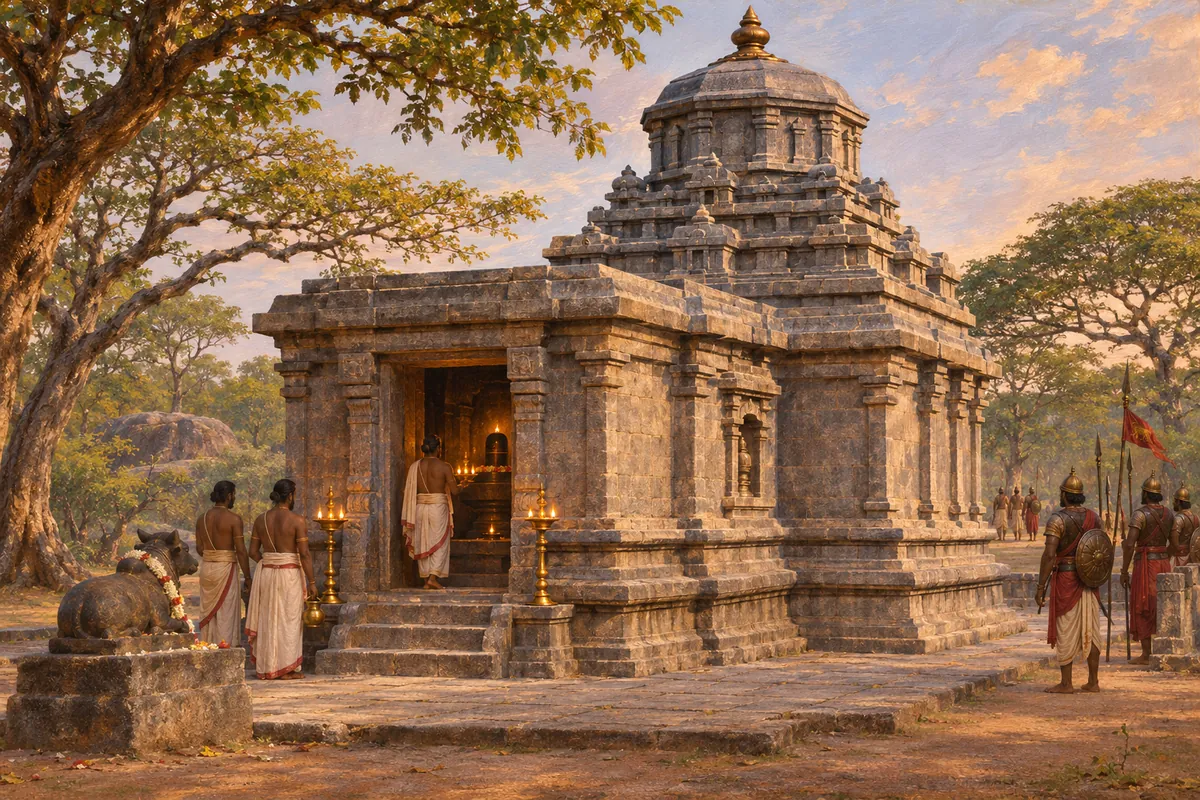
Siva Devale No. 2, Polonnaruwa
A small granite Shiva temple in South Indian style. Its Tamil inscription names it Vanavan Mahadevi Isvaram, after Rajaraja I's queen, Rajendra I's mother. It is usually called Polonnaruwa's oldest standing building.
A Chola province (1017–1055)
For about half a century the north and east were ruled from Polonnaruwa by Chola officials, while Sinhala claimants held out in Rohana. Tamil inscriptions, not the Culavamsa, are now the best evidence for the north.
Dating Siva Devale No. 2
The temple is Polonnaruwa's clearest Chola monument, but no inscription gives its year of building.
Running the province
The Cholas kept using the dry-zone reservoirs, but repair lapsed and tanks such as Minneriya and Padaviya suffered breaches. They taxed merchants and artisans and built fortified camps from which to raid the south.
Reign of Kassapa VI, Vikramabahu (1029–1040)
Mahinda V's son Kassapa, hidden in Rohana, escaped Chola searches and took the title Vikramabahu. The Culavamsa says two of his generals repelled a large Chola army, but he died of illness in 1040, after about twelve years, before he could drive the Cholas out.
1042–1055: a crowd of claimants
Rohana passed in quick succession to Vikrama Pandu (1042–43), Jagatipala (1043–46), Parakrama Pandu (1046–48), Loka (1048–54) and Kassapa VII (1054–55).
Tamil settlement and its meaning
K.M. de Silva dates more permanent Tamil settlements, the nucleus of later Sri Lankan Tamil society, from about the 10th century.
Vijayabahu's war of liberation (1055–1070)
A young prince from Rohana named Kitti united the south and, over fifteen years of raids and sieges, drove the Cholas out. He ruled as Vijayabahu I until 1110 and began the Polonnaruwa kingdom.
c. 1039–1055: the rise of Kitti
Born about 1039 and claiming descent from the old royal house, Kitti defeated the last Rohana pretender, Lokissara, at about fifteen. At sixteen, according to Codrington, he took the rank of sub-king under the name Vijayabahu. Later reckoning counts his reign from 1055.
c. 1065–1066: a first attempt fails
Around 1066 Vijayabahu attacked Chola-held Polonnaruwa, but reinforcements from India drove him back. He fell back to the Vatagiri (Wakirigala) fortress and held out there against the Chola army.
Defectors and Tamil allies
The chronicle says two Sinhala chiefs, Ravideva and Cala, went over to the Cholas with their men, while Tamil commanders served in Vijayabahu's army.
1069–1070: the decisive campaign
A succession crisis in the Chola empire ended with Kulottunga I's accession in about 1070. Vijayabahu struck. He sent one army through the east and another west of the hills, towards the port of Mahatittha to block reinforcements, while he advanced through Mahiyangana. Polonnaruwa fell after a siege of about six weeks.
1070: Anuradhapura retaken
Vijayabahu entered Anuradhapura around 1070, his fifteenth year. Kulottunga I, busy with the Chalukyas, made little effort to win Lanka back. The island was under one Sinhala ruler for the first time since before the Chola conquest.
Why Polonnaruwa?
Vijayabahu chose not to return to Anuradhapura.
Looking back: The Long Twilight of Anuradhapura
Historians no longer see this era as simple decline before a foreign blow. Anuradhapura's kings were deeply tied into South Indian politics, using Pallava and Pandyan allies and mercenaries just as Indian kings used them. Inscriptions, Chola records and Mahayana art now balance the monastic chronicles. The Chola conquest is read as an imperial venture driven by plunder, trade and rivalry, and Vijayabahu's victory as the start of a new, Polonnaruwa-centred kingdom.