 Fablewings
 › Sri Lankan history › Part 5
Polonnaruwa (1070–1236)
In 1070 Vijayabahu I drove the Cholas from Polonnaruwa and made it the capital of a reunited kingdom. Under Parakramabahu I it reached its height, with vast reservoirs, monasteries and wars abroad. After 1186 came quarrelling factions, queens set up by generals, and in 1215 the invasion of Magha, after which the old heartland of the dry zone was slowly abandoned.
Read in the page-turning reader
Vijayabahu I and the end of Chola rule
For more than seventy years the north of the island had been a Chola province. This chapter follows the Ruhuna prince who ended that rule, rebuilt the Buddhist order with help from Burma, and faced a mutiny by his own Tamil mercenaries.
c. 1039
A prince called Kitti (Keerthi) was born in Ruhuna, the south-eastern region still outside Chola control. According to Codrington, drawing on the Culavamsa, he defeated the Ruhuna claimant Lokissara when he was about fifteen and became sub-king under the name Vijayabahu at sixteen. These ages come from the chronicle and cannot be checked against inscriptions.
1055
Vijayabahu became ruler of Ruhuna. Modern lists count his reign from this year, though he did not hold Polonnaruwa until 1070. By about 1058, modern accounts say, he had cleared Chola forces from Ruhuna.
1069–1070
A succession crisis in the Chola kingdom ended with the accession of Kulottunga I in 1069 or 1070. Vijayabahu used the moment. Modern accounts say he sent several armies north and besieged Polonnaruwa for about seven months.
1070
Polonnaruwa fell and Anuradhapura was entered, about the fifteenth year of Vijayabahu's reign. The Cholas left the island, ending some 77 years of occupation. The king kept Polonnaruwa, the former Chola base, as his capital. It lay closer to the Mahaweli river and the routes to the east and south than Anuradhapura did.
1071
Buddhism had been weakened under Chola rule. According to the EBSCO Research Starter on Anawrahta, in 1071 Vijayabahu asked the Burmese king for monks. Pagan, which had conquered the Mon kingdom of Thaton in 1057, was a rising Theravada power.
1072/1073
Rebellions delayed Vijayabahu's coronation until his eighteenth year. Codrington places it in 1072/3. The ceremony was held at Anuradhapura, the ancient sacred capital, but Polonnaruwa remained the seat of government and lost its Chola name. It was now called Vijayarajapura, the city of King Vijaya.
Vijayabahu's marriages
Vijayabahu married Lilavati, daughter of Jagatipala of Kanauj in North India, and Tilokasundari of the Kalinga royal line. His sister Mitta married a Pandyan prince. The grandson of that marriage was to be Parakramabahu I.
Rebuilding Buddhism
With monks from Ramanna, ordinations were restored. Vijayabahu repaired temples neglected under Chola rule and had a temple built at the capital for the Tooth Relic, by now treated as a symbol of royal authority. Codrington names his general Nuvaragiri as builder; the Velaikkara inscription credits a minister called Deva Senapati. He also repaired irrigation tanks damaged in the wars.
The Velaikkara revolt (c. 1084–1085)
Vijayabahu sent envoys to the Chalukya king Vikramaditya VI, a Chola rival; the chronicle says the Cholas mutilated them, and he declared war. His Velaikkara mercenaries, ordered to fight the Cholas, whom they saw as kinsmen, mutinied, killed generals and burned the royal palace. The king fled, then returned and crushed the revolt, burning the ringleaders on the pyres of the generals they had killed.
The Velaikkara slab inscription
A Tamil slab found in the Tooth Relic quadrangle at Polonnaruwa, reported by H.C.P. Bell in 1903, records the Velaikkaras' promise to protect the Tooth Relic temple.
c. 1093 (38th year)
An inscription at Ambagamuwa, dated in the king's 38th regnal year, records rest-houses built on the roads to Adam's Peak (Sri Pada) and the grant of the village of Gilimale to feed pilgrims. It is one of the clearest contemporary records of Vijayabahu's rule. The exact calendar year depends on how his reign is counted.
1110
Vijayabahu died at Polonnaruwa, aged about seventy-one or seventy-two, after a reign of some 55 years counted from 1055. He is remembered as Maha Vijayabahu. He left no clear arrangement for the succession, and his death opened forty years of division.
Forty years of division (1110–1153)
After Vijayabahu, the island split between rival members of his family. Polonnaruwa, the 'King's Country', faced Ruhuna and the south-west, Dakkhinadesa. Out of this struggle came Parakramabahu I.
1110–1111: Jayabahu I
Jayabahu, Vijayabahu's brother or half-brother, was crowned while Vikramabahu, Vijayabahu's son, was away governing Ruhuna. Codrington says the Pandyan faction in the royal family arranged it.
1111–1132: Vikramabahu I
Vikramabahu ruled the King's Country from Polonnaruwa. According to Codrington, following the Culavamsa, he seized temple lands and treated monks harshly, so the monks carried the Tooth and Bowl Relics away to Ruhuna.
c. 1123
Parakramabahu was born at Punkhagama in Dakkhinadesa, the son of Manabharana and Ratnavali, according to Britannica and the Culavamsa. His father died soon afterwards, and the boy grew up at the court of his uncles. By about 1140, after his uncle Kitti Sri Megha died, he ruled Dakkhinadesa himself.
1132–1153: Gajabahu II
Gajabahu II, son of Vikramabahu, held Polonnaruwa. His uncles in the south attacked the King's Country but failed. For twenty years the island was in a stalemate between a weak king in the north and ambitious princes in the south.
The young prince at Polonnaruwa
The Culavamsa tells a long story of Parakramabahu leaving his uncle's court in secret, living at Gajabahu's court in Polonnaruwa and quietly gathering information on its weaknesses before returning to Dakkhinadesa.
1150s: the war for Rajarata
Parakramabahu annexed Dumbara, attacked the King's Country and stormed Polonnaruwa, capturing Gajabahu. Manabharana, son of Sri Vallabha, then rescued Gajabahu, but Gajabahu turned to Parakramabahu. Britannica says the prince won control only after several battles and counter-revolutions.
1153
Gajabahu abdicated and died at Kantalai. Manabharana was defeated and died in his own land. Parakramabahu became king of the whole island in 1153. Codrington says he was crowned twice. Britannica says he governed with 12 provincial governors, princes, army generals and leading merchants. He allowed Hindus freedom of worship.
Parakramabahu I (1153–1186)
Parakramabahu I is the best-documented and most praised king of the period. The Culavamsa devotes many chapters to him. His reign brought great building and irrigation works, a reformed Sangha and wars in Burma and South India, but historians now also count its costs.
1156–1157
In the king's fourth year a revolt broke out in Ruhuna, led by Sugala, mother of the defeated Manabharana. The Tooth and Bowl Relics were still in Ruhuna. Parakramabahu's armies crushed the revolt, captured Sugala and carried the relics to Polonnaruwa.
The Sea of Parakrama
Parakramabahu enlarged the reservoirs near the capital into the Parakrama Samudra, the 'Sea of Parakrama', and opened the Akasaganga channel. The Culavamsa credits him with building or restoring over 165 large tanks.
A royal city
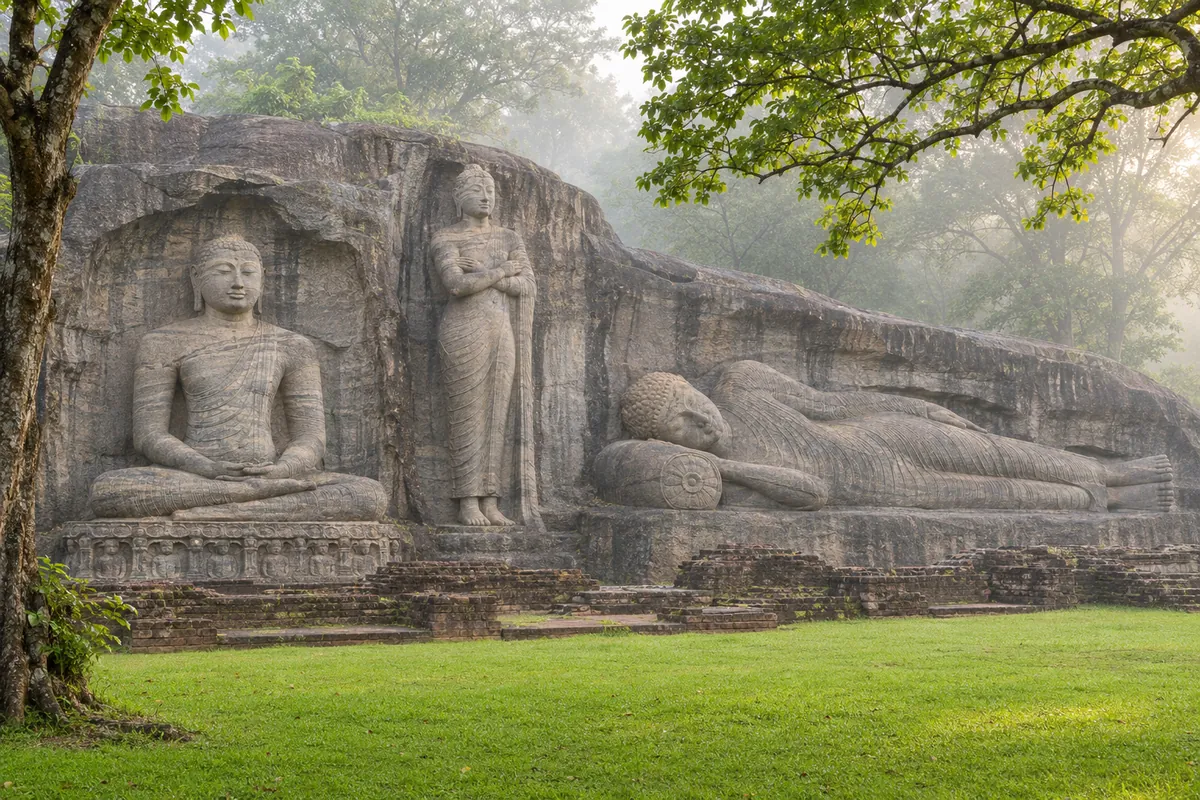
Polonnaruwa was enlarged with palaces, gardens and monasteries. Codrington lists among his works the Jetavanarama, the Alahana Parivena, the Lankatilaka image house and the Uttararama, now called the Galvihara, with its great rock-cut Buddha figures. These buildings, not the chronicle, are the strongest evidence of the reign's wealth.
The Galvihara
The rock-cut Buddhas of the Uttararama (Galvihara) date from Parakramabahu's reign. An inscription carved here records his reform of the Sangha, confirming the chronicle's account in outline.
1164–1165: the Ramanna expedition
Codrington, following the Culavamsa, says relations with Ramanna in Lower Burma broke down over the elephant trade, the mistreatment of Sinhala envoys and the seizure of a princess being sent to Cambodia. A fleet sailed from Paluvak-tota on the south-west monsoon and stormed Kusumiya on the Pegu river. The army is said to have stayed five months.
The Devanagala inscription
A Devanagala rock inscription of Parakramabahu's twelfth year (1164–1165) records land granted to the general Kit Nuvaragal for an expedition against Ramanna. The Siddham database identifies the Pagan ruler as Alaungsithu.
1165–1166: reform of the Sangha
Parakramabahu brought the monastic fraternities together under the Mahavihara tradition, expelled monks judged lax, and ended what the chronicle calls the Vaitulya heresy. Codrington dates this to 1165/6.
1167–1169: a call from Madurai
The Pandyan king Parakrama Pandya, besieged in Madurai by his rival Kulasekhara, asked Parakramabahu for help. Modern accounts date the request to about 1167 or 1169. Parakramabahu sent his general Lankapura. By the time the army reached Mahatittha (Mannar), Parakrama Pandya had been killed and Kulasekhara held Madurai.
c. 1169–1173: Lankapura in India
According to the Culavamsa, Lankapura landed after a crossing of a day and a night, took Rameswaram, built a fort called Parakramapura and won several battles. Vira Pandya, son of the dead king, joined him, and General Jagad Vijaya brought reinforcements. Kulasekhara was beaten twice and Vira Pandya was placed on the throne.
c. 1174: the Chola answer
Kulasekhara turned to the Chola king Rajadhiraja II. A Chola inscription of about 1174, reported in the Sunday Times series, records his appeal. Chola forces under Pallavarayan marched on Madurai.
The Chola counter-strike
Chola sources say Rajadhiraja II sent Annan Pallavarayan to forestall a Lankan invasion. His forces are said to have destroyed preparations in Lanka and backed a Sinhala prince, Sri Vallabha, as a rival claimant, who raided places such as Pulaicceri and Matottam.
1181–1182
Codrington says Lankan victories were recorded in 1175/6, but by 1181/2 Vira Pandya had been driven out. Supported by the Chola king Kulottunga III, Kulasekhara's son Vikrama Pandya took Madurai around 1182. Lankan and allied forces kept a hold on Rameswaram for some time, perhaps until 1182.
The cost of greatness
By the end of the reign, wars, armies, a navy and monuments had to be paid for by heavy taxes and compulsory labour (rajakariya). Large gold coins largely disappear late in the reign.
Nissanka Malla and the Kalinga kings
Parakramabahu died in 1186 without a son by his chief queen. Soon the Kalinga branch of the royal family took the throne. Its strongest ruler, Nissanka Malla, left more inscriptions than any other king of the period and used them to argue his right to rule.
1186–1187: Vijayabahu II and Mahinda VI
Vijayabahu II, known as Pandita (the learned), reigned about a year. Codrington says he was killed by Mahinda after an affair with a cowherd's daughter. Mahinda VI held the throne for only five days before Nissanka Malla, the sub-king, killed him and took power.
1187: Nissanka Malla
According to his Galpota inscription, Nissanka Malla was born around 1157–1158 at Sinhapura in Kalinga, son of King Jayagopa and Queen Parvati. Britannica describes him as the brother of Parakramabahu's Kalinga queen; Codrington calls him Parakramabahu's son-in-law or nephew.
A Kalinga claim to the throne
Nissanka Malla claimed descent from Vijaya, the legendary first king, and stressed the Kalinga right to the throne. His inscriptions declare that only a Buddhist should rule Lanka.
Lower taxes, gifts to the people
Nissanka's inscriptions say he lifted the heavy taxes of Parakramabahu's reign and gave money, gold, cattle and land to his subjects, explaining that poverty drove people to theft. Wickremasinghe, editing the Galpota, saw this as a deliberate strategy to win confidence and secure an insecure throne.
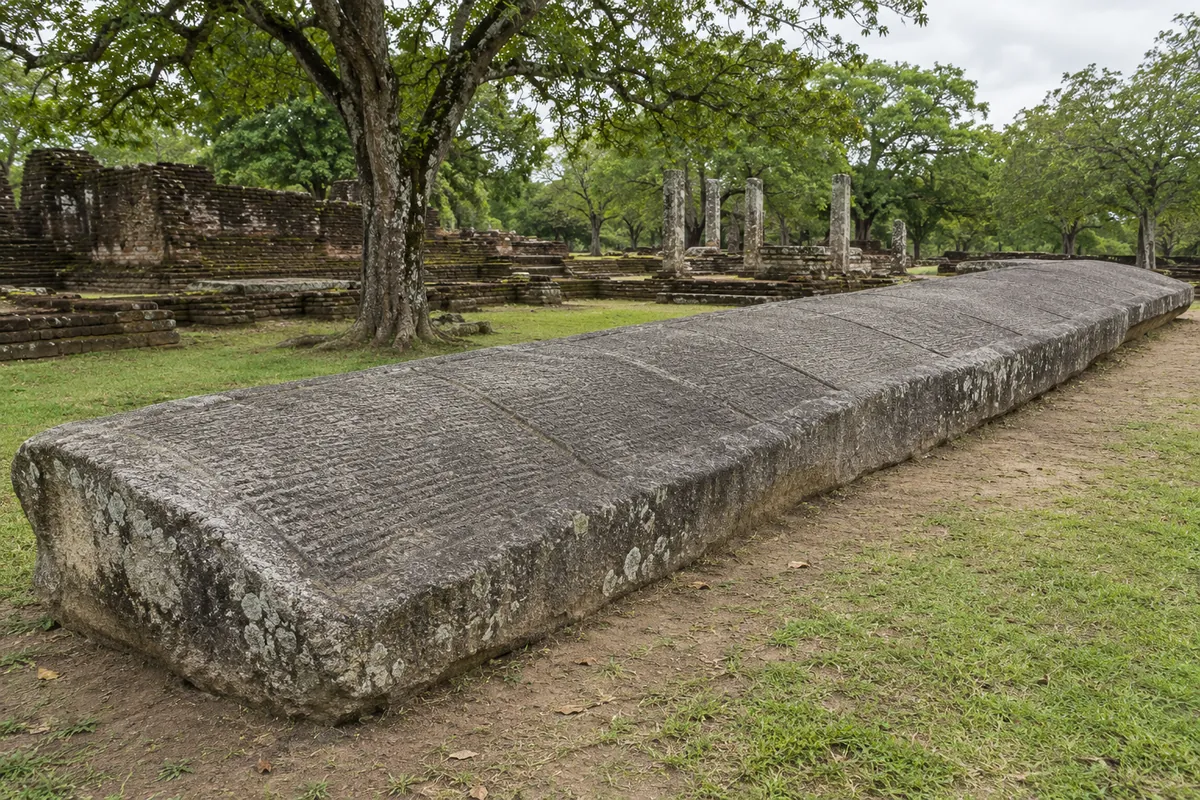
The Galpota, the 'stone book'
The Galpota is a slab more than eight metres long with 72 lines and over 4,300 letters, the longest known inscription in Sri Lanka. It sets out Nissanka's family, his foreign relations and his ideas of kingship.
The stone book
The Galpota lies near the Tooth Relic quadrangle at Polonnaruwa. Its three panels of text form Nissanka Malla's longest statement of how a king should rule.
1191 and Dambulla
A dated inscription of 1191 at the Ruwanweli dagaba at Anuradhapura, edited in the Journal of the Royal Asiatic Society, records Nissanka's work there. At Dambulla he had the cave temple gilded, and a statue of the king was placed in one cave.
Claims of conquest
Nissanka's inscriptions claim he invaded the Pandyan country three times and was honoured by South Indian rulers. They also give him credit for works begun by Parakramabahu.
Queens, generals and puppet kings (1196–1215)
Nissanka died in 1196. For nineteen years afterwards, real power lay with generals and factions. Kings and queens followed one another quickly, several of them set up or removed by soldiers. The dates below follow the Culavamsa as arranged by Codrington.
1196–1197
Nissanka's son Virabahu survived only one night on the throne before he was killed. Vikramabahu II ruled for three months before he too was slain. Codaganga, Nissanka's sister's son, then held power for about nine months, until the general Kitti had him blinded and deposed.
1197–1200: Lilavati's first reign
Kitti placed Lilavati, Parakramabahu's widow and chief queen, on the throne rather than taking it himself. She was the daughter of Sri Vallabha and Sugala, and so belonged to the Pandyan-descended line. The Culavamsa says she ruled three years without mishap.
23 August 1200
Sahassamalla, a Kalinga prince and brother of Nissanka Malla, deposed Lilavati and was crowned. He ruled for about two years.
1202–1208: Kalyanavati
The general Ayasmanta deposed Sahassamalla and set up Kalyanavati, a queen of the Kalinga line, who reigned in name for about six years while he governed. The Kalinga line kept the throne, but the general held power.
1208–1209
After Kalyanavati, Ayasmanta crowned Dharmasoka, an infant said to be three months old. Anikanga, Dharmasoka's father, came from the Chola country with an army, killed the young king and Ayasmanta, and held power for seventeen days before the general Vikkantacamunakka killed him.
1209–1212: Lilavati returns
Vikkantacamunakka set Lilavati on the throne again for about a year. Lokissara, arriving with a Tamil army, ousted her and held Polonnaruwa for nine months. The general Parakrama then removed him and restored Lilavati for a third time, about seven months.
1212–1215: Parakrama Pandya
Parakrama Pandya, landing with a Pandyan army, deposed Lilavati and ruled for about three years. Codrington suggests he may have come from the Pandyan branch of the royal family and says he ruled firmly. Lilavati's later fate is not recorded.
Coins of a troubled age
Small copper coins of the 'massa' type, about 20 mm across and weighing about 4.25 g, were struck in the names of Lilavati, Sahassamalla and Dharmasoka, as catalogued by Michael Mitchiner.
Magha of Kalinga (1215–1236)
In 1215 an invader called Magha took Polonnaruwa. The Culavamsa describes his rule as a catastrophe. Historians agree it was a turning point, but debate who he was, how far the chronicle exaggerates, and how his rule relates to the rise of a kingdom in Jaffna.
1215
Magha, said to be from Kalinga, landed with an army that the Culavamsa numbers at 24,000, made up of soldiers described as Keralas, Tamils and Kalingas. He deposed Parakrama Pandya, who Codrington says was blinded, and took Polonnaruwa.
Magha's rule, as the chronicle tells it
The Culavamsa says Magha's soldiers plundered temples, broke stupas and tortured people, and that he gave Sinhala lands and estates to his followers. Geiger's translation calls him an unjust king sprung from the Kalinga line. Britannica describes his rule as a reign of terror that ignored traditional authority and established religion.
Reading the account of Magha
The chronicle's picture of Magha has shaped Sri Lankan memory of him for centuries.
A Sangha in flight
The Tooth and Bowl Relics were hidden at Kotmale in the hills. Codrington says monks scattered, many to the Pandyan and Chola countries. Local leaders in Maya and Ruhuna did not support Magha. A Sinhala court re-formed at Dambadeniya in the south-west, where Vijayabahu III is said to have recovered the relics.
Who was Magha?
Magha's origin is uncertain. Most historians link him to Kalinga in eastern India, perhaps the Eastern Ganga dynasty. Others connect him to the Kalinga branch of the Lankan royal family.
Magha and Jaffna
The relationship between Magha and the later Tamil kingdom of Jaffna is one of the main debates of the period.
1236
The Culavamsa gives Magha a reign of 21 years, ending around 1236, when Dambadeniya rulers, with Pandyan help, began to push the Kalinga forces back. Magha's co-ruler Jayabahu had fortified Polonnaruwa.
Dambadeniya rises
Britannica says Vijayabahu III (r. 1232–1236) and his successors ruled from Dambadeniya, about 110 km south-west of Polonnaruwa. They raided Rajarata at times but did not reoccupy the city permanently. Parakramabahu II (1236–1270) built up Dambadeniya's power and expelled the Kalingas with Pandyan help.
Chandrabhanu of Tambralinga (1247–1262)
The Polonnaruwa order had ended, but the north remained contested. A Buddhist king from the Malay peninsula twice invaded, and Pandyan power grew. These invasions show how the island was now drawn into the politics of the Bay of Bengal.
1230
A Sanskrit inscription at Jaiya (Chaiya) in southern Thailand, dated 1230, names Chandrabhanu as lord of Tambralinga. George Coedès interpreted it in 1918 and 1927. It identifies Tambralinga with the Nakhon Si Thammarat region and gives the Lankan chronicle's 'Javaka' king a firm place in the history of South-east Asia.
1247
The Pujavaliya, composed in 1266 with additions in 1271, says that in the eleventh year of Parakramabahu II a king called Chandrabhanu landed Javaka troops at several ports, claiming to be Buddhists, and was driven away. The Culavamsa adds that the king's nephew Virabahu led the defence.
c. 1258–1262
According to the Pujavaliya and the Culavamsa, Chandrabhanu returned with Tamil soldiers from the Pandyan and Chola lands, landed at Mantota, won over some Sinhala troops and marched on Yapahuwa, demanding the Tooth Relic, the Bowl Relic and the kingdom. He was defeated by the king's son and nephew.
Chandrabhanu in the north
Modern summaries say Chandrabhanu took control of the north about 1255, then submitted to the Pandyan king Jatavarman Sundara Pandya in 1258. In about 1262 Pandyan forces under Jatavarman Vira Pandya defeated and killed him, according to Pandyan sources.
Why was the dry zone abandoned?
Within a century of Magha, the northern plains that had supported kingdoms for 1,500 years were largely empty. The Library of Congress study calls this one of the great unsolved puzzles of South Asian history. Historians have offered many explanations, and most now combine several.
What happened on the ground
Britannica describes Rajarata becoming a land of abandoned villages, overgrown jungle and dry tanks. People moved to the wetter south-west and the hills. As the interconnected reservoirs were neglected, less land could be farmed, and the forest advanced. Britannica calls this a losing battle against the advancing forest.
Theory 1: invasion
The Culavamsa makes Magha's invasion the decisive blow: people fled from Rajarata in fear.
Theory 2: breakdown of administration
Britannica argues the irrigation system failed mainly because the Sinhala aristocracy was pushed out of power. Mercenary officers replaced them, and noble families took their skills to other courts.
Theory 3: malaria
Codrington argued that malaria caused the fall. The Library of Congress study describes an outbreak in the thirteenth century, with mosquitoes breeding in neglected tanks, which discouraged resettlement until modern pesticides.
Theory 4: climate and soil
R.L. Brohier and others proposed that rainfall had declined. Other writers argued that the soil had been exhausted by repeated cropping.
Theory 5: the cost of Parakramabahu
Some historians trace decline back to the period's greatest king. Britannica notes that Parakramabahu's wars, army, navy and monuments depleted the treasury. Liyanagamage (1989) argues that the long war in the Pandyan country laid the foundations of Polonnaruwa's decline, and the forty years of civil war before 1153 had already cost many lives.
Theory 6: the pull of the wet zone
Murphy argued that the wet south-west attracted settlers, who then had no reason to return. Sewwandi links this to trade: growing demand for spices, especially cinnamon, made the south-west valuable.
New research
Archaeologists are testing these theories against the ground. Keir Strickland of La Trobe University leads an Australian Research Council project on how Polonnaruwa grew and was abandoned.
Looking back: Polonnaruwa
Older histories told a simple story: a liberator, a great king, a decadent age and a foreign destroyer. Historians now see a kingdom tied closely to South India and South-east Asia, ruled by rival branches of one family, staffed by mercenaries of many origins, and weakened by its own costs. The chronicle remains essential, but inscriptions, coins and archaeology now test its claims, and the abandonment of the dry zone is explained by several causes, not one.