 Fablewings
 › Sri Lankan history › Part 6
Wandering Capitals (1232–1412)
After Polonnaruwa fell, Sinhala kings ruled from a string of hill and rock capitals: Dambadeniya, Yapahuwa, Kurunegala, Gampola and finally Kotte. In the north a Tamil kingdom under the Aryacakravarti dynasty rose at Jaffna, while Pandyan, Malay, Vijayanagara and Ming Chinese forces all intervened. Dates in this era are often uncertain, and chronicles, inscriptions and foreign accounts frequently disagree.
Read in the page-turning reader
Dambadeniya: rebuilding a kingdom (1232–1272)
With Magha of Kalinga holding Polonnaruwa, a new Sinhala line built a kingdom in the south-western hills. Its rulers drew on the old traditions of Anuradhapura and Polonnaruwa to claim legitimacy, guarded the Tooth and Bowl relics, and slowly pushed back towards the old capital.
c. 1215–1236: the shadow of Magha
Codrington dates Magha's seizure of power to about 1215, when he deposed and blinded the ruler Parakrama Pandya; Britannica gives 1214–1255. Arasaratnam called his rule "a veritable reign of terror". Codrington adds that the Tooth and Bowl relics were hidden at Kotmale and many monks fled.
Reign of Vijayabahu III (dates disputed)
Vijayabahu III founded the Dambadeniya line. Codrington says he drove foreign troops out of the Maya country and brought the Tooth and Bowl relics from hiding at Kotmale. A 2025 CounterPoint summary of Anne Blackburn's research says he first held land around Ratnapura. A gathering to restore order among the clergy is attributed to him.
Why Dambadeniya?
Dambadeniya lies about 70 miles (110 km) south-west of Polonnaruwa, its palace rock over 300 feet high. Blackburn argues the hilly south-west offered defence, access to west-coast ports, and nearness to sacred sites such as Kelaniya and Sri Pada.
1236: Parakramabahu II crowned
Parakramabahu II, eldest son of Vijayabahu III, was crowned at Dambadeniya in 1236, the date Britannica and Codrington both give. He brought the Tooth Relic to the capital (from Beligala, says local temple tradition), built a Tooth temple near his palace and vowed to free the country from Magha. His name deliberately echoed Parakramabahu I.
The scholar-king
Parakramabahu II was honoured as Kalikala Sahitya Sarvagna Pandita, the all-knowing scholar of the age of strife, for his learning and patronage. The Sinhala poem Kavsilumina is attributed to him. He also issued a Katikavata, a code of conduct for monks, modelled on that of Parakramabahu I, which tied the Sangha's discipline to royal authority.
A literary flowering
Works linked to his reign include the Pujavaliya, the Thupavamsa, the grammar Sidat Sangarava and a Sinhala gloss on the Pali Visuddhimagga attributed to the king. Amaradasa Liyanagamage (1968) noted the Sanskrit astrological text Daivajna-Kamadhenu by the monk Anomadassi.
c. 1244: Polonnaruwa recovered
By about 1244 Parakramabahu II had driven Magha's forces out of Polonnaruwa, according to Codrington and later summaries. Magha's final fate is not recorded. Britannica says the king expelled the Kalingas with Pandyan help, a reminder that the Sinhala recovery depended on South Indian allies as well as local armies.
1244–1247: Chandrabhanu's first invasion
Chandrabhanu, a Malay ruler from Tambralinga, landed with troops said to use blow-pipes and poisoned arrows, and was driven back. Britannica, in a section by S. Arasaratnam, found his reasons "not altogether clear"; Codrington thought he may have been a sea-raider.
1254–1256: the great Pandyan invasion
A large Pandyan invasion under Jatavarman Sundara Pandya struck the island between about 1254 and 1256. Pandyan records claim that one king of Lanka was killed and another made tributary. Dambadeniya seems to have been little touched.
1258–c. 1264: Chandrabhanu's second war
Chandrabhanu, now holding the north, invaded again, in 1258 by Britannica's date, with South Indian troops. The Culavamsa says Prince Vijayabahu defeated him near Yapahuwa. Pandyan inscriptions claim a Pandyan prince then killed the Savaka (Malay) king, usually dated about 1262–64, and left the north to his son as a Pandyan tributary.
c. 1270: murder of Vijayabahu IV
After 33 years Parakramabahu II abdicated, about 1267/8 by Codrington's reckoning, and died about 1269–70. His son 'Bosat' Vijayabahu IV ruled briefly: in his second year, possibly about October 1270, he was killed by his general, whom the Culavamsa names Mitta and who seized the crown.
1271: Rajput mercenaries and a new king
Mercenaries described as Rajputs, led by Thakuraka (a Rajput title, Codrington notes), feigned talks with Mitta and killed him in the throne hall. Vijayabahu IV's brother Bhuvanekabahu, who had escaped, was crowned at Dambadeniya at the beginning of 1271, or 1272 in some lists.
Yapahuwa and the Pandyan years (1272–1310)
Bhuvanekabahu I moved the court to a fortified rock and reached out to Egypt. After his death a Pandyan army carried off the Tooth Relic, and the Sinhala throne may have stood empty for nearly twenty years.
Yapahuwa: a fortress capital
Bhuvanekabahu I moved the court north to Yapahuwa, a rock about 300 feet high in today's Kurunegala District. Tradition says a chieftain named Subha first fortified it under Magha, hence the names Subhagiri and Subhapabbata. Dates for the move vary from 1271 to 1273. Sinhala sources say he also repelled South Indian raids.
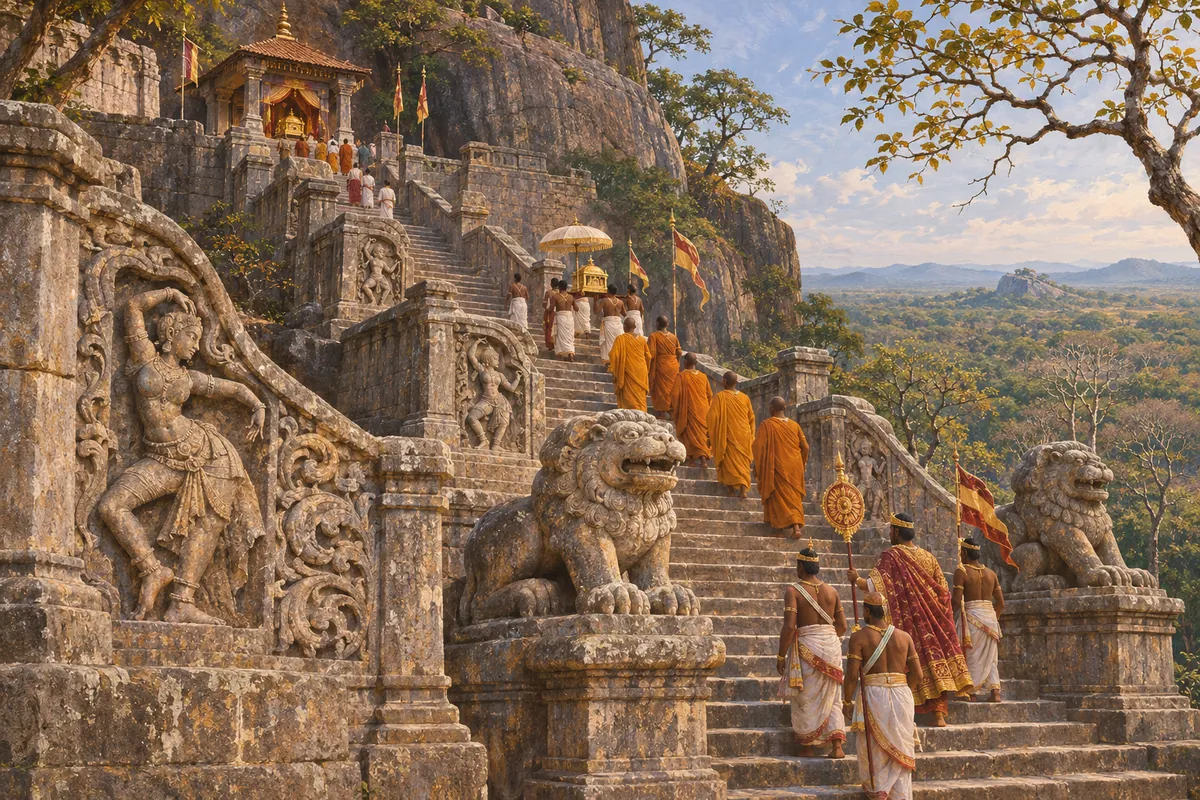
The Yapahuwa staircase
The ornate stone stairway climbing to the Tooth Relic temple is Yapahuwa's best-known monument. Its lions, dancers and musicians have been compared to Cambodian and South Indian work by Nicholas and Paranavitana and others.
Yapahuwa's foreign finds
Excavations at Yapahuwa, from H.C.P. Bell's work onwards, turned up Chinese coins and Song-period ceramics. A hoard of 1,352 Chinese coins found near the eastern entrance in 1945 is described as the largest found in the island (Sudharmawathie, 2017). Sudharshan Seneviratne has noted that Yapahuwa's overseas coins point to trade links with China.
April 1283: an embassy to Egypt
In April 1283 an embassy from Ceylon reached the Mamluk court in Cairo. According to J.M. Sudharmawathie (2017), it was led by an envoy called al-Hajj Abu Uthman, and the sultan then reigning was Qalawun (1279–1290). The letter, reportedly delivered in a golden case, proposed an alliance; Codrington dates its dispatch to the first months of 1283.
What the letter offered
The king offered pearls, gems, elephants, muslin, brazilwood, cinnamon and up to twenty ships a year. He asked for Egyptian envoys at his court and at Aden, and said he had rebuffed an envoy from Yemen.
Why Egypt?
The Mamluks controlled the Red Sea route, and Aden was a key port. Four Sri Lankan coins, the latest of Bhuvanekabahu I, were reportedly found at Mogadishu (Kiribamune, 1986, cited by Sudharmawathie).
1284: a Chinese mission for relics
Codrington records that a Chinese embassy came in 1284 seeking the Tooth and Bowl relics; Sudharmawathie identifies it as a mission of the Mongol emperor Kublai Khan, and it went home without success. This episode foreshadows later Chinese interest in the Tooth Relic under the Ming. Bhuvanekabahu I himself died around 1284, opening a succession crisis.
c. 1284: the Tooth Relic taken
After the king's death, the Pandyan ruler Maravarman Kulasekara I sent his minister Aryacakravarti, who took Yapahuwa and carried the Tooth Relic and treasure to the Pandyan country. The Culavamsa records the loss.
The interregnum (c. 1284–1302)
The chronicles say Parakramabahu III followed directly. But Codrington, using the Tamil poem Sarajoti Malai, recited at his court in May 1310 in about his seventh year, dated his reign from about 1302/3. That implies a gap of some twenty years, perhaps under Pandyan overlordship.
Parakramabahu III and the return of the Tooth
Parakramabahu III travelled in person to the Pandyan court and persuaded King Kulasekara to return the relic, which he enshrined at Polonnaruwa. Dates for this are muddled: summaries give 1287–1293 for his reign or 1288 for the recovery, while Codrington's chronology places his reign from about 1302.
c. 1292–1294: Marco Polo passes Lanka
The Venetian Marco Polo passed the island in 1292–1294 on his voyage home from China. He named its king as 'Sendemain', whose identity Codrington called obscure. Polo also described the Pandyan country, then rich and powerful under the same Kulasekara who held the Tooth Relic.
1308–1323: the Pandyan collapse
The Pandyan kingdom fell into civil war after Kulasekara's death and was struck by Muslim armies around 1310. Codrington suggested this prompted a cousin's revolt against Parakramabahu III. As Pandyan power waned, the Aryacakravarti rulers made Jaffna independent.
Kurunegala: a quieter interlude (c. 1310–1340s)
For three decades the court sat at Kurunegala. The chronicle record grows thin, and historians lean on short temple texts, inscriptions and colophons to rebuild the reigns.
Bhuvanekabahu II at Kurunegala
Bhuvanekabahu II moved the court to Kurunegala early in the 14th century. The Culavamsa makes his reign very short, but the Dalada Sirita, which Codrington called almost contemporary, credits him with nine ordination festivals.
c. 1325/6: Parakramabahu IV
Parakramabahu IV came to the throne about 1325/6 (Saka 1247), the date given by the Dalada Sirita. Codrington credits him with a Sinhala translation of the Jataka stories of the Buddha's former lives. His reign is among the last the Culavamsa covers in detail. Codrington notes a Chinese author mentioned Colombo in 1330.
Vijayabahu V and the end of Kurunegala
After Parakramabahu IV, Codrington lists a 'Jaya or Vijaya Bahu, of whom nothing is known', usually numbered Vijayabahu V and placed in the 1330s to early 1340s. His son Bhuvanekabahu IV would take the court further into the hills. The details of these reigns rest on very thin evidence.
The Jaffna kingdom of the Aryacakravartis
In the north a Tamil kingdom took shape with its capital at Nallur. By the early 14th century, Britannica says, the Aryacakravarti dynasty ruled the Jaffna peninsula and was pushing south. Pathmanathan (1978) describes a chieftain from the Pandyan kingdom gaining power there late in the 13th century. Its origins remain much debated.
Origins: three main theories
Swami Gnanaprakasar thought the first Aryacakravarti was Kalinga Magha himself; Rasanayagam (1926) thought a Rameswaram Brahmin married into Magha's family. S. Paranavitana proposed descent from Chandrabhanu.
Coins and the Ganga question
The Jaffna kings issued 'Setu' coins showing a reclining bull under a crescent, a device also found on Eastern Ganga coins. Rasanayagam and Gnanaprakasar took this as proof of Ganga descent.
The Tamil chronicles
The Yalpana Vaipava Malai was written in 1736 for the Dutch commander of Jaffna, Jan Maccara, by Mayilvakana Pulavar. He drew on the Kailaya Malai, Vaiyai Padal and Pararajasekaran Ula. It begins with a blind lute-player, Yalpadi, granted land he named Yalpanam.
Competing founding stories
The Yalpana Vaipava Malai has Koolangai Cakravarti rule after Yalpadi and tells of the founding of Nallur and the arrival of Tamil settlers. The Cekarasacekara Malai traces the royal ancestors to Brahmins of Rameswaram. The Portuguese writer Queyroz told of Gujarati Brahmins.
Sinhala sources on Jaffna
Sinhala texts see the Aryacakravartis mostly as enemies. The Culavamsa records the relic raid of the 1280s. The Rajavaliya, a 17th-century chronicle, says the Aryacakravartis collected taxes from the hill country and southern lowlands. The 15th-century Kokila Sandesaya later celebrated a Kotte victory over Jaffna.
Reign of Martanda Cinkaiariyan (c. 1325–1348?)
Tamil king lists place Martanda Cinkaiariyan, throne name Pararasasekaran, in about 1325–1348. These dates come from later lists and are uncertain. The Yalpana Vaipava Malai says he subdued rebellious Vanni chiefs. He is usually identified as the Jaffna king who hosted Ibn Battuta in 1344, described below.
Gampola and the Alagakkonaras (c. 1341–1405)
The court moved to Gampola in the central hills. Its kings built striking temples, but real power passed to the Alagakkonara ministers, who fought off Jaffna and built a fortress at Kotte.
c. 1341–1345: the move to Gampola
Bhuvanekabahu IV, son of Vijayabahu V, moved the court to Gampola on the Mahaweli river, helped by his minister Sena Lankadhikara. Codrington dates his accession to 1344/5 and Britannica the move to about 1344. But Lankatilaka records dated Saka 1266 (1344/5) call that his third year, implying an accession about 1341/2. He is attested until at least 1353/4.
Two kings at once
Codrington dated the accession of Parakramabahu V to 1344/5 as well, which means two sovereigns ruled together, Bhuvanekabahu at Gampola and Parakramabahu at Dedigama. The poem Tisara Sandesaya, earliest of its class, was addressed to Parakramabahu V at Dedigama. His last known year is 1359; one later account says he was driven out to the Malay world.
Gadaladeniya (c. 1344)
Gadaladeniya Vihara, near Kandy, is dated by its rock inscription to the reign of Bhuvanekabahu IV, usually 1344. Its builder is named as the monk Seelavamsa Dharmakirti and its architect as Ganesvarachari, a South Indian. The stone shrine combines Dravidian design with Sinhala Polonnaruwa traditions.
Lankatilaka
Lankatilaka Vihara, about two miles from Gadaladeniya, was also built under Bhuvanekabahu IV; its main Sinhala and Tamil rock records are dated Saka 1266, about 1344. Tradition names the South Indian architect Sthapati Rayar. A later record of Vikramabahu III, dated late 1359, grants it two villages.
1344: Ibn Battuta lands at Puttalam
The Moroccan traveller Ibn Battuta landed in 1344, after a near-disastrous voyage, at a town he called Battala, usually identified as Puttalam. Its ruler, Ayri Shakarwati (Arya Chakravarti), was there with pearls from the fishery; Ibn Battuta says he understood Persian and enjoyed his tales.
The pearl king
Ibn Battuta saw the king's pearls from the fishery and received valuable pearls as a gift. He credited the king with considerable forces at sea and ships for moving troops. For his pilgrimage the king provided a palanquin carried by servants and an escort of four yogis, four Brahmins and ten companions.
To Adam's Peak
Ibn Battuta went inland to the mountain he called Sarandib, revered by Muslims as bearing Adam's footprint. He described paths named for Adam and Eve, iron chains for climbers, and a footprint eleven spans long.
Kunakar and the 'Alkonar'
On the way he visited a town rendered Kunakar (Kankar in an older translation), which Gibb's text calls the capital of the principal sultan of the land, a ruler named Alkonar (Kinar in the older version). He rode a white elephant, its head decked with great rubies.
Dinawar and Colombo
Returning south, Ibn Battuta visited Dinawar, which scholars usually identify with Devinuwara, describing a great temple with a golden idol, about a thousand Brahmins and yogis and about five hundred women. He then reached Kalanba, Colombo, which he called one of the finest and largest towns in the island.
Nissanka Alagakkonara and the family's origins
The Alagakkonaras grew rich in trade and rose as court officials at Gampola, helped by adopting Buddhism; Britannica places the family's base at Rayigama. Some historians trace them to Kanchipuram or Vrinchipura in South India. G.P.V. Somaratna explained the name as 'chief of the abode of Kubera'.
c. 1359: Jaffna's tax collectors
Vikramabahu III (c. 1357–1374), nephew of Parakramabahu V, ruled at Gampola while the minister Nissanka Alagakkonara held real power. A Madawala (Medawala) inscription of his third year, about 1359, is read by historians as recording the Jaffna king's tax collectors over Matale, Dumbara and other Gampola lands.
Later 14th century: Kotte and the Jaffna war
Nissanka Alagakkonara fortified marshland south of the Kelani river near Colombo, naming it Jayawardhanapura (Kotte). The Rajavaliya says the war began when he hanged Jaffna's tax collectors; Codrington lists Jaffna camps he took at Colombo, Wattala, Negombo and Chilaw. The exact date is uncertain, probably in the 1360s or 1370s.
The Jaffna counter-attack
The Aryacakravarti king then invaded by land and sea. Later Sinhala accounts, chiefly the Rajavaliya, say the land army was beaten at Matale and the fleet routed near Colombo, its ships destroyed at Panadura.
c. 1372–1406: Bhuvanekabahu V
Bhuvanekabahu V reigned at Gampola from about 1372/3 to 1406/7 by Codrington's dates, apparently as a figurehead while the Alagakkonaras ruled. Nissanka Alagakkonara last appears in a record of 1382/3 (Saka 1304) and died some time after, opening a family struggle for power.
1385/6: Vijayanagara claims a conquest
A Vijayanagara record of 1385/6 says Prince Virupaksha (Virupanna), son of Harihara II, conquered the Sinhalas and presented jewels to his father. Britannica says Vijayanagara forces invaded a few times in the 15th century, and Jaffna was for a time its tributary.
c. 1386–1400: the family at war
Nissanka's son Kumara Alakesvara held power next, apparently in the later 1380s. Vira Alakesvara followed, but fought his brother Vira Bahu, who took the throne in 1391/2 and held a convocation for monastic reform in 1396/7. Vira Alakesvara fled to South India, and after the brief reigns of Vira Bahu's two sons he returned with foreign troops to seize power.
Vira Alakesvara or Vijayabahu VI?
Codrington says Vira Alakesvara then reigned twelve years as Vijayabahu VI. Others treat Vijayabahu VI as a separate Gampola king. The Ming Shi-lu calls the ruler the Chinese captured Ya-lie Ku-nai-er, which scholars such as Werake read as Alagakkonara or Alakesvara.
The Ming fleet in Lanka (1405–1412)
Between 1405 and 1433 the Ming eunuch admiral Zheng He led seven great voyages across the Indian Ocean. Sri Lanka lay on the route, and here the fleet fought one of its rare wars, capturing a ruler and taking him to China.
1405: the first voyage
On 11 July 1405, the Ming Shi-lu records, the Yongle emperor dispatched Zheng He to the Western Ocean; the fleet sailed later that year. In Sri Lanka it met a hostile ruler and withdrew hastily, says Britannica. Sasanka Perera notes Alakesvara's attacks were labelled piracy.
15 February 1409: the Galle stele
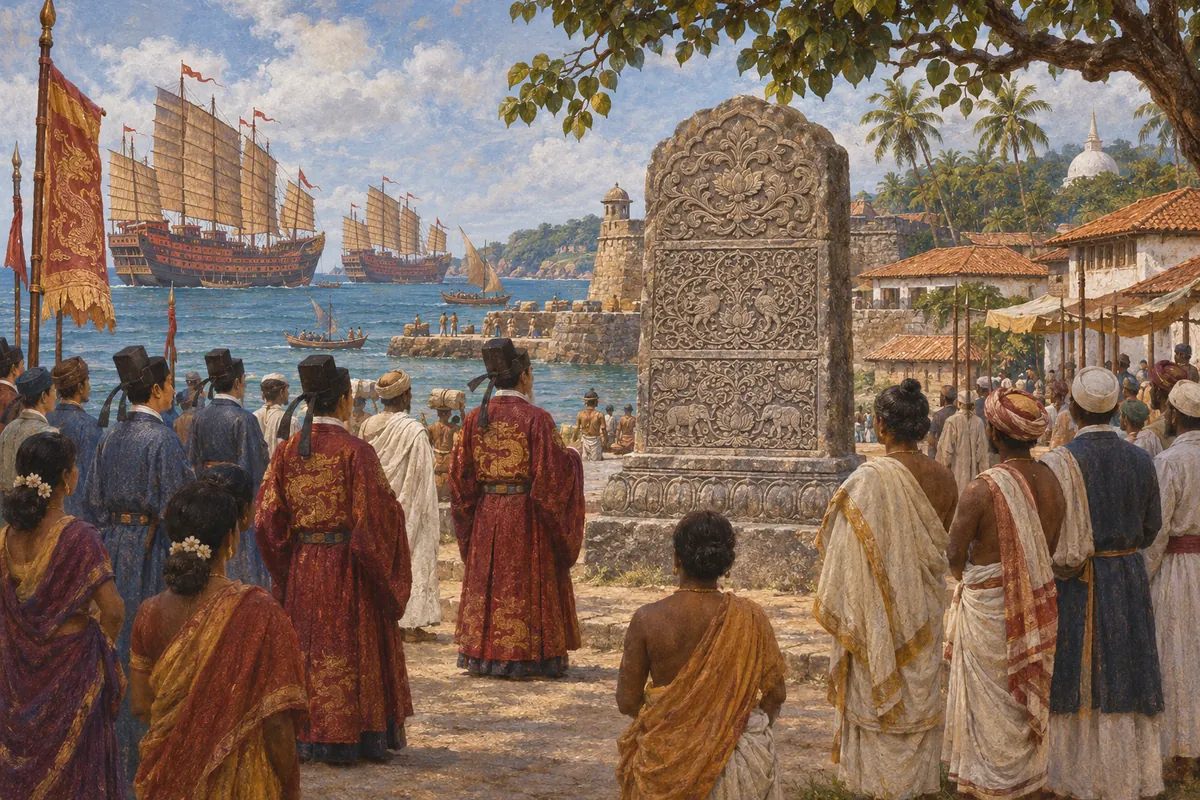
Zheng He's fleet carried a stone tablet dated the 2nd month of the 7th Yongle year, 15 February 1409, inscribed in Chinese, Tamil and Persian. J.J.L. Duyvendak (1939) argued it was carved in China before departure and set up on the following voyage, a view Werake accepted.
A stone in three languages
The Chinese text honours the Buddha, the Tamil honours Tenavarai Nayanar, god of Devinuwara, often identified with Vishnu, and the Persian honours Allah. Sinhala is absent.
What the stele offered
The Chinese text lists lavish offerings of gold, silver, silk, candles and scented oil for a Buddhist shrine in the mountains of Ceylon, usually taken as Sri Pada; the Tamil and Persian texts list similar gifts. Paranavitana edited the Tamil text in Epigraphia Zeylanica III (1933).
1911: the stele rediscovered
In 1911 H.F. Tomalin, Provincial Engineer at Galle, found the stone used as a culvert cover near the turn to Cripps Road, and had it removed. The original is now in the Colombo National Museum, with a replica in Galle.
October 1409: the third voyage
The third voyage set out in October 1409, Britannica says, with about 27,000 men by Chinese accounts. Its route took it past Sri Lanka towards Calicut. The Chinese account Hsing-ch'a sheng-lan says Zheng He made offerings at a temple, gave gifts to the king and chiefs, and set up an inscription, which Werake links to the Galle stele.
1410 or 1411: the Ming–Kotte war
The Ming Shi-lu says the king lured the fleet ashore, demanded treasure and sent over 50,000 troops to cut it off. Zheng He led 2,000 men by a back route, stormed the royal city, usually identified as Kotte, seized the king and his family, and beat off a relief army.
6 July 1411: captives in Nanjing
Zheng He returned to court on 6 July 1411 and presented the Sri Lankan captives to the Yongle emperor, the Ming Shi-lu records. On 13 September 1411, Dreyer notes, the emperor rewarded those who took part, on the joint advice of the Ministries of War and Rites. Codrington says the captive king came with his wives and children.
Pardon and return
Court ministers asked for the captive king's execution, but the Yongle emperor pardoned him and ordered him released with food and clothing, the Ming Shi-lu says, in language of imperial condescension. The captives were then sent home.
1412: a king named by China
The emperor told the Ministry of Rites to choose a worthy member of the royal family. On 20 August 1412, after inquiries among the Sri Lankans, he enfeoffed Ye-ba-nai-na as king and sent an envoy with a patent and seal. Paranavitana, and later John Holt, identified him with Parakramabahu VI.
1412–1415: Parakramabahu VI at Kotte
Britannica dates the reign of Parakramabahu VI from 1412 and says he moved the capital to Kotte, near today's Colombo. Codrington thought he took the throne in 1412 but was formally inaugurated in 1415, from which his official regnal years count. Under him the island came under one ruler, including Jaffna from about 1450.
After 1412: tribute to China
Later Ming fleets met no fighting; on the seventh voyage a Chinese inscription records arrival at Pie-lo-li, identified with Beruwala or Weligama, on 28 November 1432. Werake counts Sri Lankan missions to China in 1416, 1421, 1433, 1436, 1445 and 1459.
Looking back: Wandering Capitals
Older histories called this an age of decline caused by invaders. Historians such as Arasaratnam now stress fiscal and environmental causes, a drift of people south-west, and new Indian Ocean links. The era also saw an independent Tamil kingdom form in the north. Sinhala, Tamil, Arab and Chinese sources each tell only part of the story and must be read together.