 Fablewings
 › Sri Lankan history › Part 7
Kotte and the Coming of the Portuguese (1412–1597)
For a few decades after 1412 a king ruling from Kotte, near modern Colombo, brought the whole island under one crown and presided over a flowering of Sinhala poetry. Within a century that unity had broken, Portuguese ships had arrived, and rival Sinhala kingdoms were fighting each other with European help. By 1597 the last king of Kotte, a Catholic convert, had died and left his realm to the King of Portugal.
Read in the page-turning reader
Parakramabahu VI and the Unified Island (1412–1467)
The first part of the era belongs to one long reign. Parakramabahu VI built a new capital, defeated regional rivals, took Jaffna and dealt with Ming China as an equal partner in tribute diplomacy.
1412
Parakramabahu VI was crowned at Raigama, south-east of modern Colombo. Ming Chinese forces under the admiral Zheng He had shortly before removed the ruler Alakeshvara, and Chinese backing helped the young prince to the throne. He would reign for over half a century and is often called the last Sri Lankan king to rule the whole island.
Accession: 1410, 1412 or 1415?
Even the start of this famous reign is uncertain.
1415
The king formally made Kotte (Jayawardhanapura Kotte) his capital. The site lay inland from the western coast, protected by marshes and close to the ports through which cinnamon, gems and areca were exported. Here he built a three-storey temple for the Tooth Relic, the symbol of Buddhist kingship, and the Sunetradevi Pirivena at Pepiliyana, named after his mother.
1436, 1445 and 1459
Codrington lists Ming Chinese records of tribute missions from Lanka in 1436, 1445 and finally 1459. Modern accounts count at least five missions in the reign, partly to assure the Chinese court that piracy in Kotte's waters had been suppressed.
1447 or 1450
The king's adopted son, Prince Sapumal (Chempaka Perumal), led an army north against the Tamil kingdom of Jaffna, ruled by the Aryacakravarti dynasty. A first attempt failed; a second succeeded, and the Jaffna king Kanakasooriya Cinkaiariyan fled to South India. Britannica says the conquest, complete by 1450, unified the whole island under Kotte.
When did Jaffna fall?
The conquest is dated differently.
Who was Sapumal?
Sapumal's background is a live debate in both Sinhala and Tamil history writing.
Sapumal in Jaffna (c. 1450–1467)
Sapumal governed Jaffna on Kotte's behalf for about seventeen years. Tamil and Sinhala tradition both credit him with building or renovating the Nallur Kandaswamy temple, the great Murugan shrine of Jaffna, as well as Buddhist monasteries in the south. A Kotte prince patronising a Hindu temple was not unusual: Kotte kings themselves honoured Hindu gods alongside the Buddha.
The Literary Golden Age
Peace and royal patronage made the fifteenth century the high point of classical Sinhala poetry. Learned monks wrote for the court, and the most typical form was the sandesa, or message poem.
Totagamuve Sri Rahula
The monk Sri Rahula of Totagamuve, head of a monastic college and a favourite of the court, was the outstanding scholar of the age. Works credited to him include the Kavyasekharaya, a long poem on a Jataka story, the Parevi Sandesaya (pigeon message) and the Selalihini Sandesaya (myna message), as well as works of Pali grammar such as the Panchika Pradipa. He was introduced to court by the monk Vidagama Maitreya.
Selalihini Sandesaya
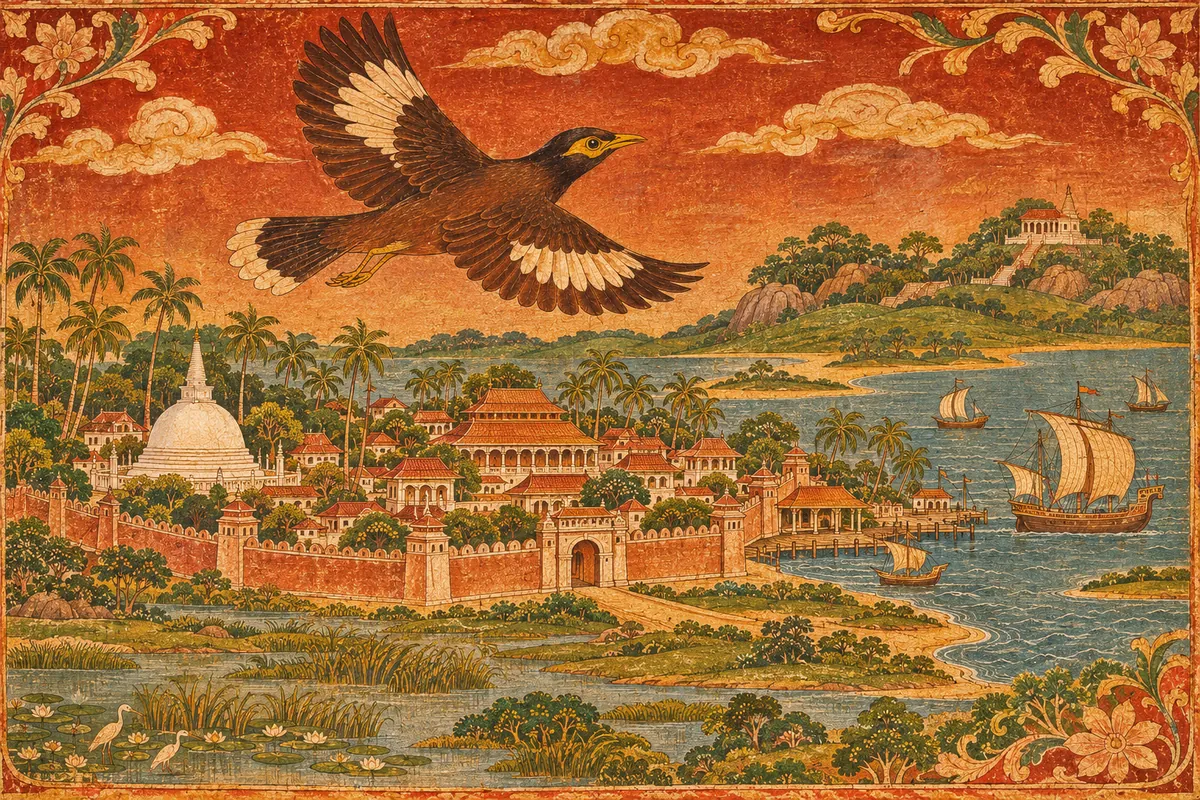
In the Selalihini Sandesaya, Sri Rahula sends a myna bird from Kotte to the god Vibhishana at Kelaniya. Modern summaries link the poem to the royal family and to Sapumal's return to Kotte. Its vivid picture of Kotte's streets is one of the few detailed descriptions of the capital before the Portuguese.
Kokila Sandesaya
The Kokila Sandesaya (cuckoo message), written by the chief monk of the Irugalkula Tilaka Pirivena at Mulgirigala, sends its bird from the south of the island to Jaffna. It praises Sapumal's conquest of the north and is valued by historians for its description of the route and of Jaffna under Kotte rule.
Can poems be history?
Historians use the sandesas, but carefully.
A message on the wing
Sandesa poets imagined birds flying between Kotte, Kelaniya and Jaffna with prayers for the king. Their verses map a prosperous island of harbours, shrines and markets at the height of Kotte's power.
1463 or 1469
A rebellion in the hill country ended Kotte's direct control there. Senasammata Vikramabahu emerged as ruler at Senkadagala, the future Kandy, founding a line that claimed independence. Sources disagree on the year: some modern accounts give 1463, during Parakramabahu VI's last years, while others place the new kingdom's foundation in 1469, after his death.
1467
Parakramabahu VI died. In the same year Kanakasooriya Cinkaiariyan returned from Madurai with mercenaries and restored the Aryacakravarti dynasty in Jaffna. Within a few years both the north and the central hills had slipped from Kotte's grasp. The unity of the island had lasted barely two decades.
Succession Struggles at Kotte (1467–1505)
Parakramabahu VI left no son. The next forty years were dominated by killings in the royal family and by chronologies that historians still struggle to reconcile.
1467–c. 1470: Jayabahu II
The old king had passed the throne to his grandson, known as Vira Parakramabahu or Jayabahu II. According to the Rajavaliya, Sapumal heard of the succession, marched from Jaffna, killed the young king and took the throne. His reign was short, and his name is sometimes left out of king lists.
Two stories of one killing
The sources tell the succession differently.
c. 1469/1472: Bhuvanekabahu VI
Sapumal was crowned as Bhuvanekabahu VI. Codrington, using the Buddhist-era date of the coronation, dated his accession to about 1472; other lists give 1469. The conqueror of Jaffna had become king of Kotte, but he now faced the same problem as his rivals: how to hold the loyalty of chiefs who saw him as a usurper.
1476
An embassy arrived from Pegu (Lower Burma), seeking monks to restore the line of ordination there. Codrington notes that a serious rebellion had broken out in Kotte at the time. Buddhist links with Burma were part of Kotte's prestige, but the king was fighting for survival at home.
c. 1480–1484: Parakramabahu VII
Bhuvanekabahu VI was succeeded by Pandita Parakramabahu VII. He was attacked and killed by his uncle, Ambulugala Raja, Sapumal's brother. Couto says the reign lasted no more than four years. Once again a Kotte king had fallen to a relative.
c. 1484–1509: Vira Parakramabahu VIII
Ambulugala Raja ruled as Vira Parakramabahu VIII. The Rajavaliya gives him a twenty-year reign. Britannica names him as the king of Kotte who received the first Portuguese visitors in 1505. In his last years he was seriously ill and his sons began to share power.
How many kings, and which numbers?
Readers will find the same kings with different numbers and dates.
Kotte's wealth around 1500
Kotte's exports were cinnamon, cardamom, pepper and gems; after the Jaffna conquest it also profited from pearls. Trade through its ports was largely handled by Muslim merchants from India and Arabia, often called Moors in European sources. These traders would be the first to oppose the Portuguese, who wanted their business.
The Coming of the Portuguese (1505–1521)
Portuguese fleets entered the Indian Ocean after 1498, seeking to control the spice trade. Lanka's cinnamon made it a prize, but at first the Portuguese came as visitors and allies rather than conquerors.
1505 (or 1506)
A Portuguese fleet under Dom Lourenço de Almeida, son of the first Viceroy of India, reached Lanka while hunting Muslim ships around the Maldives; later tradition says it touched first at Galle. At Colombo envoys went inland to Kotte, where Britannica names the king as Vira Parakramabahu. He agreed to Portuguese friendship and a cinnamon payment, and the visitors set up a stone pillar (padrão) at Colombo.
1505 or 1506? The dating debate
No date in this era is more argued over.
A padrão dated 1501?
A stone at Colombo once seemed to rewrite the story.
The Rajavaliya remembers
The Rajavaliya describes the newcomers as fair-skinned men in iron coats and hats who never rest in one place. It says they eat lumps of white stone and drink blood, usually read as bread and red wine, pay two or three gold or silver coins for a single fish or lime, and fire cannon louder than thunder. The passage records how strange and wealthy the Portuguese seemed.
Why Kotte welcomed them
Kotte's rulers had their own reasons to deal with the Portuguese.
1518
On orders from King Manuel I, the Governor of Portuguese India, Lopo Soares de Albergaria, arrived at Colombo with a large fleet and built a small fort beside a trading post (feitoria). Britannica says the Portuguese were allowed to build it and given trading rights. Biedermann links the fort to a vassalage agreement of the same year: in Portuguese eyes Kotte now owed cinnamon tribute.
1520–1521
Vijayabahu VII, who had taken the senior position around 1518, turned against the fort. With encouragement from Muslim merchants he sought help from the Zamorin of Calicut, the Portuguese enemy on the Malabar coast. According to later accounts the fort was besieged for about six months until reinforcements arrived by sea, and the Sinhala forces were driven off.
Vijayaba Kollaya and the Divided Kingdom (1521–1551)
A palace killing in 1521 split Kotte into three. For the next thirty years Bhuvanekabahu VII of Kotte and his brother Mayadunne of Sitawaka fought each other, with Portugal and Calicut backing opposite sides.
1521: Vijayaba Kollaya
Three sons of Vijayabahu VII, Bhuvanekabahu, Pararajasinha (Raigam Bandara) and Mayadunne, killed their father in his palace. The Sinhala name of the event, Vijayaba Kollaya, means 'the plunder of Vijayabahu', after the looting of the palace that followed. Bhuvanekabahu took the throne of Kotte.
Why did the princes strike?
The chronicles give a family motive.
1521: Three kingdoms
The brothers divided the inheritance. Bhuvanekabahu VII kept Kotte and the western seaports. Mayadunne took Sitawaka, roughly modern Sabaragamuwa and the inland Kelani valley. Raigam Bandara took Raigama and the Pasdun, Walallawiti and Rayigam korales. The hill kingdom of Kandy stood apart, and Jaffna remained independent.
A partition that suited no one
On paper Bhuvanekabahu was senior; in practice power was split.
1524
On orders from Portugal the Colombo fort was dismantled, though a Portuguese factor remained to handle trade. The Lisbon EVE encyclopedia explains that the two sides could not agree how tribute payments would be matched by military support. The Portuguese presence shrank to a trading post protected by Kotte.
1530s
In the 1530s Portuguese demands for cinnamon grew, and Kotte's king paid more in return for naval protection. Historians regard control of cinnamon exports as the core Portuguese interest in Lanka for the rest of the century.
1537–1538
Mayadunne, backed by a Calicut fleet, besieged Kotte and was driven off by Portuguese relief forces. In 1538 the Portuguese commander Martim Afonso de Sousa destroyed the Calicut fleet at Vedalai on the Indian coast. That year Raigam Bandara died, and Mayadunne seized Raigama, enlarging Sitawaka and becoming his elder brother's open enemy.
1540–1541
Bhuvanekabahu VII had no son. To secure the succession for his infant grandson Dharmapala, son of his daughter Samudra Devi and the noble Vidiye Bandara, he sent an embassy to Lisbon led by the Brahmin envoy Sri Radharaksa Pandita. Codrington dates its departure to 1540, others to 1541. The aim was to bind Portugal to defend Dharmapala's claim against Mayadunne.
1542–1543
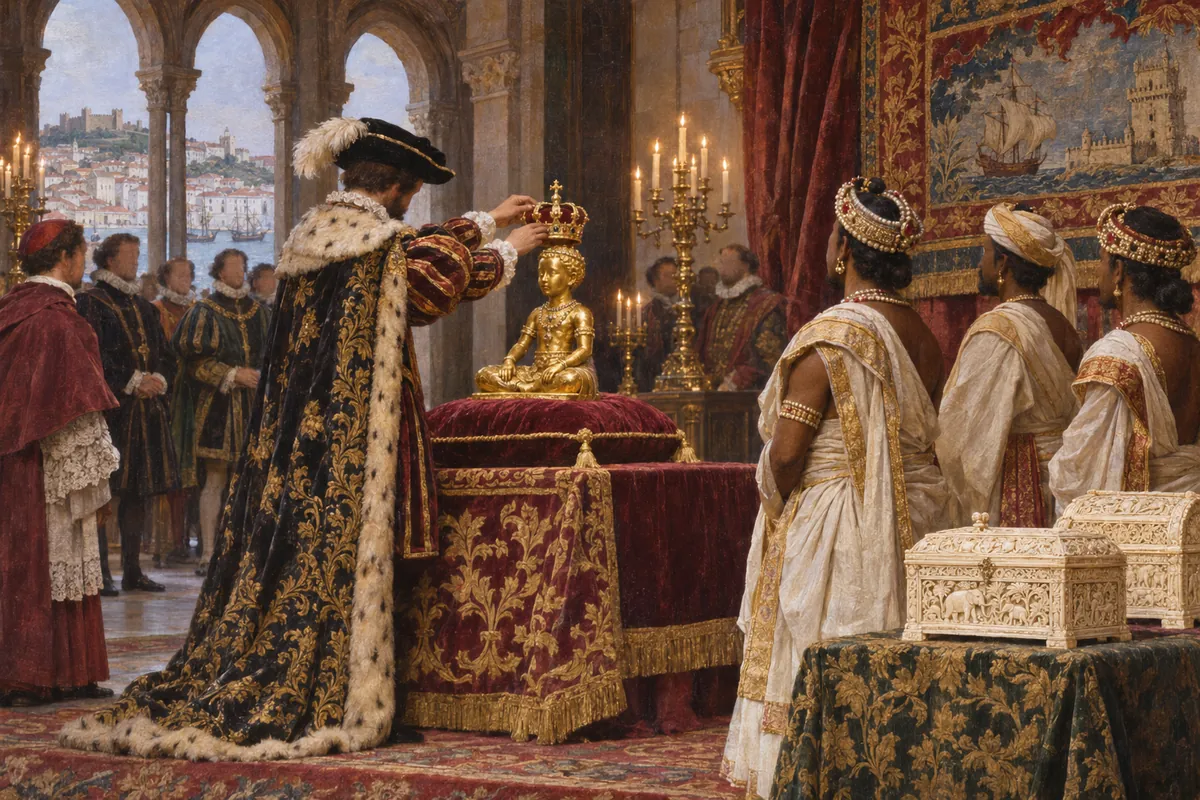
Biedermann dates the embassy's stay in Lisbon to 1542–43. A golden image of the young Dharmapala, brought by the envoys, was ceremonially crowned before King João III, who promised to protect the boy's right to Kotte. Carved ivory caskets made at the Kotte court, one now in the Munich Residenz Treasury, are linked to this diplomacy.
A weak king or a skilled one?
Older histories painted Bhuvanekabahu VII as a Portuguese puppet.
1543
Britannica dates to this year an agreement under which the Portuguese king promised protection in return for privileges and cinnamon. The first permanent Franciscan mission, led by Friar João de Vila do Conde, arrived in Kotte, and the king granted it land and support while himself remaining a Buddhist.
A crown for an image
In Lisbon, envoys from Kotte watched a golden image of a child prince being crowned before the King of Portugal. The ceremony bound Portugal to defend Dharmapala's succession and drew it deeper into Lankan politics.
1544: Mannar
Missionaries had converted many Parava fishing families on Mannar island, which belonged to the Tamil kingdom of Jaffna. Cankili I, king of Jaffna since 1519, saw the converts as a Portuguese fifth column. Late in 1544 his troops killed several hundred of them, usually given as 600 to 700. Catholics remember them as the Mannar martyrs.
Counting the Mannar dead
Almost all the evidence comes from one side.
1544–1545
A Portuguese letter of November 1544 says Cankili also had his own eldest son killed for becoming a Catholic. Francis Xavier, then working among the Paravas of South India, wrote of great prospects for conversion in Lanka and urged action against Jaffna. In 1545, according to Portuguese sources, the Jaffna king submitted and paid tribute, but no punitive expedition was sent yet.
1550
Viceroy Afonso de Noronha arrived at Colombo. Kotte forces, with Portuguese help, took Sitawaka and sacked its Hindu temple, the Berendi Kovil, but the Portuguese did not hold the city. Codrington says the viceroy's main aim was wealth: he plundered the Kotte palace and city as well, an episode remembered with bitterness.
1550 or 1551
Bhuvanekabahu VII was shot dead at his palace at Kelaniya, struck while looking out of a window. Strathern and Biedermann date his death to 1551; Codrington puts it in mid-1551, and some sources give late 1550. The Portuguese called it an accident. Before he died, he had secured Portuguese recognition of Dharmapala as heir.
Who killed Bhuvanekabahu?
The death has been blamed on several parties.
Dharmapala, Sitawaka and Jaffna (1551–1597)
In the second half of the century the struggle became sharper and more religious. A Catholic king ruled Kotte under Portuguese guns, while Sitawaka under Mayadunne and his son Rajasinha I nearly drove the Portuguese into the sea.
1551–1552
Dharmapala, about ten years old, became king of Kotte, with his father Vidiye Bandara as the real power. In 1552 Portuguese agents seized Vidiye Bandara; he escaped and became their enemy, first allying with Mayadunne, whose daughter he married, and later fighting on his own. Dharmapala now lived under Portuguese protection.
1557
Dharmapala was baptised by the Franciscans and took the name Dom João Periya Bandara. Strathern and Biedermann date the baptism to 1557; Britannica says it was announced in 1556 or 1557. His queen and many chiefs followed. Codrington notes that many subjects deserted him. Missionary sources also claimed large numbers of converts among the fishing communities of the coast.
Why did a conversion matter so much?
The conversion is often treated as the turning point of the century.
Mulleriyawa
In the marshes of the Kelani valley at Mulleriyawa, Prince Tikiri Bandara, Mayadunne's son, trapped and defeated a Portuguese-led army. Tradition says he took the name Rajasinha, 'lion king', after the victory. Some modern writers call it the worst Portuguese defeat in Asia, a claim that reflects Sri Lankan pride as much as precise comparison.
When was Mulleriyawa?
Three dates are in circulation.
1560: The Jaffna expedition
Viceroy Constantino de Bragança sailed from Goa in September 1560 with about 1,200 soldiers, ordered by the Portuguese crown to avenge the Mannar killings. The Portuguese landed at Colombuthurai, took the capital Nallur, and pursued Cankili I into the Vanni without catching him. Britannica describes the expedition as having no lasting success.
The Tooth Relic burned at Goa?
A relic seized in Jaffna became one of the century's great controversies.
1560–1561: Terms and retreat
Cankili sued for peace. He kept his throne but ceded Mannar and the western shore, promised elephant tribute and freedom for missionaries, and gave hostages. Short of men and supplies, the viceroy agreed. A popular rising then forced the Portuguese out of Nallur. They kept Mannar and built a fort there; Jaffna remained independent.
1564–1565
Sitawaka attacked Kotte and Colombo together in 1564. By July 1565 the Portuguese judged Kotte indefensible, abandoned it and moved Dharmapala and his court into Colombo. The capital built by Parakramabahu VI was left empty. From now on 'Kotte' meant a claim held by a king living inside a Portuguese fort.
1578–1580
According to Queyroz, the aged Mayadunne handed effective rule to Rajasinha in 1578. Colombo was then besieged again in 1579–1580. Mayadunne had been fighting Kotte and the Portuguese for nearly sixty years.
12 August 1580: The donation
Dharmapala signed a deed, dated 12 August 1580 by Codrington, leaving his kingdom and his overlordship of Lanka to the King of Portugal on his death. Portuguese sources and modern summaries credit Franciscan friars with persuading him. The same year Philip II of Spain also became king of Portugal, so the beneficiary was a Habsburg monarch. Biedermann traces how the gift became a title for Iberian conquest.
What exactly was given away?
The deed listed far more than Dharmapala controlled.
1581
Mayadunne died, by most accounts in his eighties. Rajasinha I became sole ruler of Sitawaka and, by Codrington's account, controlled almost the whole island apart from Colombo and the north. A kingdom born from a palace killing in 1521 was now the strongest power in Lanka.
Did Rajasinha kill his father?
The patricide story is famous but disputed.
1582
Rajasinha conquered Kandy. Its Catholic-leaning ruler Karaliyadde Bandara fled to the Portuguese with his family, including the young princess Kusumasana Devi, later known as Dona Catherina. In the north the Jaffna king was paying tribute to Portugal of ten elephants or their cash value. Only Colombo, Mannar and Jaffna lay beyond Rajasinha's reach.
1583–1587
Rajasinha executed nobles he accused of treachery. A conspiracy to make Konappu Bandara king of Kandy was exposed, and monks were found among the plotters. According to the Mandaram Pura Puvata, a later Kandyan text, 121 monks were killed in one place and the chief prelate of Sitawaka was among the victims. Rajasinha turned against the Sangha.
Rajasinha and Shaivism
Rajasinha embraced Shaiva Hinduism, the first Sinhala king said to turn from Buddhism to Shaivism. He settled Brahmin priests and Tamil Shaiva Vellalar families at Buddhist sites, and handed the pilgrimage mountain Sri Pada (Adam's Peak) to Shaiva priests. Buddhist sites were damaged, reportedly on the advice of his minister Manamperuma Mohottala.
How the chronicles framed his conversion
Buddhist writers made Rajasinha a villain.
Hero or tyrant?
Modern Sri Lanka remembers Rajasinha very differently from the chronicles.
1587–1588: Siege of Colombo
Rajasinha besieged Colombo from mid-1587 with an army reported at about 50,000. A first mass assault in August failed with heavy losses, and later assaults failed too. Portuguese reinforcements arrived by sea, and in February 1588 Rajasinha lifted the siege to deal with unrest inland. Portuguese naval power had once again saved the fort.
1590–1591
Konappu Bandara, a Kandyan noble who had been baptised in Portuguese service as Dom João of Austria, led a Portuguese-backed force to Kandy with the prince Dom Philip. When Dom Philip died suddenly, Konappu turned on the Portuguese, returned to Buddhism and proclaimed himself king as Vimaladharmasuriya I. Sources date his kingship from 1590, 1591 or 1592.
1591: Jaffna again
André Furtado de Mendonça led a second Portuguese invasion of Jaffna after its king attacked Mannar. King Puviraja Pandaram was killed, and the Portuguese installed Ethirimanna Cinkam as a client king. Britannica notes that Christian missionaries encouraged the expedition. Jaffna kept its own dynasty, but on Portuguese terms.
1592 or 1593
Vimaladharmasuriya I defeated Rajasinha's forces at Balana. On the way back to Sitawaka, Rajasinha was wounded in the foot by a bamboo splinter at Pethangoda; the wound became infected, probably with tetanus, and he died. Codrington puts the death early in 1593; other accounts say March 1592. He was under fifty, Codrington argues.
1593
Without Rajasinha, Sitawaka fell apart. His leading general Manamperuma (Manamperi), soon baptised as Jayavira Bandara, defected to Dharmapala, and Portuguese forces defeated Sitawaka armies at Kaduwara, Malwana and elsewhere and plundered the city. The princes were captured; Nikapitiye Bandara was sent to Portugal and, Codrington says, died at Coimbra in 1608.
1594: Danture
Pedro Lopes de Sousa invaded Kandy in July 1594 to enthrone Dona Catherina as a Portuguese client queen. His army took Kandy but surrounded her with Portuguese officials, alienating the Kandyans. After the Portuguese killed their own Lascarin commander, Jayavira, desertions forced a retreat, and in October the army was destroyed at Danture. Vimaladharmasuriya married Dona Catherina, strengthening his claim to the throne.
1594–1596
Jerónimo de Azevedo arrived as Captain-General in December 1594, crushed resistance in the Sitawaka lands and built stockades at Menikkadawara, Ruwanwella and Galle. In 1595 Domingos Correa, a Sinhala mudaliyar once in Portuguese service, led a rising; Dharmapala fled to Colombo. Correa was executed in mid-1596, but his brother Simão continued the revolt.
27 May 1597
Dom João Dharmapala died in the Colombo fort, childless. Codrington records that his health had been damaged by poison, allegedly given years earlier. He had reigned for 46 years, almost all of them under Portuguese protection. Under the 1580 donation his kingdom passed to Philip, King of Portugal and Spain.
The Malwana Convention
After 1597, Sinhala delegates are said to have met the Portuguese at Malwana.
Consequences
Dharmapala's death left three claimants to the island: the Portuguese in the lowlands, Vimaladharmasuriya I in Kandy with the Tooth Relic and restored Buddhist ordination, and a Portuguese-dependent king in Jaffna. The struggle of the next century would be between Kandy and Portugal, until the Dutch arrived to change the balance.
Looking back: Kotte and the Coming of the Portuguese
Older histories told this era as a fall: a golden age under Parakramabahu VI, then treacherous princes and a puppet king. Historians such as C.R. de Silva, Zoltán Biedermann and Alan Strathern now stress local agency: Lankan kings used the Portuguese as much as they were used, and religion became a mark of political loyalty only gradually. Sinhala, Tamil, Catholic and Portuguese sources each remember different heroes, and reading them together remains the historian's task.