 Fablewings
 › Sri Lankan history › Part 8
Kandy Against the Portuguese (1592–1658)
In these sixty-odd years a small hill kingdom at Kandy survived repeated Portuguese invasions while the Portuguese absorbed Kotte, Sitawaka and Jaffna. Kandy's kings then allied with the Dutch East India Company, whose fleets and sieges ended Portuguese rule by 1658. The era left lasting Catholic communities, new land and labour systems, and rival ways of telling the story.
Read in the page-turning reader
The rise of Kandy (1590–1604)
A Lascarin captain raised in Goa turned on his Portuguese patrons, took the Kandyan throne and defeated two invasions. His reign set the pattern for the next half-century: Portuguese strength on the coast, Kandyan strength in the hills.
Background: Kandy before 1590
Kandy (Senkadagala) had been a semi-independent hill kingdom under Kotte. In 1582 Rajasinha I of Sitawaka defeated its army at Balana, and King Karaliyadde Bandara fled to Trincomalee under Portuguese protection. His heir, Yamasinghe Bandara, was baptised Dom Filipe and became the Portuguese candidate for the Kandyan throne.
c. 1590–1592: Konappu Bandara takes the throne
Konappu Bandara, a Kandyan noble serving the Portuguese, helped place Dom Filipe on the throne. Dom Filipe soon died suddenly, possibly by poison. Konappu then turned on the Portuguese, drove them out and made himself king as Vimaladharmasuriya I.
Who was 'Dom João of Austria'?
Konappu Bandara was the son of Virasundara (Weerasundara) Bandara of Peradeniya. After his father fell foul of Rajasinha I, he fled to Portuguese territory and was sent to Goa, where he was baptised Dom João of Austria and fought for the Portuguese.
1593
After a failed attack on Kandy in 1592, Rajasinha I of Sitawaka died early in 1593, by Codrington's account from blood poisoning after a bamboo splinter wound. His kingdom quickly broke apart. His general Manamperuma, baptised Jayavira Bandara Mudali, went over to the Portuguese, who occupied Sitawaka on behalf of their client, Dharmapala of Kotte, and took over much of its land.
1594: The Dona Catarina expedition
The Portuguese planned to install Kusumasana Devi, Karaliyadde Bandara's daughter, as their vassal queen of Kandy. Raised by Catholic priests and baptised Dona Catarina, she marched inland with Captain-General Pedro Lopes de Sousa. The army entered Kandy and she was crowned. But she won little local support, and rumours that she would marry a Portuguese pushed many Kandyans back to the king.
1594: The Campaign of Danture
From July to October 1594 the king's forces harried the Portuguese. After Portuguese captains murdered Jayavira, the former Manamperuma, on suspicion of treachery, most Lascarins deserted. The retreating army was destroyed near Danture and Gannoruwa. Pedro Lopes de Sousa was mortally wounded, and Ekanayake Mudali's men captured Dona Catarina.
1594: Aftermath
The Portuguese field army was gone, though their coastal forts survived. Vimaladharmasuriya married Dona Catarina, giving his rule the legitimacy of the old Kandyan royal line. In December 1594 Jerónimo de Azevedo arrived as Portuguese commander. He crushed a revolt in the Sitawaka lands and built stockades at Menikkadawara, Ruwanwella and Galle.
1595–1596
Domingos Correa, a Sinhalese leader formerly in Portuguese service, led a rebellion that forced Dharmapala back to Colombo. Correa was defeated, captured and executed in mid-1596. His brother Simão Correa carried on a smaller revolt. Vimaladharmasuriya backed such risings, which kept the Portuguese tied down in the lowlands.
1597: Death of Dharmapala
Dharmapala of Kotte died on 27 May 1597. Under his 1580 donation, his lands and claim to overlordship passed to the Portuguese crown, and Azevedo proclaimed Philip I of Portugal (Philip II of Spain) as king. Kotte, already a Portuguese client, became formally a Portuguese possession within the Estado da India.
1597: The Malwana assembly
Portuguese and later Sri Lankan accounts describe an assembly at Malwana after Dharmapala's death, at which local chiefs accepted Portuguese rule while customary laws were kept and Christianity protected.
Kandy's Buddhist kingship
Vimaladharmasuriya brought the Tooth Relic to Kandy and built a two-storey temple for it near his palace. He also sent a mission to Arakan to bring monks and restore higher ordination (upasampada).
1599
By January 1599 the fortifications at Menikkadawara were complete, making it the Portuguese military centre for the inland war. In the same year Jorge Florim de Almeida compiled a revenue register for the former Kotte lands, one of the few Portuguese administrative sources found since the 1950s, according to C.R. de Silva.
1602: Joris van Spilbergen
In May 1602 the Dutch admiral Joris van Spilbergen reached Ceylon with three ships and anchored at Batticaloa. In July he travelled to Kandy and had cordial talks with Vimaladharmasuriya, who asked him to carry proposals for an alliance against the Portuguese to the Dutch. This was the first Dutch–Kandyan contact, but no alliance resulted.
1602–1603: Azevedo's offensive
Azevedo invaded the hills again and stormed the Balana pass, but his army was forced into a costly withdrawal later remembered as the 'Great Retreat'. After this the Portuguese turned to raids that burned Kandyan crops and villages.
1603: The killing of Sebald de Weert
Sebald de Weert came to Batticaloa with Dutch ships, captured Portuguese vessels and returned in 1603. At the end of May or on 1 June, after a quarrel at a banquet, the king had de Weert and many of his men killed. Accounts of the death toll vary widely, from about 50 to several hundred.
1604: Death of Vimaladharmasuriya
Vimaladharmasuriya I died in 1604 in Kandy. His successor Senarat, a kinsman who had been a Buddhist monk, left the robes and married the widowed Dona Catarina. Marriage to her again linked the crown to the old Kandyan royal line.
Senarat and the Portuguese advance (1604–1635)
Under Senarat the Portuguese came closest to breaking Kandy. They burned the capital twice, conquered Jaffna and fortified the east coast. Then a single disaster in 1630 reversed their gains.
1611
The Portuguese advanced to Balana and burned Kandy. Senarat withdrew rather than give battle, a tactic his successors also used: abandon the capital, cut supply lines, and wait for the invaders to leave. A truce followed the campaign.
1612: Boschouwer's treaty
On 8 March 1612 the Dutch envoy Marcellus de Boschouwer reached Kandy, and on 11 May he signed an agreement with Senarat. It was the first written Kandyan–Dutch treaty, but the Dutch could not yet send the forces it implied. In December Jerónimo de Azevedo, the old Ceylon commander, became Viceroy at Goa.
1614–1615
Manuel Mascarenhas Homem took command in May 1614 with orders for harsher measures. In 1615 three Portuguese campaigns plundered the highlands. The war became one of attrition, aimed at the villages and harvests that fed Kandy. In 1616–17 a pretender claiming to be the Sitawaka prince Nikapitiye Bandara raised a large lowland revolt, for a time with Senarat's backing.
1614: Registering the land
The Portuguese compiled a tombo, a land register listing holdings, crops, tax duties and owners. The 1614 register for Madampe, for example, records 617 families, and 122 abandoned amunas of paddy against 946 cultivated.
1617: The treaty of 24 August
The Nikapitiye pretender fell out with Senarat and his revolt collapsed. Senarat then made peace with the Portuguese on 24 August 1617. Codrington records that it gave the Portuguese Trincomalee, Batticaloa and Panama, with two elephants a year as tribute. In the same year the Portuguese crown ordered Trincomalee and Batticaloa fortified, but the order was not yet carried out.
Jaffna before 1617
The Tamil kingdom of Jaffna had lost Mannar to the Portuguese in 1560 and by 1582 paid tribute. In 1591 André Furtado de Mendonça killed King Puvirasa Pandaram and installed Ethirimanna Cinkam, who reigned until 1617. Ethirimanna helped Kandy and sought South Indian help against the Portuguese, a reminder that Jaffna and Kandy were often allies.
1617: Cankili II seizes Jaffna
When Ethirimanna Cinkam died in 1617, Cankili II (Sankili Kumaran) killed the appointed regent and rival princes and took power. Portuguese accounts call him a usurper; his opponents inside Jaffna included Migapulle Arachchi, who looked to the Portuguese.
1618
Constantino de Sá de Noronha became governor of Portuguese Ceylon (1618–1622). In Jaffna, Christian mudaliyars led by Migapulle Arachchi, looking to the Portuguese, rose against Cankili. Cankili turned to Raghunatha Nayak of Thanjavur, who sent troops, and to Malabar corsairs.
1619: The Portuguese conquest of Jaffna
In May–June 1619 de Sá sent Filipe de Oliveira north with a Portuguese and Lascarin army. In a short clash Cankili's forces were routed; according to Abeyasinghe the Thanjavur troops did not fight and many locals saw Cankili as illegitimate. He tried to escape by boat with his family but was captured and shipped to Goa. Oliveira became the first Portuguese captain-major of Jaffna, ending the Aryacakravarti kingdom.
The fate of Cankili II
In Goa Cankili was converted and baptised Dom Filipe; his queen became Dona Margarida. Codrington says he was tried and executed.
1620: The Danish interlude
Danish envoys arrived in 1620. On 22 August 1620, at Bintenna, Senarat agreed to cede Trincomalee to Denmark in return for help. The Danes began a fort but never completed it and were driven out. The episode shows Kandy already looking to any European rival of Portugal.
1620–1621: Resistance in Jaffna
Resistance continued. In 1620–21 Oliveira defeated Thanjavur forces called in by a rebel Christian mudaliyar, and he also fought a Karaiyar chief near Nallur. Over Portuguese rule there, three major rebellions are recorded, two led by Migapulle Arachchi, who had turned against his former allies.
1624–1628: Sealing the coast
Codrington records a fort at Kalutara (1622) under Jorge de Albuquerque's brief rule. Constantino de Sá then returned (1623–1630). Forts followed at Trincomalee (1624) and Batticaloa (1628), and the fortress of Galle was completed in 1625. In 1626 Philip ordered the Moors (Muslims) expelled; the Kandyan court settled many near Batticaloa.
1629
De Sá invaded again and burned Kandy. Around this time Senarat made his son Rajasinha, born about 1608 to Dona Catarina, co-ruler. The prince, then known as Maha Astana, led Kandyan armies in the next campaigns.
1630: The march to Randeniwela
In August 1630 de Sá invaded Uva by an unusual route instead of the Balana pass. C.R. de Silva's study gives him 628 Portuguese and about 4,500 Lascarins; Senarat's army is put at about 12,000 with 1,000 muskets. When retreating, the Portuguese were surrounded at Randeniwela, near old Wellawaya.
1630: The Lascarins change sides
De Sá learned of a planned defection and promised rewards, but at Randeniwela Dom Jerónimo Rajapakse led the first desertion, followed by Dom Cosmo, Dom Aleixo, Dom Theodosio and Dom Balthazar. Rain soaked the Portuguese powder. About 200 Portuguese fell before de Sá was killed; the rest surrendered.
How de Sá died
Constantino de Sá died at Randeniwela.
1630: Colombo under siege
After Randeniwela most of the lowlands rose for Kandy, and Colombo was besieged and then blockaded for about three months. Dom Cosmo, one of the leaders of the revolt, was rewarded with land.
1631–1633
In October 1631 Dom Jorge de Almeida became governor; in January 1632 he took the Kandyan stockade at Gurubebile near Hanwella. A peace treaty was signed at Goa on 15 April 1633. Dom Theodosio, one of the Lascarin leaders of 1630, was executed, and Senarat at first refused to ratify. On 22 November Diogo de Melo de Castro arrived in Colombo as captain-general.
1634–1635: Rajasinghe II
In January 1634 Senarat accepted the Goa treaty. He died in 1635, and Rajasinghe II became sole king.
Rajasinghe II and the Dutch (1635–1645)
Rajasinghe II broke the Portuguese field army in 1638 and brought in the Dutch. The alliance took the eastern and southern ports, but quarrels over who would keep them began almost at once.
1636–1637
In 1636 Rajasinghe wrote to the Dutch for help, offering them the fort of Batticaloa. In 1637 Dutch envoys reached his court, and Captain Jan Thijssen Payart concluded an agreement with him, preparing the way for a Dutch fleet.
1638: Gannoruwa
Early in 1638 Dutch fleets were blockading Goa. In March Diogo de Melo de Castro marched on Kandy, entered it on 27 March, and on 28 March was trapped at Gannoruwa. The Lascarins deserted and de Melo was killed.
1638: Batticaloa falls
Dutch ships under Willem Jacobszoon Coster reached Trincomalee on 3 April and Batticaloa on 8 April. Admiral Adam Westerwolt followed with the main fleet. With Sinhalese support, the Portuguese fort at Batticaloa surrendered on 18 May 1638.
1638: The Westerwolt treaty
On 23 May 1638, at Batticaloa, Rajasinghe II signed a treaty with Westerwolt and Coster. Its 19 articles, in Dutch and Portuguese, promised joint war on the Portuguese. The king would pay the cost of Dutch help in cinnamon, pepper, wax and other goods, and send cinnamon yearly to Batavia. The Dutch gained a near-monopoly of the island's trade, except in elephants.
The treaty's two readings
The key quarrel was over forts. Captured forts were to be garrisoned by the Dutch or demolished.
Deceit or misunderstanding?
Historians have argued over whether the Dutch drafted the treaty to deceive.
1639
Trincomalee surrendered to the Dutch on 2 May 1639. Codrington records that a Dutch fleet arriving in December found the garrison starving. Trust between the allies was already wearing thin.
1640: Negombo and Galle
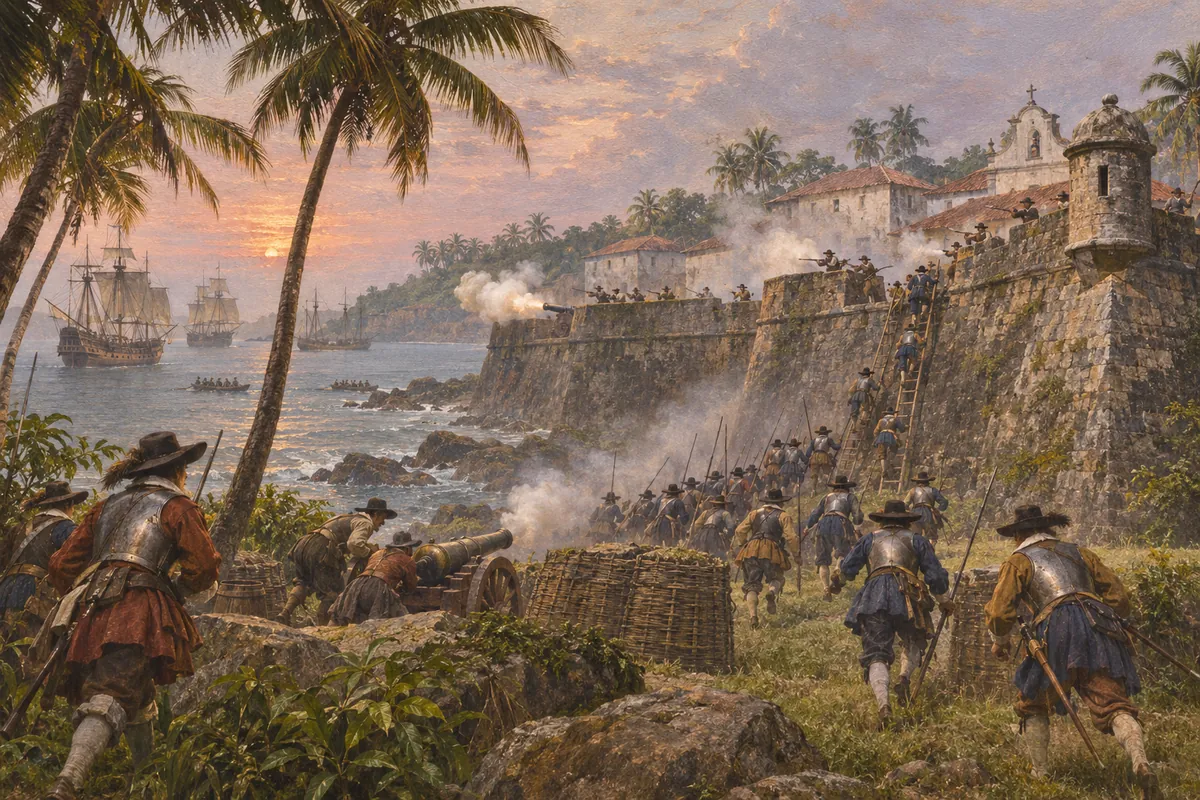
On 4 February 1640 a Dutch force under Philip Lucasz took Negombo. On 13 March Coster stormed Galle, which became the main Dutch base on the island for the next eighteen years. The Dutch kept both ports, linking their handover to the king's war debt under the 1638 treaty. Codrington notes that Coster was killed by Sinhalese on his way back to Batticaloa.
Galle, 1640
Dutch troops storm the Portuguese walls of Galle on 13 March 1640. The port gave the VOC its first secure base on the cinnamon coast.
1640: Portugal recovers
On 9 November 1640 Dom Filipe Mascarenhas retook Negombo for the Portuguese. In Europe, Portugal broke away from Spanish rule in December 1640 under John IV.
1641
Civil war broke out between Rajasinghe and his brother Vijayapala, who held part of the kingdom. Vijayapala lost and fled to the Portuguese, who sent him to Goa, where he died in 1654. Codrington dates the outbreak to 1641. In June 1642 the Portuguese blockaded Galle by land, and in February 1643 news arrived of a ten-year Dutch–Portuguese peace in Europe, though fighting over Galle's hinterland went on.
1644–1645: The truce
In January 1644 the Dutch retook Negombo but failed before Colombo. On 10 November 1644 an eight-year truce was signed, and its details were settled at Colombo on 10 January 1645. On 9 March 1645 the Dutch and Portuguese even agreed to protect each other against the Kandyans.
The fall of Portuguese Ceylon (1646–1658)
After a decade of uneasy truce and Kandyan–Dutch clashes, war resumed in 1652. Colombo fell in 1656 and Jaffna in 1658, but Kandy gained little of the coast.
1646–1647
Joan Maetsuycker replaced Jan Thyszoon as Dutch commander. In 1646 Kandyan forces destroyed a Dutch column under van der Stel and captured the Dutch garrison in the Seven Korales. An embassy sent to Kandy in 1647 achieved nothing.
1649–1652
A new treaty with Rajasinghe in 1649 dropped the Company's cinnamon monopoly, a concession to Kandy. Jacob van Kittensteyn replaced Maetsuycker in 1650. In 1652 the truce ran out and Dutch–Portuguese war resumed in Ceylon.
1653–1654
On 8 January 1653 the Portuguese commander Figueira defeated the Dutch at Anguruwatota. Francisco de Melo de Castro arrived as captain-general on 10 May 1653. From July 1653 to March 1654 the Portuguese blockaded the Dutch at Kalutara until it fell to them.
1655: Hulft arrives
In September 1655 Gerard Hulft reached Galle with a large fleet as Director-General. Kalutara surrendered to the Dutch on 14 October. A Portuguese field force of about 700 was nearly destroyed, and the survivors fell back into Colombo. Hulft camped on the rise now called Hulftsdorp.
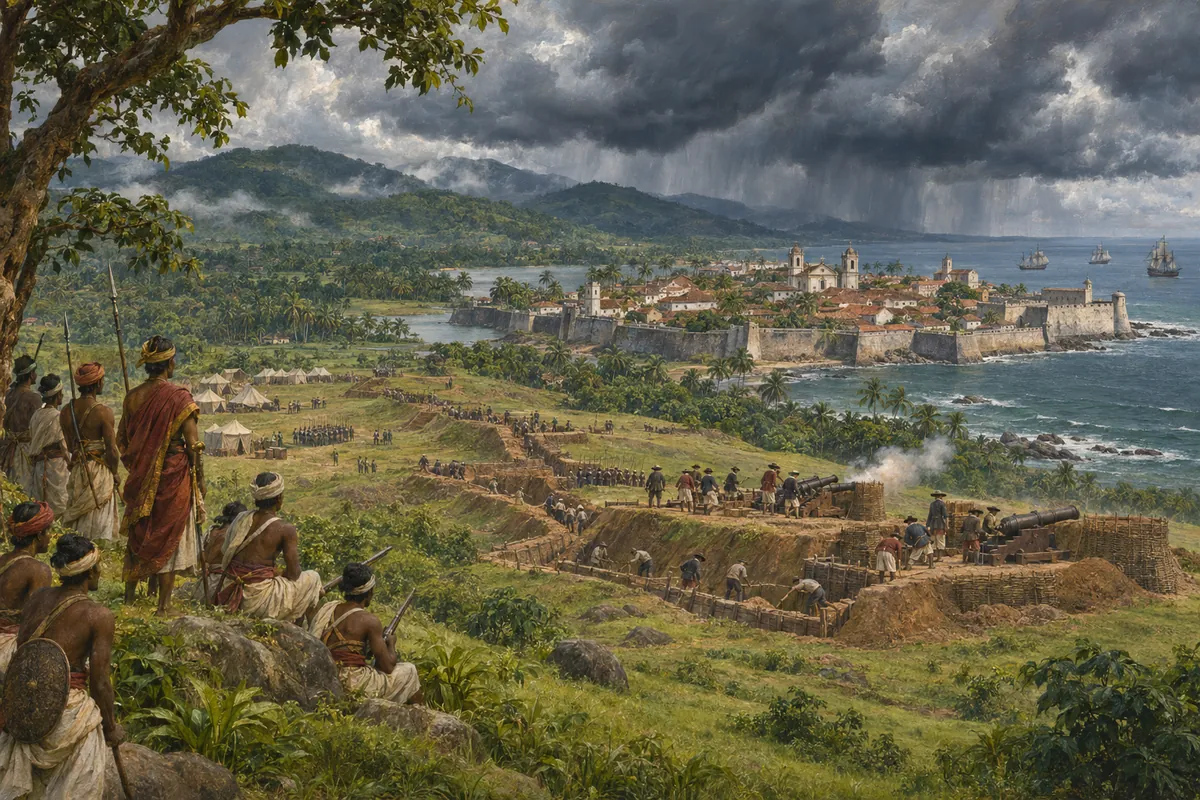
1655–1656: The siege of Colombo
R.L. Brohier puts the defenders at about 1,300 people, some 500 of them regular troops. Hulft chose to starve the city. Kandyan forces helped encircle it, while the Portuguese held out for months with fire-pots and firebrands. Hulft himself was killed on 10 April 1656.
1656: Colombo surrenders
On 7 May the Dutch took the bastion of São João at a cost of over 400 men. On 12 May 1656, short of food and powder, the Portuguese surrendered to Adriaan van der Meyden. Brohier records about 90 soldiers and 100 non-combatants marching out.
Siege of Colombo, 1656
Dutch siege lines surround Portuguese Colombo in 1656, with Kandyan troops in the hills behind. Hunger, not storming, decided the siege.
1656: The allies part
Rajasinghe wanted Colombo handed over or demolished. The Dutch shut the gates on his men and kept it.
1657–1658: Mannar
After blockading Goa in 1657, the Dutch sent Rijcklof van Goens, who reached Colombo on 1 January 1658. Van Goens's fleet reached the coast on 19 February 1658. After a naval fight, troops landed on 22 February and held Mannar island by the next morning. About 400 of its 700 Portuguese soldiers fled to Jaffna.
1658: The siege of Jaffna
The Dutch reached Jaffna on 7 March. The town fell by 18 March, and the fort was encircled. Nearly 6,000 people crowded inside; about 2,170 died of hunger and disease. Tristan Mostert's VOC study concludes the city was starved out.
Portuguese legacy and the historians
What did a century and a half of Portuguese presence leave behind, and who has told the story? The answers depend on where the teller stands.
How the Portuguese governed
Britannica notes that the Portuguese kept Kotte's administrative structure. The lowlands were divided into four provinces (dissavanis), each under a dissava. Portuguese officials held top posts while Sinhalese nobles filled local ones. Service tenure continued, and obligations once owed to the king now went to the Portuguese state.
Cinnamon, elephants and labour
Cinnamon and elephants were Portuguese monopolies, as were pepper and areca. Cinnamon was peeled under compulsory service by the Salagama caste. At Madampe, C.R. de Silva found output rising from about 20 bahars (1614) to 100–110 (1639), driven by pressure on Salagama workers and forced labour from other castes.
Catholic communities
Franciscans arrived in 1543, Jesuits worked in the north, and Dominicans and Augustinians came by the century's end. Many nobles converted after Dharmapala, often taking Portuguese surnames. Mass conversion took place on the coasts, especially in Jaffna, Mannar and the fishing communities north of Colombo. At Madampe, Jesuits reported 200 baptisms in 1613.
Fishing peoples and the Church
The Paravas (Bharathas in Sri Lanka) began converting in the 1530s in return for Portuguese protection; Francis Xavier's mission in the 1540s added thousands more. In 1544 Cankili I of Jaffna killed converts on Mannar. Karava and Mukkuva fishing communities also became Catholic.
Was conversion forced?
The question has divided historians.
War poems on both sides
Sinhala poetry carried the war into memory. The Sitawaka Hatana depicts the Portuguese as destroyers. The Kustantinu Hatana, celebrating a Portuguese victory, reflects the views of Christian converts loyal to Portugal.
Queyroz's Conquista
The Jesuit Fernão de Queyroz (1617–1688) completed his Conquista Temporal e Espiritual de Ceylão in Goa in 1687. It stayed unpublished until P.E. Pieris edited it in 1916; S.G. Perera's English translation followed in 1930.
Triumph and lament
Portuguese chroniclers such as Queyroz and Ribeiro wrote of the loss of Ceylon as a moral tragedy for a Christian empire. Early twentieth-century Sri Lankan writing turned this around.
Kandy as a symbol
In modern Sri Lankan writing, Danture, Randeniwela and Gannoruwa are often told as freedom struggles. A 2023 Sunday Times independence series called them the last stands of the Sinhalese.
The revisionists
Since the 1990s scholars have moved beyond heroes and villains.
Looking back: Kandy Against the Portuguese
Historians now see this era less as a simple contest of Sinhalese against Europeans and more as a many-sided struggle. Kandy, Jaffna, Portuguese, Dutch, Danes, South Indian Nayaks, Lascarin captains and converts all pursued their own aims. Kandy survived through Buddhist legitimacy, terrain and shrewd alliances, yet the Dutch, not Kandy, inherited the coast. Lasting Catholic communities and colonial land and labour systems remained.