 Fablewings
 › Sri Lankan history › Part 9
The Dutch Coast and the Kandyan Hills (1658–1796)
For almost 140 years Sri Lanka had two masters. The Dutch East India Company (VOC) held the coast, its forts and its cinnamon, while the kings of Kandy ruled the hills. The era saw Robert Knox's captivity, a Nayak dynasty from Madurai, a Buddhist revival with Siamese monks, a bitter war in the 1760s and, finally, a British takeover in 1795–96.
Read in the page-turning reader
The Company takes the coast (1658–1675)
By 1658 the Dutch had driven the Portuguese from the island. Rajasinha II of Kandy had invited them in as allies, but the Company meant to stay. These years set the pattern: Dutch forts on the shore, a suspicious king inland, and a long contest over land, trade and prestige.
1658: Mannar falls
In February 1658 a Dutch force under Rijckloff van Goens landed on Mannar island. According to the Sri Lankan Sunday Times, the island was in Dutch hands by 22 February, about four days after the landing. The Portuguese governor, Antonio de Amaral de Meneses, died in the fighting.
1658: Jaffna surrenders
The Dutch marched through the Vanni and besieged Jaffna by land and sea. Short of water, the defenders capitulated in June 1658, ending Portuguese rule on the island. Van Goens also took Tuticorin in India.
1658: Colombo becomes the capital
Galle had been the centre of Dutch power since its capture in March 1640. Once the Portuguese were gone, Colombo, taken in May 1656, became the seat of the Dutch governor and stayed so until 1796. Rajasinha II had been shut out of Colombo after its fall, and in November 1656, Codrington records, the Dutch drove him from its surroundings. The alliance was already broken.
How the Company ran the coast
Codrington describes the structure. A governor sat in Colombo, with a Disawa over the Colombo district and junior chiefs at Kalpitiya, Negombo and Kalutara. Galle and Jaffna each had a Commandeur. Dutchmen held these posts; below them, local headmen collected dues.
Courts and Roman-Dutch law
Codrington lists a Raad van Justitie (council of justice) at Colombo for criminal cases and appeals, a Landraad for local land disputes, and a Civiel Raad for small civil claims, with similar courts at Jaffna and Galle. Britannica notes that Dutch justice combined Roman-Dutch law with the island's customary law, and that most historians see this legal framework as the main Dutch legacy.
1659: the Anne is damaged
The English East India Company ship Anne, captained by Robert Knox senior with his son Robert aboard, was hit by a storm off Masulipatam on 19 November 1659 and had to cut away its mainmast. The crew were sent to Kottiyar Bay near Trincomalee to find timber for repairs. Kottiyar lay in territory claimed by Rajasinha II, not by the Dutch.
1660: Knox is taken
The Anne reached Kottiyar in February 1660. The National Trust of Sri Lanka says Captain Knox failed to send the customary gifts to the king. On 4 April the king's chief summoned him ashore. Father, son and fourteen crew were detained and marched inland.
1660–1661: Bandara Koswatte
On 16 September 1660 Knox and his father reached Bandara Koswatte, a village about thirty miles north of Kandy, and were given a hut without walls. Both caught malaria. The captain died on 9 February 1661; his son and a young servant buried him by the paddy fields. The younger Knox, about twenty, lived by knitting caps, buying thread for three pence and selling caps for nine.
Rajasinha II's foreign captives
Knox was one of many. Rajasinha II kept Portuguese, Dutch, English and French prisoners and envoys for years, often well treated but not free to leave.
1664: the Nilambe revolt
Shortly after midnight on 21 December 1664, five chiefs stormed Rajasinha's palace at Nilambe, killing guards and the First Adigar, Daldeniye Rala. The king escaped to Hanguranketa with about fifty followers. Order returned within a month and four ringleaders were executed. A fifth, Ambanvela Rala, was sent in chains to the Dutch in Colombo, who held him as a possible political card.
1665: the Dutch move inland
Codrington records that Rajasinha sought Dutch help during the revolt, and that the Company, under Governor Rijckloff van Goens (in office with gaps 1660–1675), occupied fifteen border districts in 1665, plus Trincomalee and Batticaloa. Arasaratnam shows annexation continuing for five years after the 1664 rebellion. The king kept his court at Hanguranketa.
1667–1675: ports shut, open war
The Company took Kalpitiya in 1667 and Kottiyar in 1668, then closed the ports of Kottiyar, Batticaloa and Kalpitiya, cutting Kandy off from overseas trade. Arasaratnam describes a largely indecisive war from 1670 lasting about seven years. Rajasinha could not take the forts, so he raided and emptied border lands, the method Britannica describes him using since the 1640s.
c. 1668: Knox at Eladetta
After moves in 1664 and 1666, Knox bought land around 1668 at Eladetta, about five miles north of Gampola, and built a house with fellow captives Roger Gould, Ralph Knight and Stephen Rutland. His shipmate John Loveland died there on 22 October 1670. Around 1673 Knox adopted a small girl named Lucea, and later left her property in his will.
1672: the French at Trincomalee
On 22 March 1672 a French fleet under Admiral de la Haye reached Trincomalee; the Dutch burned their small fort and withdrew. Rajasinha agreed to let the French fortify the harbour. After de la Haye left, the Dutch returned and the French garrison surrendered.
1672: Baldaeus describes Ceylon
In 1672 the Dutch Reformed minister Philippus Baldaeus published his description of Ceylon in Dutch. He had preached in Jaffna; a tamarind tree at Point Pedro under which he was said to have preached survived until a cyclone in 1964. With Knox and Fernão de Queyroz, whose Conquest of Ceylon was finished in 1687, he is a key European source for the century.
Old king, new king, and a book (1675–1707)
The last years of Rajasinha II brought war, then a slow return to peace. Knox escaped and published the first English book on the island. Under Vimaladharmasuriya II, Kandy and the Company reached a working compromise, and a Goan priest, Joseph Vaz, rebuilt the Catholic Church in secret.
1675–1677: rising and retreat
Rijckloff van Goens the Younger governed from 1675 to 1679. Codrington records a general rising and a Kandyan invasion of Dutch districts in 1675, and in 1677 an order from Batavia to return the districts taken in 1665.
1679–1680: Knox escapes
On 22 September 1679 Knox and Rutland left Eladetta disguised as pedlars, traded their way to Anuradhapura, then followed the Malvatu Oya through the forest. On 18 October they reached the Dutch fort of Arippu, south of Mannar, and Colombo on 2 November. Knox sailed via Batavia and docked at Greenwich on 6 September 1680, writing his account at sea.
1681: An Historical Relation
Knox's book appeared on 1 September 1681, printed by Richard Chiswell, printer to the Royal Society, and priced at ten shillings. The scientist Robert Hooke wrote a long preface and helped edit it; Sir Christopher Wren added a brief commendation. It was the first book about Ceylon in English. The East India Company paid Knox £20 in compensation.
Knox as a source
Historians still use Knox for Kandyan village life, farming, caste and law. But his book has limits.
1687: the death of Rajasinha II
In 1684 Rajasinha's forces seized the Hambantota salt pans. He died in late 1687 after a reign of about fifty-two years. His son succeeded peacefully as Vimaladharmasuriya II, and the Dutch recognised him.
1687: Joseph Vaz lands at Jaffna
In 1687 Joseph Vaz, a priest from Goa born on 21 April 1651 and a member of the Goa Oratory, reached Jaffna disguised as a labourer, according to the Archdiocese of Colombo and the Catholic Encyclopedia. Under the Dutch, Calvinism was the official faith and Catholic priests were banned. Vaz ministered secretly to Catholic families who had lost their priests.
1688: a new deal with Kandy
Vimaladharmasuriya II demanded free ports and the return of the districts taken in 1665. In 1688, Codrington records, the Company agreed and gave them up. The Dutch frontier settled along what later became the inland boundary of the Western and Southern Provinces. With short interruptions, this line held until the war of the 1760s.
1690s: Jaffna under the Company
The Commandement of Jaffnapatnam was a busy place. A census of 1692 counted about 200,000 people in some forty castes, according to historian K.D. Paranavitana, quoted by Scroll.in. The VOC taxed trade with south India, sold elephants from the Vanni to Indian rulers, and ran a seminary in Jaffna between 1690 and 1723.
1692–1696: Vaz in Kandy
In 1692 Vaz was imprisoned in Kandy, denounced as a Portuguese spy; the king later freed him, and Kandy became his base. Church sources say rain followed his prayers in a drought of 1696.
1694–1696: slaves to Jaffna
The VOC took part in the Indian Ocean slave trade. According to Scroll.in, citing VOC memoirs, about 3,589 enslaved people were shipped from Nagapattinam to Jaffna between 1694 and 1696. The Company charged customs duty on each import and a yearly poll tax on slaves. The Jaffna commandeur Hendrick Zwaardecroon later became Governor-General of the Dutch East Indies.
1697: monks from Arakan
In 1697 Vimaladharmasuriya II sent an embassy to Arakan in Burma, with Dutch transport. Thirty-three monks came to Kandy, and at Getambe thirty-three novices received higher ordination (upasampada). The Company also eased trade limits on goods other than cinnamon.
1701–1707: gates and ports
Relations worsened under Governor Gerrit de Heere (1697–1702). In 1701 the Kandyans closed their frontier gates; they reopened in 1703. That year the Company limited shipping passes to Colombo, Galle and Jaffna. In November 1707, Codrington records, it definitively closed Kandy's ports. Kandy held the cinnamon forests; the Dutch held the sea.
1707: the Thesawalamai
In 1707 the Dutch promulgated the Thesawalamai, the customary law of the Tamils of Jaffna. Britannica says a Dutch official spent three years collecting the customs, which leading Tamils revised. Codrington credits the compilation to Governor Cornelis Joan Simons.
Narendrasinha and the Nayak succession (1707–1747)
Vimaladharmasuriya II died on 4 June 1707. His son, born around 1690, became king at about seventeen as Sri Vira Parakrama Narendrasinha, the last of the old Sinhala line. He married princesses from Madurai, and after him a century of Nayak kings began, while the Company struggled with revolts, corrupt governors and cinnamon.
1708: Madurai brides
In 1708 Narendrasinha married a daughter of Pitti Nayakkar of Madurai, and in 1710 took another Madurai bride. In 1708, too, a stone at the new Hendala leper asylum near Colombo bore the monogram of Governor Hendrick Becker (1707–1716). The medical historian C. de F.W. Goonaratna notes that Becker found the building far too large and had part of it pulled down.
1709: a Portuguese adigar
In 1709 Narendrasinha made Pedro Dascon, a friend who had protected him in a conspiracy, his Second Adigar, one of the kingdom's highest offices.
1711: the death of Vaz
Joseph Vaz died in Kandy on 16 January 1711. By then, Church sources say, he and his fellow Oratorians had revived Catholic communities across the island. A process for his sainthood began in 1713. Pope John Paul II beatified him in Colombo in 1995, and Pope Francis canonised him on 14 January 2015 as Sri Lanka's first saint.
1715: a teacher executed
Weliwita Saranankara, born on 19 June 1698, had been ordained as a novice under Suriyagoda Rajaguru, a monk with royal favour. In 1715 Suriyagoda was executed for treason. Saranankara and his companions formed a strict group called the Silvat Samagama, living by monastic discipline at a time when many robed men, called ganinnanse, lived much like laymen.
1716–1723: Moors and Chetties
Under Governor Isaac Augustijn Rumpf (1716–1723), Muslim traders, the 'Moors of the Coast', tried to open a port north of Puttalam; the plan was blocked. Codrington notes that Moors and Chetties owed uliyam, compulsory labour, payable in cash, while Malays owed military service.
1723: the peelers revolt
In 1723 the cinnamon peelers revolted, Codrington records. Peeling was the hereditary service of the Salagama (Chalia) caste. Echelon describes peelers in gangs of fifty to sixty under an Arachchi, harvesting wild bark.
1726–1737: misrule and repair
Governor Petrus Vuyst (1726–1729) ruled so tyrannically, Codrington writes, that the Company arrested, tried and executed him. Under Jacob Christiaan Pielat and Diederik van Domburg, districts and peelers revolted again. Gustaaf Willem van Imhoff arrived in 1736 and restored order by the end of 1737. Echelon notes that he promoted coconut, coffee and pepper, a push the VOC halted in the 1750s because it interfered with cinnamon.
1739: Narendrasinha dies
Narendrasinha died on 13 May 1739 with no son by his queen. His son by a Sinhala noblewoman, Unambuwe Bandara, was passed over. Backed by the monk Saranankara, the crown went to the queen's brother, Sri Vijaya Rajasinha.
Was the Nayak dynasty 'foreign'?
Four Nayak kings ruled Kandy from 1739 to 1815. Gods' shrines were not new: Codrington dates the Kandy Maha Devale to 1731, under Narendrasinha.
The debate in modern Sri Lanka
The question is not only academic. Some nationalist writing treats the Nayaks, and especially the last king, as Tamil usurpers whose rule weakened Kandy.
1739: Sri Vijaya Rajasinha
The new king married a daughter of Narenappa Nayaka of Madurai and pressed hard to revive the Sangha. Codrington also records that churches were destroyed and Catholics persecuted under him. On the Dutch side, the Gospels were translated into Sinhala in 1739 and into Tamil in 1743, part of a Protestant mission among the coastal people.
1740–1742: ships and monks
On 20 June 1740, Codrington records, the Company granted a yacht for Kandyan embassies seeking monks; that year cinnamon shipments stopped. Urged by Saranankara, the king sent envoys to Siam and Pegu. A Daily News account says one mission was wrecked and another reached Siam via Batavia with only one envoy, Wilbawegedera. None brought monks back.
1743–1751: van Gollenesse
Governor Julius Valentijn Stein van Gollenesse (1743–1751) built Colombo's Wolvendaal Church, the main Dutch Reformed church on the island, and cut back the number of headman offices, according to Codrington. The Reformed Church was supported by church councils (kerkraad) at Colombo, Jaffna and Galle.
1747: Kirti Sri Rajasinha
Sri Vijaya Rajasinha died on 11 August 1747. His wife's brother, a young Nayak prince, succeeded as Kirti Sri Rajasinha. He ruled until 1782.
Kirti Sri: revival and war (1747–1766)
Kirti Sri Rajasinha restored higher ordination with Siamese monks, giving Lankan Buddhism the Siyam Nikaya. He then faced a plot at home and a full war with the Dutch, in which Kandy itself was captured. The treaty that ended it cost the kingdom its coast.
1750: the mission to Siam
On 1 August 1750 a royal embassy under Ellepola Mohottala left Trincomalee for Siam aboard a Dutch ship, carrying the king's letter. The request, made at Saranankara's urging, was for monks able to perform higher ordination. The Siamese king agreed and chose a party led by the monk Upali.
1753: Upali arrives
The Siamese party sailed on 21 January 1753 and reached Lanka on 13 May. In July, at Kandy, Upali and his colleagues ordained Saranankara and others. The king made Saranankara Sangharaja. The new lineage became the Siyam Nikaya, with Malwatta and Asgiriya chapters.
Ordination at Kandy, 1753
Siamese monks led by Upali restore higher ordination for Saranankara and his pupils, with King Kirti Sri Rajasinha watching. The revival created the Siyam Nikaya, still a leading Buddhist order today.
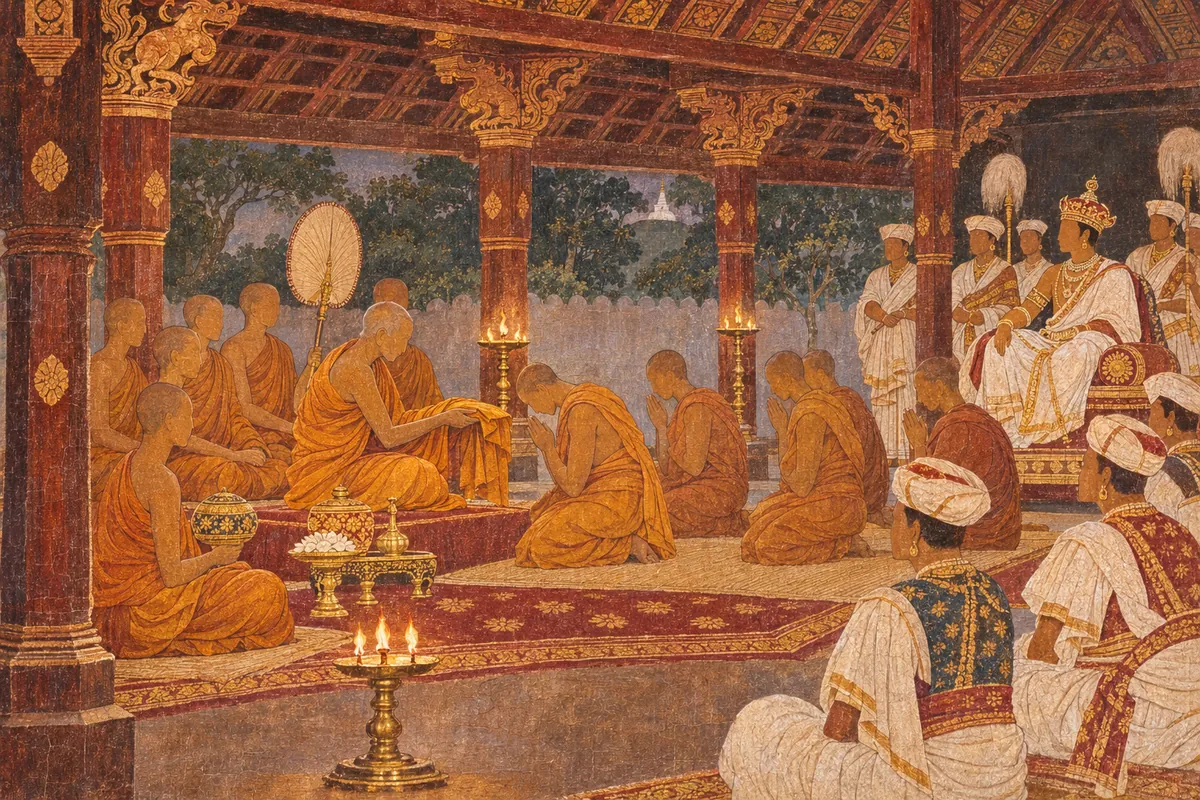
1753: what the revival meant
The revival renewed monastic discipline and learning in Kandy. It has been studied closely by Kitsiri Malalgoda and Anne Blackburn.
1753–1758: elephants and land
Codrington notes that pepper planting began in Dutch districts in 1753, and that Kandy demanded a share of the elephant trade, which the Company refused. Elephants were among its most profitable exports, sold to Indian rulers, Scroll.in reports. In 1758 Governor Jan Schreuder resolved to take over planted land in cinnamon areas, adding to agrarian grievances in the low country.
1760: plot and rising
In 1760 Kandyan nobles plotted to overthrow Kirti Sri and crown a Siamese prince. The plot was discovered, the lay leaders executed and the prince sent away with reluctant Dutch help. A violent rising also broke out in the Dutch low country.
1761–1763: Kandy strikes back
In 1761 Kirti Sri's forces attacked Dutch posts in the south, including Matara, Katuwana, Tangalle and Marakade, and took Hanwella near Colombo, according to Codrington and reference works. Dutch counter-attacks failed. A Dutch column sent into the hills in 1763 also failed, Codrington writes, defeated by Kandyan guerrilla tactics.
1762: Pybus and van Eck
In 1762 John Pybus of the English East India Company at Madras visited Kirti Sri, but no alliance followed. A new Dutch governor, Lubbert Jan van Eck, arrived, built the Star Fort at Matara and took Chilaw and Puttalam.
1764: caste and ordination
In 1764 a group within the Siyam Nikaya restricted higher ordination to men of the Govigama caste. The last non-Govigama monk so ordained was Sitinamaluwe Dhammajoti, of the Durava caste.
1765: Kandy captured
Early in 1765 van Eck marched again. He reached Katugastota on 16 February and occupied Kandy on 19 February; Kirti Sri withdrew to Hanguranketa. Van Eck left on 4 March and died in Colombo on 1 April. The garrison he left behind was besieged and, Codrington says, fought its way out later in 1765. Iman Willem Falck became governor that year.
1766: the Treaty
On 14 February 1766 Kandy and the Company made peace. The king recognised full Dutch sovereignty over their lands and ceded the remaining coastal strip. Kandy was cut off from the sea. Cinnamon peeling in Kandyan forests was regulated.
Company, coast and communities (1766–1794)
After 1766 the Company ruled the whole coast. Under Governor Falck it began planting cinnamon instead of relying on Kandy's forests, and it ran schools, churches and village registers. Meanwhile Britain and France fought around Trincomalee, and Kandy began looking for new friends.
1767–1769: Falck's plantations
In 1767 the government tried to reclaim the Muturajawela marsh near Negombo for rice. In 1769 Governor Falck grew cinnamon from seed in his garden at Grandpass, then ordered headmen, including his cousin Cornelis de Cock, Disawa of Colombo, to start plantations. Codrington places a trial at Maradana. Salagama peelers still worked under compulsory service.
Tombos and schools
Codrington describes a Scholarchal Commission that supervised schools and local marriages and appointed schoolmasters and tombo-holders, keepers of the tombos, registers of land and people. In 1788 there were 55 schools between Kalpitiya and Bentota; a 1789 census counted 817,000 inhabitants.
Church and Catholics
The Dutch Reformed Church was the official faith, and Catholic worship was banned for much of the era. Bible translation went on: the Tamil New Testament in 1759, the Sinhala New Testament between 1771 and 1780, the Tamil Pentateuch in 1790.
Who were the Burghers?
Dutch rule produced the Burgher community, a name usually explained as the Dutch for a town citizen. Most descended from VOC employees and European settlers, many of whom married local or Eurasian women.
1778: Saranankara dies
Weliwita Saranankara died on 18 July 1778, aged about eighty, at a forest hermitage near Hantana. He had written works in Sinhala and Pali, including the Muni Guna Alankaraya and the Satara Banavara Sannaya. He is remembered as the restorer of the Sangha, despite his apparent role in the 1760 plot.
1782: Kirti Sri dies
Kirti Sri Rajasinha died on 2 January 1782 after a fall from his horse. His brother succeeded as Rajadhi Rajasinha (1782–1798), a scholar fluent in Pali and Sanskrit. That year Lord Macartney, Governor of Madras, sent Hugh Boyd to Kandy seeking help against the Dutch; the king would not negotiate, reportedly because Boyd's credentials came from Madras, not King George III.
1782: Hughes takes Trincomalee
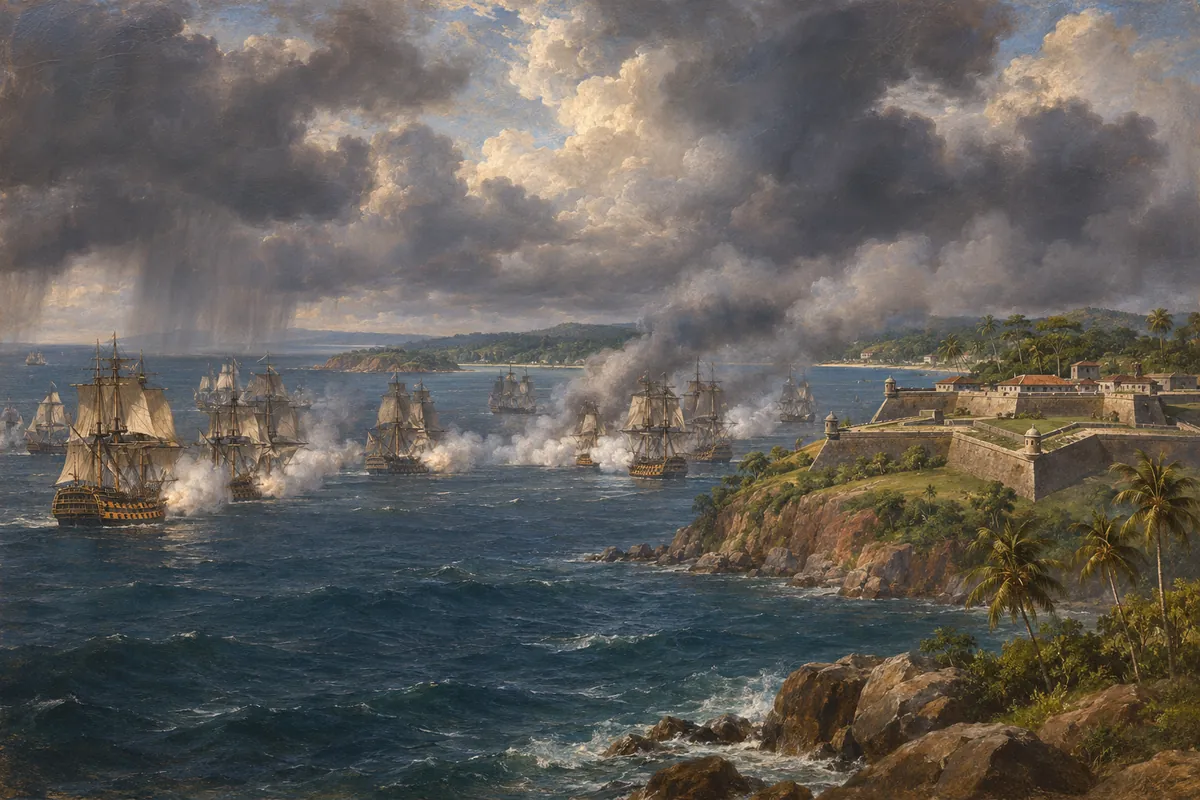
Britain was at war with the Dutch Republic, then allied with France during the American War of Independence. On 11 January 1782 Admiral Sir Edward Hughes captured Trincomalee from the VOC. Hughes and the French admiral Suffren then fought indecisive battles off Sadras (17 February), Providien near Trincomalee (12 April) and Negapatam (6 July; Codrington gives 4 July).
1782: Suffren retakes it
On 25 August 1782 Suffren reappeared and landed about 2,400 French troops. The British garrison surrendered within days. Hughes arrived too late and fought Suffren offshore in September. Kandy sent officials, men and physicians to help the French.
Trincomalee, 1782
British and French warships trade fire off Trincomalee's great harbour, with the Dutch fort on the headland. Fought over three times in 1782 and 1795, the port drew Britain into Sri Lankan affairs.
1785–1792: Kandy and France
Falck died on 5 February 1785; Willem Jacob van de Graaff succeeded. In 1791 Kandy mobilised and the Dutch reinforced the frontier. The adigar Pilimatalawe leaked information that led to the interception of a royal letter seeking French help. In 1792 Batavia stopped van de Graaff's plans for war.
1793–1794: cinnamon at home
From 1793, Codrington writes, the Company made a serious effort to free itself from the king's cinnamon. Echelon notes that van de Graaff leased plantation lots to smallholders, and that by 1794 plantations and private land produced about 5,000 bales, roughly 200 tonnes, enough to stop harvesting in Kandyan forests. In 1794 Johan Gerard van Angelbeek became governor.
The fall of Dutch Ceylon (1794–1796)
In the winter of 1794–95 French armies overran the Netherlands; the Stadtholder William V fled to England in January 1795 and the Batavian Republic was proclaimed. In February he wrote from Kew telling Dutch colonies to accept British protection. On 30 March, at Neuchâtel, Hugh Cleghorn agreed terms with Count de Meuron to bring his Swiss regiment, part of Colombo's garrison, into British service.
1795: Trincomalee falls
In July Lord Hobart, Governor of Madras, invited van Angelbeek to hand over the colony. British troops under Colonel James Stuart landed north of Trincomalee in early August. After a bombardment the forts fell in late August; 679 men became prisoners.
1795: the coast collapses
Batticaloa surrendered on 18 September 1795. Jaffna gave in to Stuart on 27 or 28 September without serious resistance. Mullaitivu fell on 1 October and Mannar on 5 October. In October the Colombo government resolved to resist to the end with 1,617 men, 845 European and 772 Malay. On 13 October de Meuron's regiment left Dutch service.
1796: Colombo surrenders
British troops landed at Negombo on 5 February 1796, crossed the Kelani River and reached Colombo. Van Angelbeek agreed to capitulate on 15 February. The terms did not oblige Britain to return the island.
Bridge: 1798 and beyond
Rajadhi Rajasinha died on 26 July 1798 without naming an heir. Set on the throne by the First Adigar Pilimatalawe, his teenage nephew was crowned as Sri Vikrama Rajasinha, the last king of Kandy. Van Angelbeek stayed in British Colombo and died there on 2 September 1799. The next era follows Kandy's struggle with its new British neighbour.
How the VOC era is remembered
Memories differ. Britannica says most historians see the Dutch legal system, including the codified Thesawalamai, as the main Dutch legacy.
Looking back: The Dutch Coast and the Kandyan Hills
Historians now see this era less as simple colonial rule and more as a long negotiation. The VOC held the sea and the coast but depended on Kandy's cinnamon and on local headmen. Kandy, often called isolated, had a cosmopolitan court, and its Nayak kings led a Buddhist revival. The British inherited a divided island whose two halves would soon collide.