 Fablewings
 › Sri Lankan history › Part 10
The British Take the Island (1796–1848)
In half a century Britain went from holding a few Dutch forts on the coast to ruling the whole island. The Kandyan kingdom fell in 1815, a great rising was crushed in 1818, and the reforms of 1833 joined the island under one government. Coffee, roads, new land laws and migrant labour then remade the hill country, and a peasant revolt in 1848 showed the cost.
Read in the page-turning reader
Company rule on the coast (1795–1802)
Britain first came to the island as an Indian power. Troops and officials of the East India Company, sent from Madras, took the Dutch coastal territories during the wars with Revolutionary France, and at first ran them as an outpost of their Indian empire.
1795–1796
While the Netherlands was under French control, British forces from Madras besieged Trincomalee, which surrendered on 26 August 1795; Fort Oostenburg fell days later. Jaffna and other posts followed, and on 16 February 1796 the British took over Colombo. The Kandyan kingdom stayed independent, but it had swapped one European neighbour on the coast for another, far stronger one.
1796: Madras men in charge
The territories were run by Madras civil servants under Lord Hobart, Governor of Madras. Robert Andrews, Superintendent of Revenue, brought in Madras methods. Indian revenue agents, amildars, took over work long done by local headmen, the mudaliyars. A new tax on coconut trees, from late 1796, added to the anger.
1797: revolt and the de Meuron inquiry
A general revolt broke out on the coast in 1797. The coconut tax was suspended. A commission under Pierre-Frédéric de Meuron, whose Swiss regiment had served the Dutch in Colombo before changing sides, advised restoring the headmen and using Dutch officials. Hobart agreed, and the trouble eased.
1798: Frederick North arrives
Frederick North arrived in October 1798 as the first Governor. A royal commission placed the settlements under the Crown, but Crown and Company shared control, an awkward 'dual' system. North kept many Dutch officials; according to a 2024 Sunday Observer account, the post office took 26 Dutch recruits and the survey department 17, though top posts went to Britons.
1798: a new king in Kandy
King Rajadhi Rajasinha died in 1798. The first Adigar (chief minister), Pilimatalawe, placed a young prince, Kannasamy, on the throne as Sri Vikrama Rajasinha. A rival had a stronger claim; historians suggest Pilimatalawe wanted a dependent king.
The Nayakkar kings
Sri Vikrama Rajasinha was the fourth and last king of the Nayakkar line, whose forebears came from Madurai in South India. The dynasty had ruled Kandy for nearly a century as Buddhist kings. Tamil was a court language.
1802: a Crown Colony
From 1 January 1802 the coast ceased to be Company territory and became a Crown Colony, ruled from London through a Governor. In March 1802 the Treaty of Amiens with France formally ceded the Dutch possessions to Britain.
North's war with Kandy (1802–1805)
North wanted a road from Trincomalee to Kandy and a British garrison in the Kandyan capital. The king refused. Within a year a trade dispute gave the Governor his reason for war, and the result was the worst British defeat on the island.
1802: the areca nut convoy
In April 1802 Kandyan officers seized a convoy of areca nut at Puttalam owned by merchants under British protection. North demanded compensation and used the incident to justify war.
1803: the invasion
On 31 January 1803 North's forces invaded. A Colombo division under Major-General Hay MacDowall and a Trincomalee division under Colonel Barbut marched inland. The king set fire to Kandy and withdrew. The British found the capital empty and crowned Muttusamy, a rival prince North favoured, as a puppet king.
June 1803: Davie's garrison
Davie was ordered to leave Kandy but had no transport for the sick. On 23 June Pilimatalawe warned him an attack was coming. Fighting on 26 June spread across Watapuluwa, Nittawela and nearby villages. Davie raised a flag of truce and agreed terms that let him march for Trincomalee with his fit men and Muttusamy.
June 1803: the Mahaweli crossing
At the Paranaganthota ferry the Mahaweli was in flood and the promised boats never came. The Kandyans demanded Muttusamy; Davie handed him over and he was beheaded. Still no boats arrived. The troops tried to build bamboo rafts, then fell back and were killed. Sick men left in the Kandy hospital were also put to death.
The survivors and Davie's fate
Corporal George Barnsley is said to have feigned death, escaped and reported what happened. Davie was taken to the king and kept in Kandy for the rest of his life. A road near the river long bore his name before being renamed Paranaganthota.
Was it a massacre?
British writers long called the killing a massacre and a breach of faith. In 2024 S. Herath counted 3,387 troops sent into the kingdom and 1,091 dead between January and June 1803, and judged the word justified.
1805: an unfinished war
Later in the war Kandyan forces reached Hanwella, near Colombo, before British firepower drove them back. In 1805 they took Katuwana in the south. On 19 July 1805 Sir Thomas Maitland replaced North. No peace treaty was signed; the fighting simply stopped.
Maitland, Brownrigg and Kandy's last years (1805–1814)
Between 1805 and 1814 the coast was reorganised and the Kandyan court tore itself apart. A suspicious king, ambitious chiefs and a British intelligence network in Colombo all played parts. The sources for these years are mostly British, which shapes what we know.
1810: D'Oyly's diaries
John D'Oyly, who had arrived in 1801 and learned Sinhala from the monk Karatota Dhammarama, became chief translator and intelligence chief. His diaries of 1810–1815 record agents inside the kingdom: mudaliyars, provincial governors, Muslim traders and monks.
1811: Pilimatalawe's fall
Pilimatalawe was found plotting against the king and beheaded. His nephew Ehelepola succeeded him as first Adigar. On the coast, a new Charter of Justice extended jury trial to all British subjects.
1812: Brownrigg arrives
Sir Robert Brownrigg took office as Governor on 11 March 1812, and the island's first botanic garden was set up that year. In Kandy the king was completing major works: the lake, the octagonal Pattirippuwa beside the Temple of the Tooth and other buildings. Obeyesekere describes this as the completion of a 'cosmic city'.
1814: Ehelepola breaks with the king
Ehelepola, governor of Sabaragamuwa, was sent to deal with unrest there but would not return to Kandy when summoned. He sought British support to depose the king. Brownrigg refused open help. In May 1814 Ehelepola fled into British territory and placed himself under British protection.
1814: the killing of Ehelepola's family
On 17 May 1814, by most accounts, the king had Ehelepola's wife and children put to death, along with his brother and others. The usual story says the children were beheaded and their mother drowned in the Bogambara lake. Many Sabaragamuwa chiefs were also reportedly executed. The killings turned many nobles against the king.
The Ehelepola story: who says what
This is one of the most debated episodes in Sri Lankan history, because it was used to justify the British conquest.
Was it propaganda?
Obeyesekere notes that Sinhala texts such as the Ahelepola Varnanava call the king a heretic yet barely mention the family's death. He argues treason was punishable by death under the law of the time.
November 1814: the merchants
In November 1814 ten traders from British territory were seized in the Three Korales and accused of spying. According to Codrington, they were mutilated; seven died on the spot and the survivors were sent on to Colombo. Brownrigg treated this as an outrage against British subjects.
The fall of Kandy (1815–1816)
The 1815 campaign took weeks, not years. Leading chiefs changed sides, the king fled, and on 2 March the chiefs and the Governor agreed terms that ended the kingdom's independence. Ever since, people have argued over who really gave Kandy away.
January–February 1815: the advance
Kandyan troops crossed the border hunting Ehelepola's supporters and attacked a British post at Sitawaka. On 10 January 1815 the first clash took place and war was declared the same day. British columns marched inland with Ehelepola. Molligoda and other chiefs went over to them, and resistance collapsed.
February 1815: Kandy entered
British forces entered Kandy almost unopposed. Codrington gives 14 February 1815; a widely used summary gives 10 February. The king had already fled into the hills near Medamahanuwara with his queens and his mother.
18 February 1815: the king captured
On the night of 18 February an armed party of Ehelepola's followers, led by Ekneligoda Disava and accompanied by a British officer, found the king near Medamahanuwara. According to the Sunday Times account, his own subjects bound him with ropes and led him to a nearby village. He was then held by the British.
2 March 1815: the Kandyan Convention
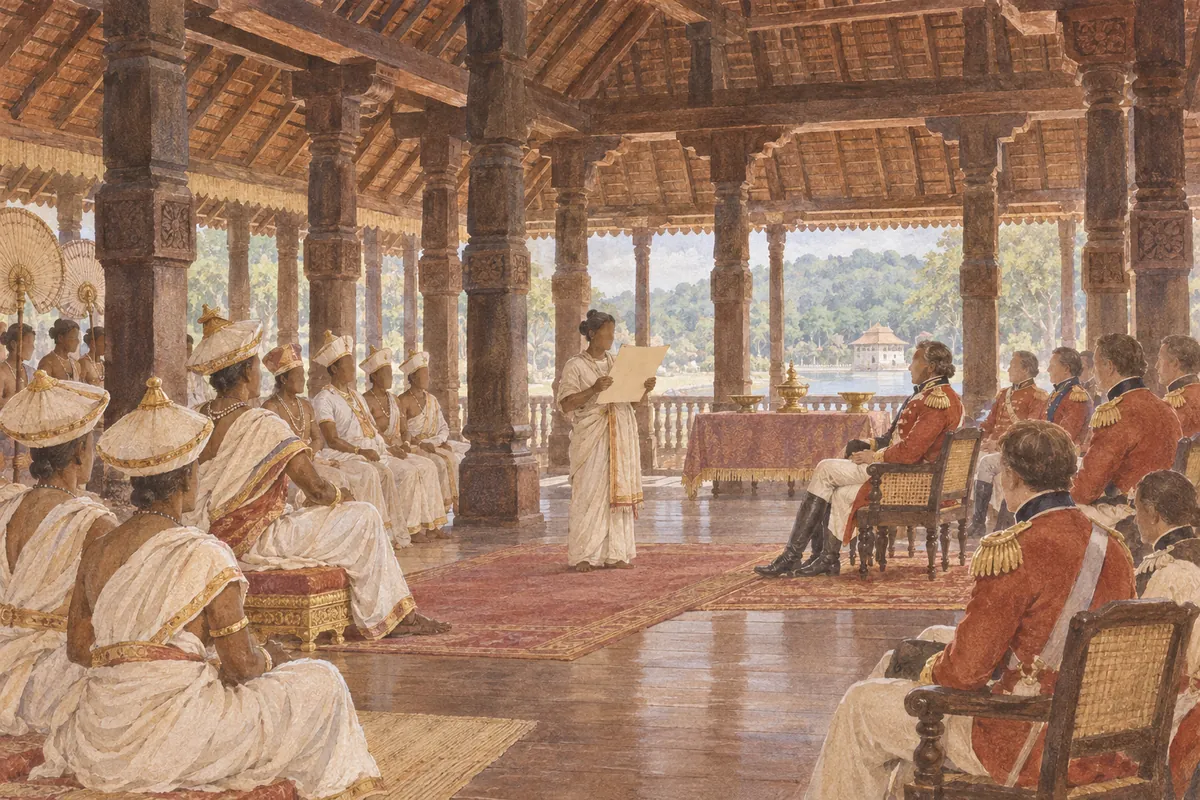
At about 3.30 pm on 2 March, in the Magul Maduwa, the royal audience hall, the agreement was read out. James Sutherland read the English text, and Mudaliyar Abraham de Saram the Sinhala. The British flag was raised and a royal salute fired for George III.
What the Convention said
The king was declared to have forfeited the throne and his dynasty was excluded for ever. Sovereignty passed to the British Crown. The chiefs kept their ranks and powers, Kandyan law and custom would continue, and only the Governor could order death sentences.
The Buddhism clause
The fifth clause declared the religion of Buddhism 'inviolable', and promised that its rites, ministers and places of worship would be maintained and protected. For Kandyans this was the heart of the deal: the British would take the king's place as protector of the Sasana and the Tooth Relic.
Who signed
Brownrigg signed for Britain, with D'Oyly, who drafted the text, and Sutherland. The Kandyan signatories, as usually printed, were the two Molligodas, the two Pilimatalawes, Monarawila, Ratwatte, Dullewe, Millewe, Galagama and Galagoda; some signed in Tamil script. Ehelepola is not on the usual list.
The 'Malabar' clause and other readings
The Convention called the deposed king 'Malabar', a period word for Tamil, and barred his relatives. K.T. Rajasingham reads this as a Sinhala chiefs' ploy, with British approval, against Tamils in Kandyan affairs.
The flag story
A famous story says the monk Wariyapola Sri Sumangala pulled down the Union Jack and trampled it, insisting the Kandyan flag fly until the Convention was signed.
1816: exile to Vellore
On 24 or 25 January 1816 the king, his queens and relatives sailed on HMS Cornwallis for Madras. From there he went by palanquin and slow marches to Vellore fort, where he lived in the 'Kandy Mahal' on a British allowance. He would never return.
Picture: the Magul Maduwa
The royal audience hall in Kandy, where the Convention was read on 2 March 1815. British officers, Kandyan chiefs and interpreters gathered here as the kingdom's independence ended.
The Great Rebellion (1817–1818)
Less than three years after the Convention, much of the Kandyan country rose against British rule. It began in Uva and Wellassa, spread across the hills and was put down with great brutality. It is now remembered in Sri Lanka as a war of independence.
1817: causes
Chiefs found British officials ignoring them and monks felt slighted. In September 1817 the Governor, on D'Oyly's advice, appointed Haji Marikkar, a Muslim from Wellassa, as Madige Muhandiram. Local chiefs saw this as a breach of their customary rights. Badulla chiefs protested.
1817: the pretender
Major Sylvester Wilson, Assistant Resident at Badulla, heard that a claimant to the throne had appeared in Wellassa. He sent Haji Marikkar to investigate. Marikkar was seized and killed on 26 September. The claimant, called Doresamy, was really Wilbawe, a former monk with no link to the royal family.
16 October 1817: Wilson killed
Wilson rode out with Malay soldiers to negotiate. Near Bibile he and a servant were killed by arrows, and the rising is usually dated from this moment. On 30 October Brownrigg sent Colonel Kelly to Badulla with 271 European and 456 Asian troops.
Keppetipola changes sides
The British sent Keppetipola, Disava of Uva, to restore order. Instead he sent his men home, handed back the British arms and joined the rebels. He became the rising's military leader. Wilbawe was proclaimed king, and the revolt spread through Uva, Wellassa and beyond.
Early 1818: the rising spreads
In February 1818 Keppetipola led five to six thousand men against Fort MacDonald at Paranagama, besieging it into March. The British abandoned most posts in Uva and Wellassa. Martial law, first proclaimed in Uva, was extended across the Kandyan provinces in early 1818. Ehelepola himself was arrested on suspicion; he was later exiled to Mauritius, where he died in 1829.
Scorched earth
Brownrigg set up his headquarters in Kandy and asked Madras for reinforcements. His troops killed cattle, burned rice fields and villages, destroyed salt stocks and seized rebels' property. Fort MacDonald's commander was accused of torture and summary hangings. London's Lord Bathurst had suggested pulling back to the coast; Brownrigg refused.
How many died?
No reliable count exists. Estimates for Kandyan deaths, from fighting, famine and disease, are commonly put at around 10,000, though none rests on a firm count. British losses came mostly from sickness.
October–November 1818: the end
With supplies gone and leaders split, the rising collapsed. Keppetipola, ill, was captured near Nuwara Kalaviya around 28–30 October. The chief Madugalle was taken on 1 November. On 26 November both were beheaded at Bogambara in Kandy. Others were executed or exiled to Mauritius.
1818: the proclamation and the gazette
Brownrigg's proclamation of 10 January 1818 named Keppetipola and 18 other leaders as traitors and outlaws, and their property was confiscated. Confiscated lands and broken chiefly families were the lasting result, and the Convention's promises to the chiefs counted for less from then on.
Roads, reform and one government (1820–1833)
After 1818 the British set out to make sure the hills could never again be lost. Military roads came first. Then a royal commission from London took the whole system apart and rebuilt it, laying foundations that lasted a century.
1825: the Colombo–Kandy road
The Colombo–Kandy road was finished in 1825, cutting the journey to a few days. Built for soldiers under Governor Sir Edward Barnes, it would soon carry coffee. Barnes himself took up coffee, with an estate at Gannoruwa, near today's Peradeniya.
1824–1827: coffee and the first labourers
In 1824 George Bird, with Barnes's backing, opened a coffee estate at Sinhapitiya near Gampola, usually called the first in the hill country. Bird later recruited labourers from Tirunelveli, Tiruchi, Madurai and Tanjore in South India. They landed at Mannar, walked to camps at Matale for quarantine and vaccination, and then went to the estates.
1829: the Commission of Eastern Inquiry
Spending had outrun revenue, partly because the coast and Kandy were run as separate systems. In 1829 London sent William Colebrooke to investigate, with William Mackenzie, and Charles Hay Cameron joined in 1830 to study the courts. Governor Barnes opposed the inquiry.
1832: the king dies at Vellore
On 30 January 1832 Sri Vikrama Rajasinha died at Vellore of dropsy, aged 52, after seventeen years in captivity. He was cremated by the Palar river. His only son died childless in the early 1840s. Descendants long drew a British, then Indian, pension.
1832: the end of rajakariya
An order-in-council of 12 April 1832 abolished rajakariya, the compulsory service owed for land, for native and Indian subjects. London overruled local officials who wanted to keep it. A law barring Moors and Chettiars from owning land in Colombo was repealed in May.
1833: the Colebrooke–Cameron reforms
Letters patent of March 1833 created an Executive Council to advise the Governor and a Legislative Council to make laws. The island's separate low-country, Kandyan and Tamil systems were replaced by one administration over five provinces. Government monopolies, including cinnamon, were ended.
1833: courts and councils
Cameron's Charter of Justice, dated 31 August 1833, created a Supreme Court and one legal system for all. The Legislative Council first met on 1 October 1833, with only officials present. Its six unofficial seats, filled later, went to three Europeans and three Ceylonese: a low-country Sinhalese, a Burgher and a Tamil.
Coffee, land and missions (1834–1847)
In the 1830s and 1840s coffee transformed the hill country. Forests fell, planters arrived from Britain, and the government claimed vast areas as Crown land. Missionary schools and English education spread, and South Indian labourers began their long journey to the estates.
Missions in the north
Baptist missionaries arrived in 1812, Wesleyans in 1814 and the Church Missionary Society in 1818. An American, Samuel Newell, came in 1813; the main American party landed in 1816, when Edward Warren opened a school at Tellippalai. The mission set up Jaffna's first press in 1820, Batticotta Seminary in 1823 and Uduvil girls' school in 1824.
Why coffee boomed
The abolition of slavery in the British West Indies in the 1830s cut coffee output there. Demand turned to Ceylon. British investors and officials bought hill land. Native smallholders, too, grew a large share of the crop, perhaps a quarter of total output, and Jeronis de Soysa became a major Sri Lankan planter.
1840: the Crown Lands Ordinance
Ordinance No. 12 of 1840, the Crown Lands (Encroachments) Ordinance, presumed that forest, waste, unoccupied and uncultivated land belonged to the Crown unless someone proved otherwise. In the Kandyan provinces this included chena land, cultivated in rotation and left fallow for years.
1840: proving title
To keep such land a villager needed a royal grant (sannas) or proof of customary taxes, dues or services rendered within twenty years. Few had such papers. Crown land was sold to planters at a minimum of five shillings an acre, raised to £1 in 1844, and large areas of hill forest were cleared.
South Indian labour
Kandyan villagers largely refused estate work on harsh terms, so planters turned to South India. Recruiters brought workers to Mannar, from where they walked inland. Many died in their first months. Workers were bonded, underpaid and cut off from wider island society.
1847: Torrington and Tennent
Colonial Secretary James Emerson Tennent proposed moving from export duties to direct taxes. Earl Grey, the Secretary of State, agreed. The coffee duty was abolished and cinnamon duty cut. Viscount Torrington, a well-connected Whig peer new to colonial rule, became Governor on 29 May 1847.
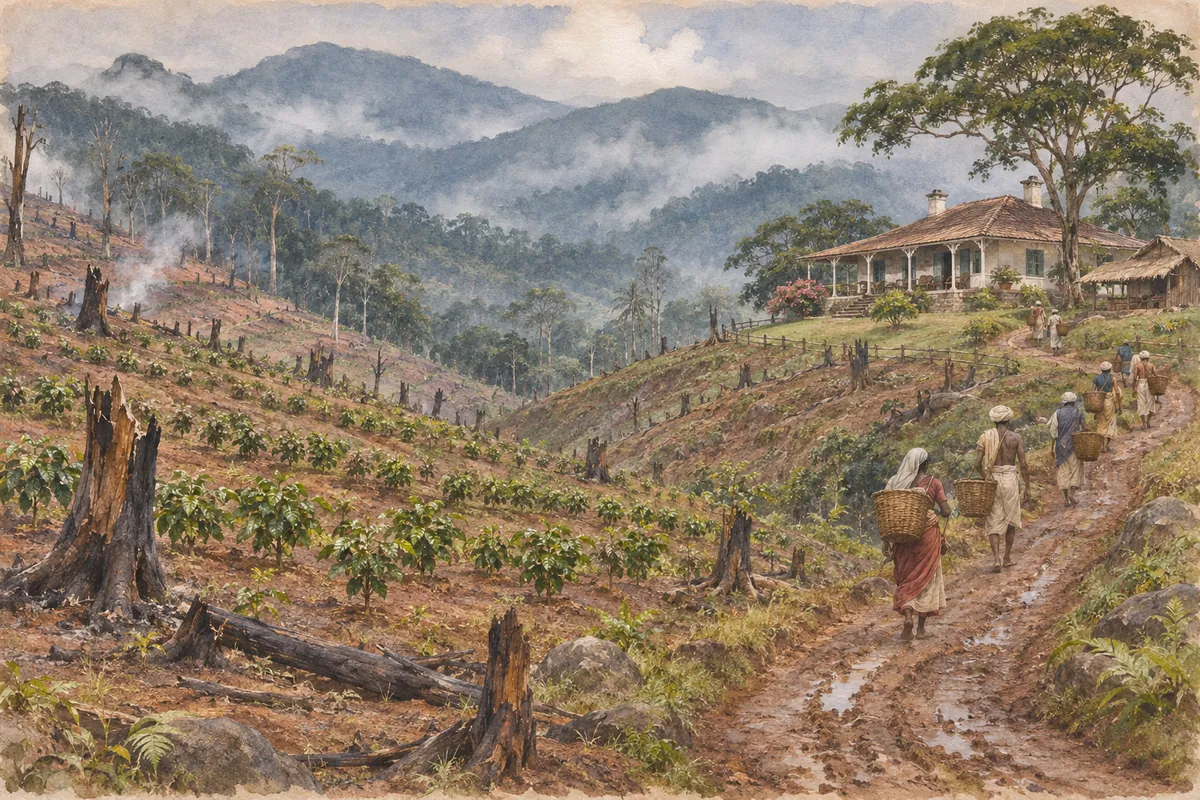
Picture: a coffee estate
Hillside forest cleared for coffee in the Kandyan country, 1840s. Roads built for soldiers now carried coffee to Colombo, and South Indian labourers worked the new estates.
The 1848 rebellion
The new taxes came into force on 1 July 1848. Within a month the Kandyan districts were in revolt. The rising was small and soon over, but the government's response caused a scandal that reached the House of Commons and ended a governor's career.
July 1848: the new taxes
From 1 July 1848 people paid taxes on guns, dogs, shops and carts. Road Ordinance No. 8 of 1848 made men aged 18 to 55 work six days a year on roads or pay instead.
6 July 1848: the crowd at Kandy
A large, unarmed crowd gathered before the Kandy kachcheri to present petitions to the Government Agent, Buller, demanding the taxes be withdrawn. Torrington's own letter put it at about 3,000; a Sunday Observer account says 5,000. A British record notes Gongalegoda Banda was present.
Who led the rising?
Leadership came from ordinary men, not the great chiefs broken in 1818. Gongalegoda Banda, born Wansapurna Dewage David in 1809, had worked for the colonial police. Puran Appu, born Francisco Fernando near Moratuwa in 1812, was a low-country outlaw with a following in Uva.
26 July 1848: a king at Dambulla
Rebel leaders met at the Dambulla cave temple. The monk Giranegama Thera crowned Gongalegoda Banda king. His brother Dines was made sub-king; Dingirala led in the Seven Korales; Puran Appu became chief minister and sword-bearer. Accounts of the crowd range from about 400 to 4,000.
28–29 July 1848: Matale sacked
Rebels marched on Matale, attacked the kachcheri, the jail and other government buildings, and destroyed tax records. Some sources say Puran Appu's followers hailed him as king there. On 29 July Torrington declared martial law in Kandy.
29–31 July 1848: Wariyapola and Kurunegala
British troops met a large rebel force near Wariyapola and opened fire. A Sunday Observer account says about 50 were killed and many wounded, with one British soldier hurt. On 31 July about 4,000 people attacked Kurunegala; by one account at least 200 rebels died. Martial law was extended there that day. Sources disagree on whether Wariyapola came before or after Kurunegala.
8 August 1848: Puran Appu shot
Puran Appu was captured, tried by court martial for waging war against the Queen and shot by firing squad by the Bogambara lake on 8 August. In a later letter Torrington recorded his last words, that a few more men as bold as he might have taken Kandy.
August–October 1848: martial law
Martial law lasted until 10 October. Courts martial sentenced eighteen people to death. Others were flogged, jailed, transported or had property seized. The monk Kadahapola (Kudapola) Unnanse was shot in his robes, an act widely condemned. Chief Justice Sir Anthony Oliphant clashed with Torrington, urging mercy.
21 September 1848: Banda captured
Gongalegoda Banda hid in a cave at Elkaduwa. The government offered a reward for him; National Archives records show £100, though some accounts say £150. On 21 September Malay soldiers of the Ceylon Rifle Regiment arrested him after a struggle and took him to Kandy.
November–December 1848: trial
His trial for high treason opened in the Supreme Court at Kandy on 27 November. He pleaded guilty and was sentenced to hang on 1 January 1849. A proclamation of 29 December commuted this to 100 lashes and transportation. Torrington argued exile for life would deter rebels more than death.
1849–1850: the inquiry in London
Critics complained of Torrington's severity. A House of Commons Select Committee examined the affair in 1849 and 1850. Captain Albert Watson, accused of brutality at Matale, was criticised by a commission but cleared by a court martial.
1850: Torrington recalled
Torrington left the island on 8 October 1850, recalled after the inquiry and the publication of his private letters. The affair fed opposition to Earl Grey's colonial policies; Grey left office in 1852. Puran Appu and Gongalegoda Banda are now honoured as national heroes.
Looking back: the British take the island
Older British histories told this era as a story of order brought to a misruled island. Sri Lankan nationalist writing later recast it as conquest, betrayal by chiefs and heroic resistance. Today historians such as K.M. de Silva and Gananath Obeyesekere stress how much depended on Kandyan politics, how biased the colonial sources are, and how land laws and coffee reshaped the hill country, its people and its ethnic map for generations.