 Fablewings
 › Sri Lankan history › Part 11
Coffee, Tea and Revival (1848–1919)
Between the Matale rising of 1848 and the founding of the Ceylon National Congress in 1919, Ceylon became a plantation colony. Coffee boomed and then collapsed to a leaf fungus, tea took its place, and railways and immigrant South Indian labour bound the hill country to the world market. At the same time Buddhist, Hindu and Muslim revivals answered Christian missions, and a new English-educated elite began asking for a political voice.
Read in the page-turning reader
Rebellion and the coffee frontier (1848–1866)
This chapter opens with a tax revolt in the Kandyan hills and follows the coffee boom, the first railway plans and the first public challenges to Christian missionaries.
Before 1848: the setting
The Colebrooke-Cameron Commission (1829–1832) had urged an end to rajakariya, the old system of compulsory service, a single administration and English-medium schooling; Britannica says most proposals were accepted. In 1840 the Crown Lands (Encroachments) Ordinance No. 12 made it easier for the state to claim uncultivated land, much of it later sold to coffee planters.
1848 (July): the Kandy petition
On 6 July 1848 people from Dumbara handed a petition to the Kandy Kachcheri. They said Roads Ordinance No. 8 of 1848 brought back the compulsory labour abolished in 1833, and asked for the new road, shop, gun and dog taxes to be withdrawn. Governor Torrington put the crowd at about 3,000 unarmed people and wrote that Government Agent Buller 'somewhat lost his presence of mind'.
1848 (late July): Dambulla and martial law
On 26 July Gongalegoda Banda was consecrated as a king-claimant at Dambulla Vihara, reportedly before about 4,000 supporters. On 28 July Captain Albert Watson left Kandy with Malay troops; the next morning rebels attacking Wariyapola estate were cut down. Martial law was declared in Kandy on 29 July and in Kurunegala on 31 July, where eight people died.
1848 (August–November): repression
Veera Puran Appu was executed on 8 August. Some leaders were court-martialled at Matale and shot. Gongalegoda Banda was arrested by Malay soldiers on 21 September and tried at the Kandy Supreme Court from 27 November. His death sentence was commuted to 100 lashes and deportation to Malacca. Monks such as Kudapola Unnanse were also among those captured.
Protest or rebellion?
Even the name of 1848 is argued over.
1848: dates and rewards
Small details differ between sources.
1848: the politics of blame
Torrington, aged 35 on taking office and a cousin of Prime Minister Lord John Russell, backed Watson's harsh methods.
1848: Arumuga Navalar opens a Saiva school
In Jaffna, Arumuga Navalar (born Nallur, 18 December 1822) had worked for the Methodist missionary Peter Percival on a Tamil Bible. From 31 December 1847 he preached weekly at the Vaitheeswaran temple, Vannarpannai, and in 1848 founded the Saivaprakasa Vidyasala and left Percival's service. He aimed to match mission schools with Saiva ones.
1849–1851: a Tamil printing press
In 1849 Navalar and his colleague Sadasiva Pillai went to Madras to buy a press. Set up at Vannarpannai, it produced its first children's readers in 1850–1851. Scholars such as David Shulman and Kamil Zvelebil credit Navalar with early printed editions of classical Tamil works and with prose that bridged medieval and modern Tamil.
1852: a young Scot arrives
James Taylor, born in Kincardineshire in 1835, sailed from London on 22 October 1851 and reached Ceylon in 1852, aged 16, according to the Ceylon Tea Museum. By 1857 he managed Loolecondera, a coffee estate bought from the Crown in 1841. Many early planters were Scots, especially from around Aberdeen.
1854: 'King Coffee'
A Sri Lankan newspaper history dates the first coffee estate to George Bird near Gampola in 1821, a boom from 1825, a price fall in 1847 and a peak of 'King Coffee' around 1854. Governor Barnes had backed coffee earlier; the Sri Lanka Tea Board notes hill land sold for a few pence an acre and new roads such as the Kandy–Colombo trunk route.
1856–1857: surveying a railway
A Ceylon Railway Company, formed in 1847, began work towards Kandy in 1856 but made little progress. In December 1856 Governor Sir Henry Ward ordered Captain W.S. Moorsom to survey a line. His report of May 1857 compared six routes and favoured one of about 79 miles over the 'Parnepettia' pass, with a summit near 1,780 feet.
1862–1864: the state takes over
Moorsom's estimate proved far too low and the Ceylon Railway Company was wound up in 1862. The colonial government created the Ceylon Government Railway in 1864. That year M.C. Siddi Lebbe, a young Kandy-born Muslim lawyer, was admitted to the Supreme Court; he would later lead a Muslim educational revival.
1864 or 1865? The first train
Railway histories disagree on the first opening.
1865: debates begin
Migettuwatte (also Mohottiwatte) Gunananda Thera, born 1823 near Balapitiya, began open challenges to missionaries. A debate in writing took place at Baddegama, and a spoken one at Waragoda in 1865. By then Navalar had also opened a Saiva school at Chidambaram in India, and Taylor was trying cinchona and planting tea seeds from Peradeniya along Loolecondera's paths.
Rust, rails and tea (1867–1882)
Rails reached Kandy just as a leaf fungus began to destroy coffee. Planters searched for a new crop while Buddhists, Saivites and Muslims built their own presses and schools.
1867: the railway reaches Kandy
The last rails were laid to Kandy on 15 April 1867 and the first engine arrived the next day. A goods train ran from Colombo on 30 April and passenger trains began on 1 August. Moving coffee to Colombo became far cheaper, and the hill country's link to the port was set for generations.
1867: nineteen acres of tea
At Loolecondera, James Taylor cleared 19 acres (about 7.7 ha) and planted tea, using Assam hybrid seed according to one account. The Sri Lanka Tea Board treats this as the start of the Ceylon tea industry. Neighbouring estates such as Hope, Rookwood, Mooloya, Le Vallon and Stellenberg later followed.
Was Taylor first?
Taylor's fame can hide a longer story.
1869: coffee rust
The fungus Hemileia vastatrix, coffee leaf rust, was first recorded in Ceylon in 1869, the date given by the Ceylon Tea Museum and by historian Stuart McCook. Leaves dropped, yields fell year after year, and through the 1870s the disease steadily ruined plantations. Planters tried cinchona and cocoa, but the Tea Board says pests also defeated these.
When did the rust strike?
Popular histories give different years.
1870: coffee's height and deadly roads
Coffee was near its height: a WGBH report drawing on Stuart McCook puts exports at about 118 million lb in 1870. That year the Principal Civil Medical Officer reported mortality of 24.5 per cent among Indian labourers found sick along the roads and 20.5 per cent among sick estate labourers, against 8 per cent for the sick local poor. Later 'quarantine routes' aimed to stop infection spreading rather than protect migrants.
The kangani system
Estates rarely hired workers directly. A trusted labourer, the kangani, went back to South Indian villages to recruit relatives, friends and caste fellows, then supervised them on the estate, handling wages, rations and disputes. Advances for travel created debts deducted from wages, and many workers arrived already owing money. About a million Indians are estimated to have come between 1840 and 1942.
Who ran the labour system?
Historians disagree on how far the state was responsible.
1871: the first island-wide census
The 1871 census counted 2,400,380 people, according to the Department of Census and Statistics' published series (shown as 2,400.4 thousand). In June 1871 Gunananda debated Christian speakers at Gampola over two days, 9 and 10 June. Census categories of 'race' introduced by the British would later shape political representation.
1872: a tea factory
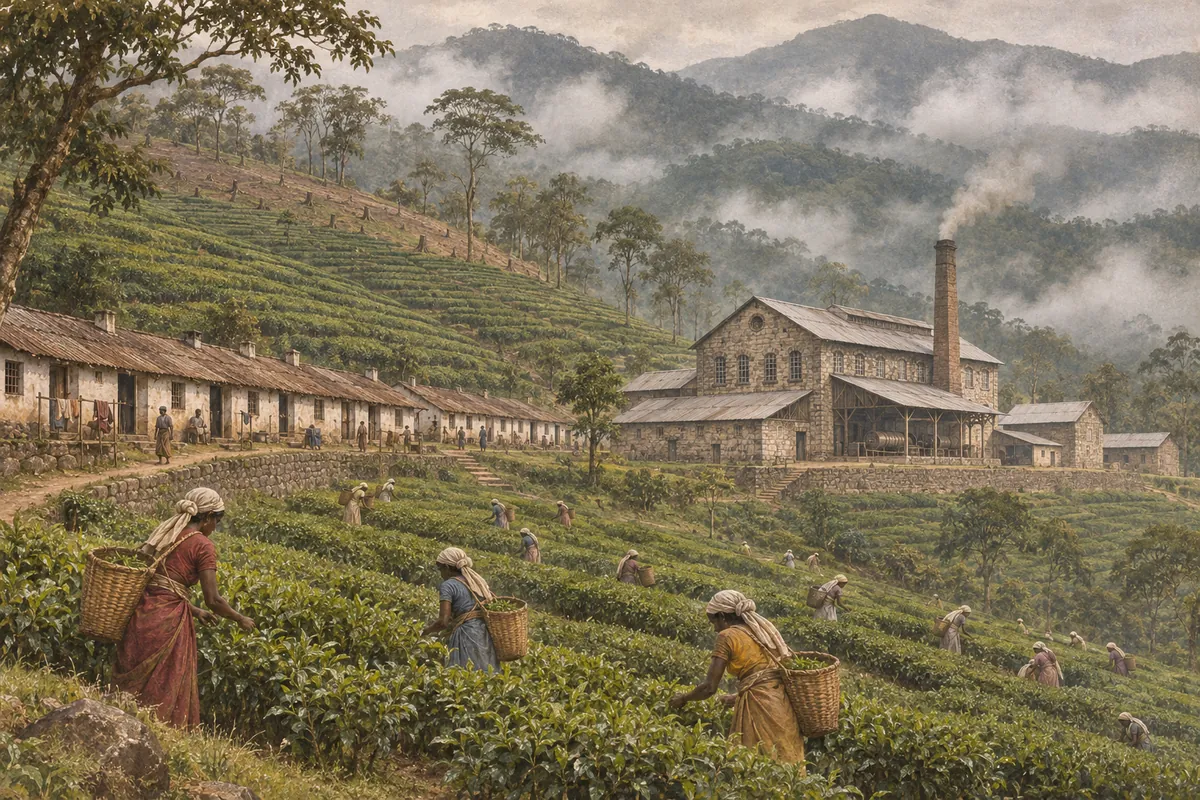
Taylor opened a fully equipped tea factory at Loolecondera, using a leaf-rolling machine of his own design, and made the estate's first tea sale in Kandy. This mattered because tea, unlike coffee, needed processing on the estate. Factories, machinery and resident labour forces made tea estates larger, more capital-heavy businesses.
1873: the Panadura debate
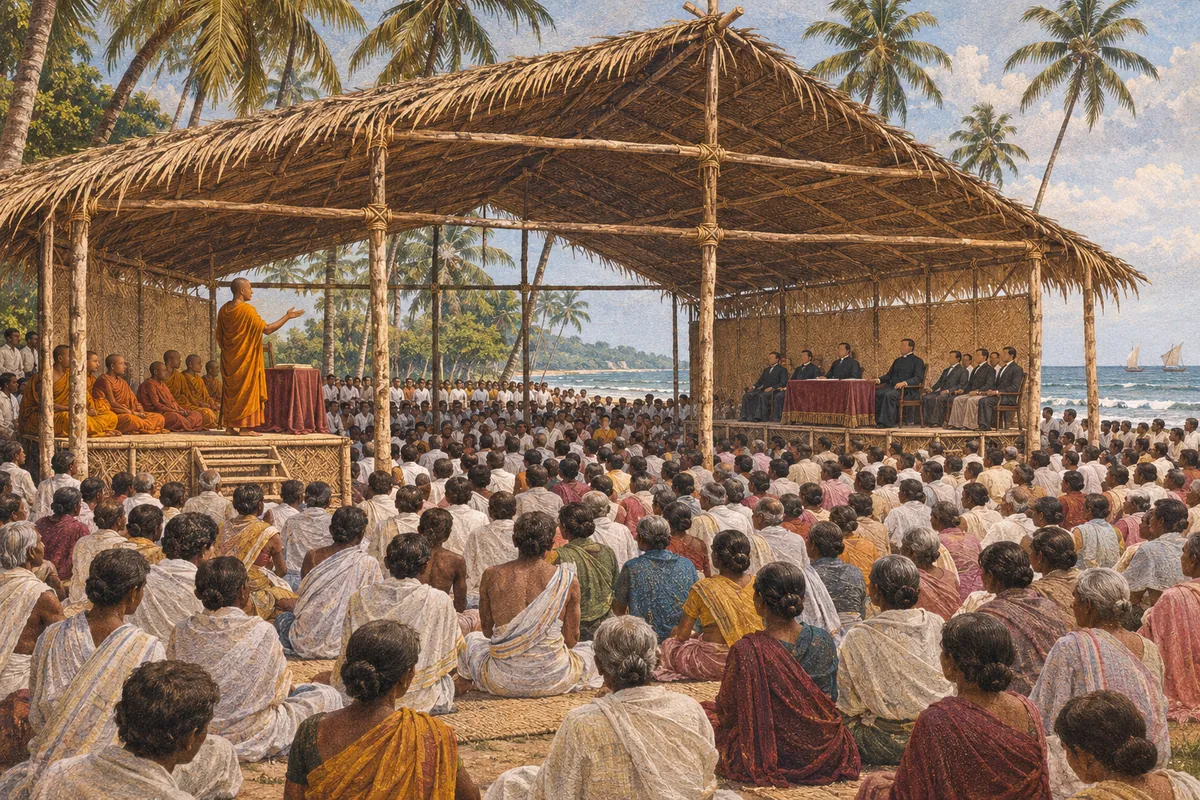
On 26 and 28 August 1873, in a temporary shed at Dombagahawatte near Panadura, Gunananda faced the Wesleyan pastor David de Silva and other Christian speakers. Rules had been signed on 24 July. Large crowds gathered. Buddhists claimed victory, and the debate became a symbol of renewed Buddhist confidence.
Panadura, August 1873
Crowds gathered at a temporary shed near Panadura beach to hear Buddhist and Christian speakers debate.
Panadura: what really happened?
Accounts of Panadura are mostly by sympathisers.
1873: tea goes to London
The first Ceylon tea, about 23 lb (10 kg), was shipped to London; the Tea Museum says Taylor's tea sold at Mincing Lane that year. It was a tiny start. The Tea Museum records production rising from 23 lb to 81.3 tons by 1880, as rust drove more planters from coffee.
1875 or 1878? Panadura reaches America
The debate reached a world audience in print.
1879: coffee doubts; Navalar dies
R.B. Tytler still wrote hopefully about Ceylon coffee despite the leaf disease, a sign of how long some planters held on. In Jaffna, Arumuga Navalar died on 5 December 1879, aged 56. D. Dennis Hudson describes him as central to a Saiva revival that spread across Sri Lanka and South India.
Navalar's legacy
Navalar is honoured and criticised in equal measure.
1880: Olcott and Blavatsky
Henry Steel Olcott and Helena Blavatsky, founders of the Theosophical Society (New York, 1875), landed at Galle on 17 May 1880. At the Wijayananda temple in Galle they publicly took the three refuges and five precepts, among the first Westerners to do so formally. Olcott then promoted a Buddhist Theosophical Society to fund Buddhist schools.
1880: when and where?
Even the arrival is told differently.
1881: census and a long tour
The 1881 census counted about 2.76 million people (2,759.8 thousand in official tables), roughly 15 per cent more than in 1871. Olcott returned for a second visit and toured the Western Province for eight months raising money for Buddhist schools. Village subscriptions and English-medium teaching became the hallmark of the new Buddhist schools.
1882: Muslim Nesan and Orabi's exile
In December 1882 Siddi Lebbe launched Muslim Nesan, described as the first Muslim journal, in Tamil. That month the defeated Egyptian nationalist Ahmed Orabi (Arabi) Pasha and six companions were sentenced to exile in Ceylon; they reached Colombo in January 1883. His presence became a rallying point for the island's Muslims.
The tea empire and the revivals (1883–1899)
Tea overtook coffee, Colombo became an auction centre, and the revivals produced flags, schools and international movements. Communal seats in the Legislative Council grew.
1883: the Colombo tea auction
On 30 July 1883 the first public Colombo tea auction was held at Somerville and Company's premises under the Ceylon Chamber of Commerce. Selling locally rather than only in London gave Colombo merchants and brokers a bigger share of the trade. Orabi Pasha was by then living in Ceylon, eventually with a home in Kandy.
A tea estate in the 1880s
Tea bushes spread over cleared hillsides, with a factory and workers' lines below. By 1888 tea covered more land than coffee.
1884: schools and factories
Siddi Lebbe opened the first Anglo-Mohammedan school in Colombo with Orabi Pasha and Wapichie Marikar. He also founded Muslim schools in Kandy, Gampola, Polgahawela and Kurunegala, and a girls' school in Kandy. The Central Tea Factory opened at Fairyland estate (Pedro) near Nuwara Eliya.
1885: a flag and a holiday
After Olcott lobbied in Colombo and London, Governor Sir Arthur Gordon declared Vesak a public holiday on 27 March 1885. A Colombo committee chaired by Hikkaduwe Sri Sumangala, with members including Gunananda and Don Carolis Hewavitharana, designed a Buddhist flag, hoisted at Dipaduttaramaya, Kotahena, on 28 April 1885, the first Vesak holiday under British rule. Winning the holiday was a political victory for the revival.
April or May 1885?
Sources disagree on the flag's first day.
1886: Ananda and a new flag
A Buddhist English school opened at 61 Maliban Street, Pettah, with C.W. Leadbeater as first principal and 37 pupils; it grew into Ananda College. Olcott and J.R. de Silva reshaped the flag to national-flag proportions, published in Sarasavi Sandaresa on 8 April 1886. A handbook for London's Colonial and Indian Exhibition promoted Ceylon tea.
'Protestant Buddhism'
Scholars still debate what the revival changed.
1888: tea overtakes coffee
The area under tea passed the area under coffee. That year the English-language paper The Buddhist began, edited by C.W. Leadbeater, with the young David Hewavitarne (born 17 September 1864) closely involved. Educated at Christian schools, he had worked as Olcott's translator, joined the Theosophical Society and taken the name Anagarika Dharmapala.
1889: new communal seats
Two seats were added to the Legislative Council to represent the Kandyans and the 'Moors' (Muslims). The council had begun in 1833 with 15 members, nine officials and six nominated unofficials. Nominations were by community, and this logic of representing 'races' would shape Ceylon's politics for decades.
Communal representation
Why did the British count by community?
1890: deaths and dealmakers
Gunananda Thera died at Kotahena on 21 September 1890. Thomas Lipton, the Glasgow grocer, visited Ceylon and bought four estates; King's College London's archive notes he cut out middlemen to sell cheap tea to the British public. The Tea Museum gives 1890 production as 22,899.8 tons.
1891: census and the Maha Bodhi Society
The census counted 3,007,789 people. A Statesman's Year-Book table lists 2,041,158 Sinhalese, 723,853 Tamils including Indian immigrants, 197,166 Moors, 21,231 Burghers, 10,133 Malays and 6,348 Europeans. On 31 May 1891 Dharmapala founded the Maha Bodhi Society in Colombo to restore Bodh Gaya in India.
Reading the census
Colonial censuses must be read with care.
1892: endings and beginnings
James Taylor died at Loolecondera on 2 May 1892, of dysentery according to the Tea Museum. Al-Madrasathul Zahira opened in Colombo on 22 August with 35 pupils; it later became Zahira College. The Maha Bodhi Society moved its offices to Calcutta and began its journal.
Who founded Zahira, and when?
Muslim school histories differ.
1893: Chicago
Dharmapala, aged 29, represented Theravada Buddhism at the World's Parliament of Religions in Chicago and opened an American branch of his society. Ceylon tea sold over a million packets at the Chicago World's Fair, and a Ceylon tea fetched a record £36.15 a pound at a London auction.
1897: the moving workforce
The Statesman's Year-Book recorded 153,075 arrivals and 109,213 departures in 1897, mostly estate labourers. It called Tamil immigrants the mainstay of tea as they had been of coffee. The figures show a constant two-way flow between South India and the estates.
Reform and riot (1900–1919)
A larger, better-educated elite pressed for reform. Temperance became a mass cause, the 1915 riots and martial law shocked the island, and the Ceylon National Congress was born.
1901: census and Orabi's return
The census counted 3,565,954 people (3,566.0 thousand), an increase of about 18.6 per cent on 1891 by our calculation. Orabi Pasha was pardoned and returned to Egypt after about 18 years in Ceylon. His former house in Kandy now holds the Orabi Pasha Cultural Centre. Tea then covered almost 400,000 acres (1899), coffee only about 11,392 acres (1900).
1906–1907: press and passing
In 1906 Dharmapala founded the Sinhala weekly Sinhala Bauddhaya, which spread his message of Buddhist moral reform and criticism of colonial and Christian influence. Olcott died at Adyar, near Madras, on 17 February 1907, aged 74. Schools linked to his work include Ananda, Dharmaraja, Mahinda and others.
Dharmapala: reformer or polemicist?
Dharmapala divides opinion more than any revival figure.
1910: the 'educated Ceylonese' seat
The Crewe–McCallum reforms enlarged the Legislative Council to 21 members: 11 officials and 10 unofficials. Four unofficials were elected by a narrow franchise: two Europeans (urban and rural), one Burgher and one 'educated Ceylonese'. Six were nominated by community: two low-country Sinhalese, two Tamils, one Kandyan and one Moor. The first polls followed in December 1911.
1910: the politics of reform
The 1910 reforms satisfied few.
1910: schools by the numbers
According to the Statesman's Year-Book, in 1910 the government ran 734 vernacular schools with about 91,000 pupils; 1,699 aided vernacular schools taught about 170,000; and 236 English or Anglo-vernacular schools taught about 38,000. Missions ran many aided schools. English schooling was the road to office, and the English-educated remained a small, influential class.
1911: the census by community
The March 1911 census counted about 4.11 million people (4,106.4 thousand in the official series). Including estate immigrants, the Statesman's Year-Book lists 2,714,616 Sinhalese, 1,059,354 Tamils (about 460,000 of them recent immigrants), 266,454 Moors, 26,857 Burghers, 13,089 Malays and 7,625 Europeans. Buddhists numbered 2,144,605, Hindus 500,375, Christians 369,947 and Muslims 276,361.
1912: the temperance movement
Dharmapala and others had campaigned against drink since the 1890s, but a mass movement followed Governor McCallum's liquor policy of 15 April 1912, which meant more taverns to recover revenue. It was formally launched on 14 July 1912. D.S. and F.R. Senanayake, D.B. Jayatilaka, W.A. de Silva and Piyadasa Sirisena were prominent. A 1915 colonial intelligence report on the movement survives in British files.
Temperance as politics
Was temperance moral reform or disguised nationalism?
1915 (May): the riots begin
The 1915 riots broke out at Vesak, the centenary year of the 1815 Kandyan Convention. In Kandy, a dispute over a Buddhist procession passing the Castle Hill Street mosque with music led to violence on the night of 28–29 May. Rumours that Muslims would attack the Temple of the Tooth helped spread the riots to Colombo (from 31 May), Rambukkana, Matara and elsewhere.
Where did it start?
The first spark is placed differently.
1915 (June): martial law
Governor Sir Robert Chalmers declared martial law on 2 June 1915, first in the Western Province and then in most others, excluding the Northern and Eastern Provinces; it lasted until 30 August. Inspector-General of Police Herbert Dowbiggin was prominent in the crackdown. Troops, including Punjabi soldiers from India, could shoot suspected rioters. One writer noted: 'Martial Law was declared after the riots were practically over.'
1915: the arrests
Dozens of Sinhala leaders, many from the temperance movement, were held at Welikada and elsewhere. They included D.S. Senanayake, F.R. Senanayake, D.B. Jayatilaka, Dr C.A. Hewavitarne, John de Silva and A.E. Gunasinha. Most were released after about six weeks without trial (accounts give 40 to 46 days). Edmund Hewavitarne, Dharmapala's brother, got penal servitude and died in prison in November 1915.
1915 (July): Henry Pedris
Captain Edward Henry Pedris, aged 26 or 27 (sources differ), son of a wealthy Colombo merchant family and an officer in the Colombo Town Guard, was accused of firing on Muslims and inciting a march on Colombo. A field general court martial convicted him of treason with no appeal, and he was shot by firing squad on 7 July 1915. His case became a nationalist symbol.
How many died?
Casualty figures for 1915 vary and are partly unreliable.
1915: three perspectives
Each community remembers 1915 differently.
1915–1916: protest and recall
E.W. Perera, later called the 'Lion of Kotte', sailed to London in wartime with a memorandum, reportedly hidden in his shoe, and Ponnambalam Ramanathan joined the campaign. Detained leaders were freed, Chalmers was recalled and Sir John Anderson replaced him. Dharmapala was confined to Calcutta and barred from returning.
The Pedris case revisited
The Pedris story has been re-examined a century on.
1919: the Ceylon National Congress
Reform groups, including the Ceylon Reform League of 1917 and the Ceylon National Association, combined on 11 December 1919 to form the Ceylon National Congress, a multi-community body seeking constitutional reform. The National Archives name Sir Ponnambalam Arunachalam, a Tamil leader, its first president. Its leaders, many detained in 1915, wanted elected majorities and an end to official rule.
1917 or 1919?
Some accounts blur the Congress's origins.
Looking back: Coffee, Tea and Revival
Historians now see 1848–1919 as the making of modern Ceylon. The plantation economy brought railways, revenue and a large Indian Tamil workforce whose hardships were long ignored. Religious revivals built schools and identities that answered missionaries but also sharpened community boundaries.
The 1915 riots and martial law pushed a cautious elite into organised politics. Sinhala, Tamil, Muslim and colonial memories of these years still differ.