 Fablewings
 › Sri Lankan history › Part 12
The Road to Independence (1919–1948)
In under thirty years Ceylon moved from a colony with a tiny, mostly unelected council to a self-governing dominion. Along the way it gained universal adult suffrage in 1931, lived through a world war on its doorstep and argued bitterly over how power should be shared between communities. Whether independence was negotiated, granted or won is still debated.
Read in the page-turning reader
Congress and its break-up (1919–1924)
The period opens with a moment of unity: Sinhalese and Tamil reformers founded one national body. Within two years a quarrel over a single council seat in Colombo had split it, and that quarrel set the pattern for minority politics for decades.
1918: a written promise
On 7 December 1918 James Peiris of the Ceylon National Association and E.J. Samarawickrema of the Ceylon Reform League promised in writing to back a reserved Tamil seat in the Western Province, provided the electorate stayed territorial. The Jaffna Association joined the reform movement on that basis.
1919: the Ceylon National Congress
On 11 December 1919 the Ceylon National Congress was inaugurated, bringing together the Ceylon National Association (founded 1888) and the Ceylon Reform League (1917). Sir Ponnambalam Arunachalam, a retired Tamil civil servant, was elected its first president unanimously. Its resolutions asked for a larger, mainly elected Legislative Council, an elected speaker and an Executive Council at least half Ceylonese.
1919: one nation or many?
From the start the Congress opposed communal electorates, seats reserved for particular communities. Its leaders argued that territorial seats would build a single Ceylonese nation.
1920: the first Manning reforms
Governor Sir William Manning (1918–25) introduced an Order-in-Council dated 13 August 1920. The Legislative Council grew from 21 to 37 members: 14 officials and 23 unofficials, giving unofficials a majority of nine. Eleven unofficials sat for territorial seats, while Europeans, Burghers and the Chamber of Commerce kept their own seats. About 4 per cent of people could vote, and no women.
1921: the Colombo seat
Under the 1920 rules Arunachalam was ready to stand for Colombo. A Sinhalese faction backed James Peiris instead, and Arunachalam withdrew. The promised Western Province Tamil seat had not appeared, and he resigned from the Congress he had led. Most Tamil members followed.
1921: the Tamil Mahajana Sabha
Tamil leaders regrouped. A. Sabapathy, founder of the Jaffna Association, became vice-president of the Tamil Mahajana Sabha in 1921, angered that the reforms fell short of Congress assurances. Arunachalam founded a Ceylon Tamil League to defend Tamil interests.
1922: the poll tax campaign
The labour leader A.E. Goonesinha campaigned against the poll tax, a yearly charge of two rupees on adult men, payable instead by a day's road labour. He urged followers to refuse payment and do the road work, breaking stones himself. A Daily Mirror profile credits the campaign with the tax's withdrawal in 1923; accounts differ on the details.
1923: the second Manning reforms
An Order of 19 December 1923 enlarged the council again, to 49 members: 12 officials and 37 unofficials. Twenty-three members were elected for territorial seats, and eleven by communal electorates: three Europeans, two Burghers, three Muslims, two Indians and one Ceylon Tamil for the Western Province. The governor nominated three more. James Peiris was later elected vice-president.
1924: Arunachalam's death
Sir Ponnambalam Arunachalam died on 9 January 1924 at Madurai in South India while on pilgrimage. Born in 1853, he had been a senior civil servant, a reformer and the Congress's first leader. His lecture 'Our Political Needs' is often credited with laying the intellectual basis for the Congress. A. Sabapathy died in May the same year.
1924: the reformed council
The new Legislative Council met on 15 October 1924. Fewer than 205,000 people, about 4 per cent of the population, could vote. Arunachalam Mahadeva, Arunachalam's son, won the new Western Province Tamil seat. D.S. Senanayake was returned unopposed for Negombo, and C.W.W. Kannangara won Galle. Unofficial members now formed a large majority but still could not control the executive.
Youth, labour and the Donoughmore Commission (1924–1931)
The late 1920s brought new voices: radical students in Jaffna, Kandyan leaders seeking autonomy, a growing labour movement, and a British commission that would propose something almost no colony had: the vote for every adult.
1924: the Jaffna Youth Congress
Late in 1924 a Students' Congress was inaugurated in Jaffna with about 300 present, and it was renamed the Jaffna Youth Congress in 1926. Led by figures such as Handy Perinbanayagam (1899–1977), it was secular and campaigned for Poorana Swaraj, complete self-rule, national unity and an end to caste discrimination.
1925: the Kandyan National Assembly
Kandyan Sinhalese leaders felt sidelined by the low-country elite. In 1924 a low-country candidate defeated Dr Kobbekaduwa in a Central Province seat. In 1925 Kobbekaduwa, Molamure and Ratnayake left the Congress and formed the Kandyan National Assembly. By 1927 it was asking for a federal system with three units.
1927: Gandhi in Ceylon
Mahatma Gandhi toured Ceylon in 1927, visiting Jaffna at the Youth Congress's invitation. His ideas of all-India nationalism and social reform inspired its founders. Rajan Philips notes that the Youth Congress looked to India's freedom movement rather than to communal bargaining.
1927: the Donoughmore Commission
In July 1927 the Conservative Colonial Secretary Leo Amery announced a commission under the Earl of Donoughmore to review the 1924 constitution. Its other members were Sir Matthew Nathan, Sir Geoffrey Butler MP and Dr Thomas Drummond Shiels MP. It reached Ceylon in November 1927, held 34 sittings and heard about 140 witnesses.
1928: a bold report
The Donoughmore Report argued that the 1924 system had produced a divorce of power from responsibility: elected members could criticise but not govern. It proposed near-universal adult franchise, the end of communal seats and a State Council whose members would sit on seven executive committees, each chaired by a Ceylonese minister. The Spectator, on 21 July 1928, called it a startling experiment.
1928: why universal suffrage?
Few Ceylonese leaders had asked for votes for all adults.
1928: minorities alarmed
Abolishing communal seats alarmed minorities. The All-Ceylon Tamil League warned that universal franchise without communal representation would mean death to the minorities. Sinhalese leaders were doubtful about mass voting but accepted it in return for ending communal electorates. The commission hoped the committee system would stop any one group controlling all patronage.
1929: votes and departures
In December 1929 the Legislative Council accepted the Donoughmore scheme, as modified by the Colonial Office, by 19 votes to 17. Tamil members opposed it, partly because it did not grant full self-government. A.E. Goonesinha's labour movement drifted away from the Congress in these years, one of several departures that weakened it.
1931: one of Asia's first universal franchises
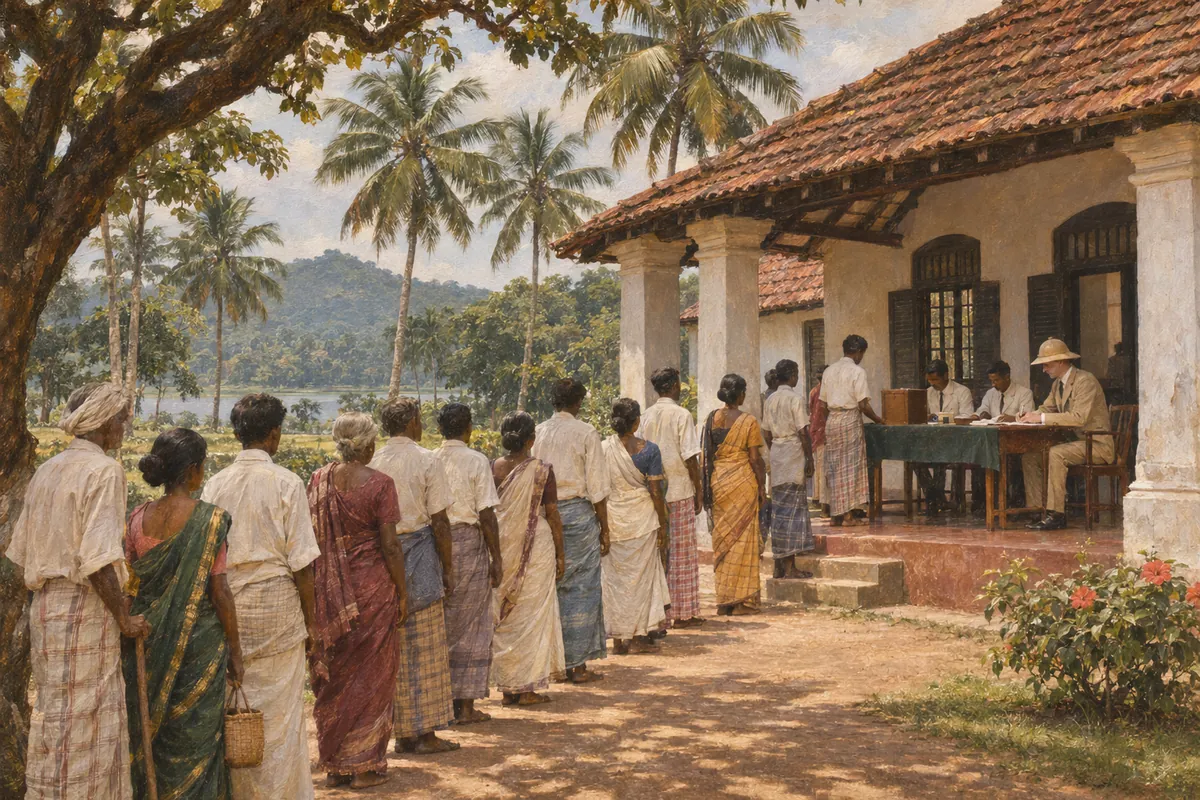
The electorate jumped from about 205,000 in 1924 to over 1.5 million. Every man and woman aged 21 or over could vote, with no property or literacy test. Evidence from women's suffrage campaigners, including Agnes de Silva, had helped.
1931: the Jaffna boycott
Early in 1931 the Jaffna Youth Congress called for a boycott of the elections because the reforms fell short of self-government. No nominations were received for Jaffna, Kankesanthurai, Kayts and Point Pedro, so four of the Northern Province's five seats stayed empty. Only Mannar-Mullaitivu returned a member.
1931: polling day
Polling took place between 13 and 20 June 1931. Nine candidates were returned unopposed, among them D.S. Senanayake and S.W.R.D. Bandaranaike. The State Council had 50 elected members, 8 nominated by the governor and 3 British officers of state.
The first State Council
The first State Council met on 7 July 1931. For the first time, ministers answerable to an assembly elected by all adults ran much of the island's domestic government.
The State Council years (1931–1939)
For sixteen years Ceylon was governed through an unusual system of committees. It trained a generation of ministers and opened the door to welfare politics, but critics said it encouraged communal and personal factions rather than national parties.
1931: how the committees worked
The State Council divided into seven executive committees: Home Affairs; Agriculture and Lands; Local Administration; Health; Education; Transport and Works; and Labour, Industry and Commerce. Each elected its chairman, who became a minister. The seven ministers and three British officers, covering finance, legal matters and the public service, formed the Board of Ministers. The governor kept reserve powers.
1931: the first ministers
D.B. Jayatilaka became Leader of the House (1931–42). D.S. Senanayake took Agriculture and Lands and C.W.W. Kannangara Education, both strong ministers. A.F. Molamure was the first Speaker. Land settlement laws began opening the Dry Zone to colonists.
Was the committee system a success?
The design was meant to spread power.
1933: Jaffna returns
On 2 January 1933 a conference of prominent Jaffna Tamils agreed to end the boycott. Rajasingham records this date. By-elections were then prepared for the four empty seats. Many saw the boycott as having cost Tamils influence during the Council's first years.
1933: strikes and flowers
In February 1933 the South Colombo Youth League backed a strike of about 1,400 Wellawatte mill workers. In November radicals revived Suriya-Mal, selling suriya flowers on Armistice Day instead of poppies, for Ceylonese ex-servicemen. Doreen Young, a British teacher, became president.
1934: Tamil members take their seats
By-elections in early July 1934 filled the boycotted seats: G.G. Ponnambalam won Point Pedro, Arunachalam Mahadeva Jaffna, Subbaiya Natesan Kankesanthurai and Nevins Selvadurai Kayts. They entered the Council on 17 July 1934. Ponnambalam, a brilliant barrister, would become the leading voice of Ceylon Tamil politics. F.A. Obeysekera became Speaker the same year.
1934–35: drought and malaria
The south-west monsoon failed from May to October 1934 and paddy cultivation stopped. When rain returned, pools in dried riverbeds bred Anopheles mosquitoes. By December the epidemic peaked in the Kelani, Deduru Oya and Maha Oya valleys. About 1.5 million of 5.5 million people fell ill.
1935: relief and blame
Officials were criticised for slow action. Relief began in early December 1934 in Kegalle, Kurunegala, Kandy, Matale and Ratnapura. Suriya-Mal and Youth League volunteers took food and medicine into villages, bringing young Marxists into close contact with rural poverty. It was the first major crisis of the elected State Council.
1935: the LSSP is founded
On 18 December 1935 the Lanka Sama Samaja Party held its inaugural conference. Growing out of the Suriya-Mal and Youth League networks, it aimed at complete national independence and socialism. Colvin R. de Silva was its first president; other founders included N.M. Perera, Philip Gunawardena, S.A. Wickramasinghe and Leslie Goonewardene. The first State Council had been dissolved on 7 December.
1936: the second State Council election
Voting ran from 22 February to 7 March 1936. Seven members were returned unopposed. The LSSP won two seats: Philip Gunawardena at Avissawella and N.M. Perera at Ruwanwella. They became the first Marxists in the island's legislature.
1936: the pan-Sinhala Board
After the election, the Sinhalese majority arranged the committee votes so that all seven ministers were Sinhalese. This 'pan-Sinhala Board of Ministers' was led by D.B. Jayatilaka and D.S. Senanayake. W. Duraiswamy, a Tamil, became Speaker (1936–47).
1936: the Sinhala Maha Sabha
S.W.R.D. Bandaranaike founded the Sinhala Maha Sabha, the Great Council of the Sinhalese, which promoted a revived Buddhist-centred Sinhalese nationalism. It gave him a separate political base inside the wider national movement, and it joined the UNP in 1946.
1937: the Bracegirdle affair
Mark Bracegirdle, a young Briton, joined LSSP union work on the estates. On 22–23 April 1937 Governor Sir Reginald Stubbs ordered his deportation under emergency powers. He went into hiding and appeared at a mass rally on Galle Face Green on 5 May. On 18 May the Supreme Court ruled he could not be deported for free speech.
1938–39: communal parties multiply
The Burgher Political Association was formed in 1938. On 25 July 1939, during Jawaharlal Nehru's visit as Gandhi's envoy, rival Indian bodies merged at his urging into the Ceylon Indian Congress, to speak for Indian Tamil estate workers and other Indians. Many Sinhalese nationalists questioned whether estate workers belonged to Ceylon or India.
War on the island (1939–1945)
The Second World War turned Ceylon into a frontline base. It brought Japanese bombs, an army mutiny and a new Allied headquarters in Kandy. It also gave Ceylonese ministers leverage, which D.S. Senanayake used to bargain for self-government.
1939: war and a party split
After war began in September 1939, the LSSP executive voted 29 to 5 that it had no faith in the Communist Third International. The pro-Moscow minority, led by S.A. Wickramasinghe, was expelled, later forming the Communist Party. The LSSP called the war imperialist and opposed Ceylon's participation.
1940: the left is jailed
Detention orders were issued for the LSSP leaders. N.M. Perera, Philip Gunawardena and Colvin R. de Silva were arrested, and Edmund Samarakkody the next day; Leslie Goonewardene went underground. The party was banned.
1941: civil defence
Japan's entry into the war drew closer. On 1 December 1941 a Civil Defence Department was set up, with Oliver Goonetilleke as Commissioner and the British academic Ivor Jennings as his deputy. Governor Sir Andrew Caldecott had sent reform proposals to London on 12 November 1941. An Indo-Ceylon agreement on immigration was also published that year.
1942: a military regime
On 5 March 1942 Vice-Admiral Sir Geoffrey Layton was appointed Commander-in-Chief, Ceylon, with wide powers over civil government. Admiral Sir James Somerville arrived to command the Eastern Fleet. Singapore had fallen in February, and Ceylon was now Britain's key naval base in the Indian Ocean and a vital source of rubber.
5 April 1942: the Easter Sunday raid
Aircraft from five Japanese carriers attacked Colombo harbour. Warned by a Catalina sighting the day before, the British had dispersed much shipping. The armed merchant cruiser Hector and destroyer Tenedos were sunk. Bombs killed about 37 patients at a mental hospital, among other civilian casualties. Japanese aircraft sank the cruisers Dorsetshire and Cornwall at sea; 424 men died.
1942: the jailbreak
Four detained LSSP leaders escaped from jail with a guard named Solomon and reached India. That month the Bolshevik-Leninist Party of India was formed, with the LSSP as its Ceylon unit. Party sources say its leaders joined the Indian freedom struggle.
8 May 1942: the Cocos mutiny
On the night of 8–9 May 1942, on Horsburgh Island in the Cocos (Keeling) Islands, Ceylon Garrison Artillery gunners led by Bombardier Gratien Fernando mutinied, planning to hand the islands to Japan. They failed. Fernando, Carlo Gauder and Benny de Silva were executed in Colombo on 5, 7 and 8 August 1942.
1942: Senanayake takes the lead
In December 1942 D.B. Jayatilaka retired and became Ceylon's representative in New Delhi. D.S. Senanayake became Leader of the House and Vice-Chairman of the Board of Ministers. He secured the election of A. Mahadeva, a Tamil, as Minister of Home Affairs, ending the all-Sinhalese board. The University of Ceylon was also founded by ordinance in 1942.
Senanayake's wartime bargain
Senanayake, Goonetilleke and Jennings worked together closely.
26 May 1943: the Declaration
Whitehall announced that after the war Ceylon would receive full responsible government under the Crown in internal civil matters. Defence and external affairs would stay with Britain. The ministers were invited to draft a constitution, to be accepted if three-quarters of the State Council approved it.
1943: SEAC and a split with Congress
In August 1943 the Allies created South East Asia Command under Admiral Lord Louis Mountbatten. On 21 December 1943 Senanayake left the Ceylon National Congress, which J.R. Jayewardene then took over, according to Abhayavardhana.
1944: the ministers' scheme
The ministers' draft constitution, prepared with Jennings's help, was sent to London on 3 February 1944 and published as Sessional Paper XIV of 1944. It sought dominion-type self-government. On 15 April 1944 Mountbatten arrived and SEAC headquarters moved from New Delhi to Kandy, bringing Allied commanders to the hill capital.
1944: a commission after all
Instead of judging the ministers' draft alone, Britain decided to send a commission under Viscount Soulbury, with Sir Frederick Rees and Sir Frederick Burrows. Colonial Secretary Oliver Stanley told the Commons on 5 July 1944. The Daily Mirror describes this as a departure from the 1943 Declaration.
1944: the Tamil Congress and 50-50
In October 1944 G.G. Ponnambalam founded the All Ceylon Tamil Congress, with S. Sivasubramaniam as general secretary. Its central case was 50-50: half the seats for the Sinhalese, half for all minorities. Supporters saw a safeguard against permanent majority rule; critics called it undemocratic. Governor Caldecott left on 17 October; Sir Henry Moore was appointed governor on 3 December 1944.
Soulbury and the transfer of power (1944–1948)
In just over three years Ceylon moved from a commission of inquiry to full dominion status. The terms were shaped by Senanayake's private diplomacy in London, by Indian and Burmese independence, and by debates over how to protect minorities.
22 December 1944: Soulbury arrives
The Soulbury Commission arrived in Ceylon on 22 December 1944, held public sittings in early 1945 and returned to London in April. The ministers officially boycotted it but met the commissioners informally. Kandyan representatives put a federal proposal, and the Tamil Congress pressed its 50-50 scheme.
1945: Senanayake in London
Senanayake left for London on 11 July 1945. He spent a weekend with Lord Soulbury on 20–23 July. Britain's Labour Party won the general election, and George Hall became Colonial Secretary. On 13 September the ministers' tenth draft, asking for full independence, was sent to Hall.
1945: the Soulbury Report
The report broadly followed the ministers' scheme. It proposed a bicameral parliament and a cabinet led by a prime minister, with Britain keeping defence and external affairs. Weighting for sparsely populated areas and multi-member seats would help minorities. Laws imposing disabilities on one community alone would be invalid.
1945: Section 29
The minority safeguard became Section 29 of the Ceylon (Constitution) Order in Council, 1946. It barred laws making one community or religion 'liable to disabilities or restrictions' others escaped, or giving it privileges others lacked. Critics later argued it proved weak in practice.
8 November 1945: the vote
A White Paper, announced in the Commons on 31 October 1945, set out Britain's offer: full internal self-government, falling short of dominion status. On 8 November, after a two-day debate, the State Council accepted it by 51 votes to 3, far more than the three-quarters required.
1946: the UNP is formed
On 6 September 1946 the United National Party was formed. It brought together the Congress, Bandaranaike's Sinhala Maha Sabha and others under D.S. Senanayake. Arthur Creech Jones became Colonial Secretary on 4 October 1946. A wave of strikes in October showed the strength of organised labour.
1947: dominion status in sight
In February 1947 Senanayake wrote asking for dominion status. In March Oliver Goonetilleke negotiated in London, seeking terms no worse than India or Burma. In June Britain announced that Ceylon would receive fully self-governing status. The Soulbury constitution came into force in 1947, with a 101-seat House of Representatives and a 30-member Senate.
1947: the general election
Polling ran from 23 August to 20 September 1947; turnout was about 56 per cent of 3.05 million voters. The UNP won 42 of 95 seats, the LSSP 10, the Tamil Congress 7, the Ceylon Indian Congress 6, the rival Bolshevik Samasamaja Party 5, Communists 3, Labour 1 and independents 21. Senanayake became Prime Minister on 24 September.
November 1947: the agreements
On 11 November 1947 Ceylon and Britain signed defence and external affairs agreements. Britain kept the right to use bases on the island. The Ceylon Independence Bill was introduced in the House of Commons on 13 November.
December 1947: the Independence Act
On 5 December the House of Representatives approved the independence motion by 59 votes to 11. The Ceylon Independence Act received royal assent on 10 December 1947. Sir Henry Moore was appointed the first Governor-General. A Sunday Times account says Senanayake signed the final documents late on 11 December, witnessed by Goonetilleke and Jennings.
4 February 1948: independence
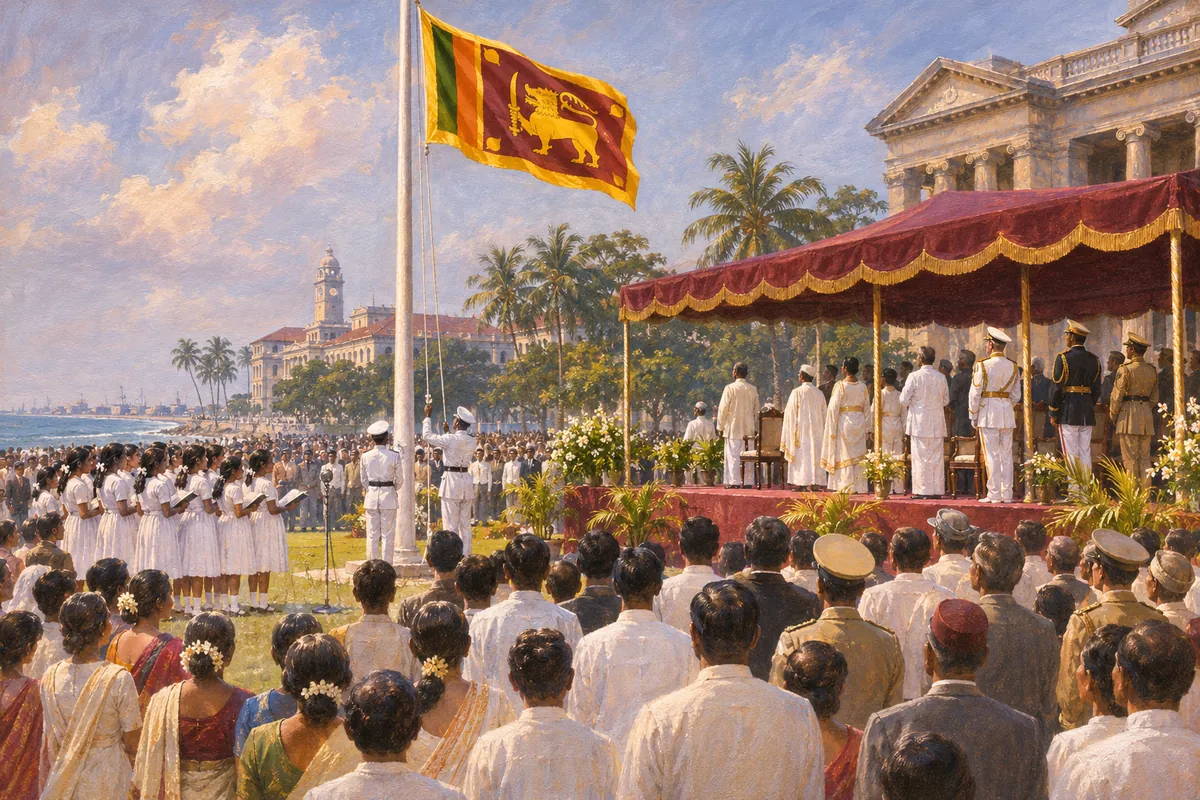
Ceylon became a self-governing dominion within the Commonwealth. Senanayake raised the national flag. The Duke of Gloucester represented King George VI and opened the first Parliament on 10 February at Torrington Square, Colombo. Students of Musaeus College sang Ananda Samarakoon's song, later the national anthem.
Independence Day
Flags, crowds and ceremony marked 4 February 1948. The Ceylon Daily News hailed the birth of a new dominion, with an amnesty for prisoners.
Was it a 'gift'?
How independence came is still argued.
Dominion or republic?
Some writers date full independence to 1972.
1948: the citizenship question
Within months, the new Parliament passed citizenship laws in 1948 and 1949 that excluded most Indian Tamil plantation workers. Hector Abhayavardhana estimates about 900,000 people lost voting rights. Ponnambalam opposed the first bill. S.J.V. Chelvanayagam and others left the Tamil Congress and founded the Federal Party in 1949.
Looking back: The Road to Independence
Historians now see 1919–1948 as a peaceful but uneven transfer. Universal suffrage in 1931 was remarkably early and gave Ceylon lasting democratic habits. Yet the same years hardened communal divisions: the Congress split, the pan-Sinhala board, the 50-50 debate and the citizenship question. Whether the result was a skilful negotiation or an elite settlement remains debated.