 Fablewings
 › Sri Lankan history › Part 13
Dominion of Ceylon (1948–1972)
On 4 February 1948 Ceylon became a self-governing dominion within the Commonwealth. Over the next 24 years two parties, the UNP and the SLFP, alternated in power through elections, while disputes over citizenship, language, land and religion divided Sinhalese, Tamils and other communities. The era ended with a youth revolt in 1971 and a republican constitution in 1972.
Read in the page-turning reader
Senanayake's Dominion (1948–1951)
D.S. Senanayake, leader of the United National Party (UNP), became the first prime minister. His government settled who would count as a citizen, began large irrigation schemes in the dry zone and kept close defence ties with Britain. Each of these choices was praised by some communities and resented by others.
1948
Independence took effect on 4 February 1948, when the 1947 constitution came into force. Parliament had two houses: an elected House of Representatives and a Senate that was partly nominated. A governor-general represented the British monarch, while the cabinet ran the government. Agreements with Britain signed in November 1947 let British forces keep bases on the island, including the naval base at Trincomalee.
1948: The first knock on the UN door
In May 1948 Senanayake applied for United Nations membership. The Soviet Union vetoed the application in the Security Council.
1948: The Ceylon Citizenship Act
Parliament passed the Ceylon Citizenship Bill on 20 August 1948 and it became law, as Act No. 18 of 1948, on 15 November. Citizenship by descent required proof that a father or grandfather had been born in Ceylon, which most Indian Tamil plantation workers could not supply. About 780,000 Indian Tamils lived on the island by 1946, roughly 11.7% of the population.
1948: Who lost out, and why
More than 700,000 people, about 11% of the population, were left without citizenship.
1949: The vote is taken away
The Indian and Pakistani Residents (Citizenship) Act of 1949 offered registration to some long-term residents, but under strict conditions. The Ceylon Parliamentary Elections Amendment Act No. 48 of 1949 then removed the vote from those who were not citizens. In 1947 the Ceylon Indian Congress had won six of the 95 elected seats; in 1952 no Indian Tamil was elected.
1949: The Gal Oya scheme
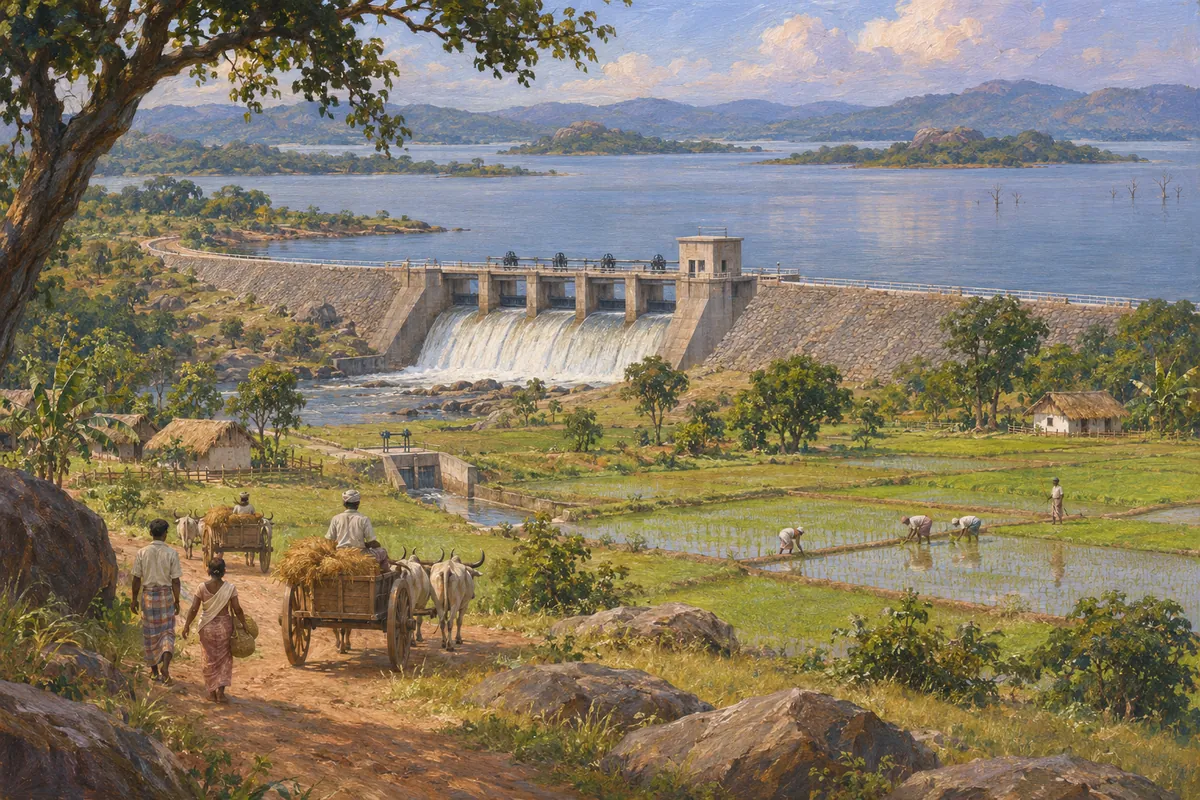
Work on the Inginiyagala dam across the Gal Oya river began in August 1949 and finished in 1953, creating Senanayake Samudra, the island's largest reservoir. In 1949 the government also set up the Gal Oya Development Board to settle the newly irrigated land with farmers growing paddy, sugar cane and other crops. Senanayake saw dry-zone settlement as a way to grow food and relieve crowded villages.
1949: Whose land? The colonisation debate
Between 1950 and 1958, the anthropologist S.J. Tambiah recorded, 5,859 settlers moved into 43 village units on Gal Oya's Left Bank.
1949: The Federal Party is born
On 18 December 1949 about 60 Tamils met in a hall in Colombo and founded the Ilankai Tamil Arasu Kachchi (ITAK), known in English as the Federal Party. Its leader was S.J.V. Chelvanayakam, a lawyer born in Ipoh, Malaya, in 1898. The party wanted a self-governing Tamil state in the Northern and Eastern Provinces, joined to a Sinhala state within one federal Ceylon.
1949: Why the Tamil Congress split
Chelvanayakam had been deputy to G.G. Ponnambalam in the All Ceylon Tamil Congress.
Building the dry zone
The Gal Oya dam and Senanayake Samudra reservoir were the showpiece of D.S. Senanayake's plan to resettle the dry zone. For some the scheme meant land and food; for others it meant a threat to their homeland.
1950
In January 1950 Colombo hosted a conference of Commonwealth foreign ministers, which led to the Colombo Plan for economic aid to South and Southeast Asia. At home the economy looked strong: tea, rubber and coconuts earned about 90% of foreign exchange. But the population was growing fast, food was largely imported, and generous rice subsidies were becoming expensive.
1951: Bandaranaike breaks away
In July 1951 S.W.R.D. Bandaranaike, an Oxford-educated minister, left the UNP government, and on 2 September he founded the Sri Lanka Freedom Party (SLFP). His base was the Sinhala Maha Sabha, which he had set up in the 1930s. That year the Federal Party's first convention, at Trincomalee, formally called for a federal constitution.
Dudley, the Hartal and Kotelawala (1952–1955)
The sudden death of D.S. Senanayake brought his son Dudley to power. A cut in the rice subsidy then provoked the largest protest the young state had seen. Under Sir John Kotelawala Ceylon stepped onto the world stage, but the language question was quietly gathering force.
1952: Death of the first prime minister
On 21 March 1952 D.S. Senanayake fell from his horse on Galle Face Green; he died the next day. On 26 March the governor-general chose his son, Dudley Senanayake, as prime minister rather than Sir John Kotelawala, D.S.'s nephew. The country study calls D.S. the one leader who could credibly symbolise national unity.
1952: The second general election
Dudley called an election, held in late May 1952, and the UNP won comfortably. The UNP took 54 seats. The SLFP and the LSSP won nine each, and Bandaranaike became leader of the opposition. The Federal Party took only two seats against the Tamil Congress's four. Because Indian Tamils could no longer vote, no upcountry Indian Tamil MP was elected.
1952: The cost of cheap rice
A 1952 World Bank study found that social and welfare services took 35% of the budget, mostly through the rice subsidy, and advised cutting it. Falling rubber and tea prices made the problem worse. Food subsidies were reported to account for most of the government's budget shortfall.
1953: Rice almost triples
In July 1953 the government ended the rice subsidy. The price of a measure of rice rose from 25 to 70 cents. Rail fares and postal rates went up, and the free midday bun for schoolchildren was withdrawn. Protests began on 21 July, and a large rally was held on Galle Face Green on 23 July.
1953: The Great Hartal
On 12 August 1953 the left parties and trade unions, led by the Lanka Sama Samaja Party (LSSP), called a hartal, a general shutdown of work and shops. Large parts of the western and southern lowlands stopped. Fearing for its safety, the cabinet met on the British warship HMS Newfoundland in Colombo harbour and declared emergency rule that afternoon.
1953: Counting the cost of the Hartal
Police fired on crowds, a curfew was imposed and thousands were arrested.
1953: A change of leader
Shaken and unwell, Dudley Senanayake partly reversed the cuts and resigned in October 1953, citing his health. Sir John Kotelawala became prime minister on 12 October and also took defence and external affairs. J.R. Jayewardene lost the finance ministry in the new cabinet. The UNP's reputation among poorer voters never fully recovered before 1956.
1954: The Colombo Powers
From 28 April to 2 May 1954 Kotelawala hosted the prime ministers of India, Pakistan, Burma and Indonesia at Kandy and Colombo. They discussed the war in Indochina and other regional problems. The meeting proposed a wider Asian-African conference, which became the Bandung Conference of 1955.
1954: Kotelawala's foreign policy
Kotelawala was openly anti-communist and kept the defence agreement with Britain.
1955: Bandung
In April 1955 Ceylon was one of 29 African and Asian countries that met at Bandung in Indonesia, a meeting that laid groundwork for the later Non-Aligned Movement. Kotelawala caused a stir by arguing that Soviet control of Eastern Europe was a form of colonialism, just like Western rule. This put him at odds with Nehru and China's Zhou Enlai.
1955: Into the United Nations
On 14 December 1955 Ceylon was admitted to the United Nations together with other countries, after the United States and Soviet Union agreed a package deal that also admitted several Soviet allies.
1955: The language question sharpens
Since the 1940s most leaders had expected both Sinhala and Tamil to replace English in government, an idea known as swabhasha (own language).
1956 and its aftermath (1956–1959)
The 1956 election is often called a turning point, even a social revolution. It brought Sinhala-educated voters, Buddhist monks, teachers and village doctors into national politics. It also produced the Sinhala Only Act, the first serious ethnic riots after independence, and a failed attempt at compromise.
1956: The Buddha Jayanti election
The 1956 election coincided with the Buddha Jayanti, the 2,500th anniversary of the Buddha's passing, which tradition also linked to Vijaya's legendary landing. Bandaranaike's SLFP led the Mahajana Eksath Peramuna (MEP, People's United Front). The Marxist LSSP and Communist Party agreed not to compete against it in many seats.
1956: A landslide
Voting took place from 5 to 10 April 1956. The UNP was reduced to 8 seats. Bandaranaike became prime minister on 12 April. The Federal Party won 10 seats and became the leading party in Tamil areas.
1956: Who Bandaranaike spoke for
Bandaranaike had swapped Western clothes for national dress and presented himself as a defender of Sinhala Buddhist culture. He promised to nationalise plantations, banks and insurance, and to put trade under local control.
1956: The Official Language Act No. 33
The Official Language Bill, soon called the Sinhala Only Act, had its second reading from 5 June 1956 and passed in mid-June by 56 votes to 29, according to The Morning. It made Sinhala the sole official language and came into force on 7 July. The Tamil parties and the Marxist LSSP and Communist Party, which wanted parity for both languages, opposed it.
1956: How each community saw Sinhala Only
Nearly a quarter of the people spoke Tamil as their first language.
1956: Muslims and Burghers
The smaller communities responded in different ways.
1956: Satyagraha on Galle Face
On 5 June, as the bill was debated, Federal Party MPs and supporters held a satyagraha, a peaceful sit-down protest, on Galle Face Green. A mob attacked them while police reportedly looked on. Rioters then looted Tamil-owned shops in Colombo. A fast by Professor F.R. Jayasuriya, who demanded no concessions to Tamil, led Bandaranaike to drop a clause on Tamil's use in administration.
1956: The Gal Oya riots
From about 10 June violence spread to the Gal Oya valley, fed by false rumours after attacks on Sinhalese in Batticaloa District. Mobs of settlers and labourers attacked Tamil colonists. Army reinforcements ended the killing around 16 June.
1956: A new direction abroad and at home
Bandaranaike followed what he called 'dynamic neutralism', keeping friendly ties with both Cold War blocs. Ceylon opened diplomatic relations with the Soviet Union and China, and in 1957 Britain handed over its naval base at Trincomalee and air base at Katunayake. A National Planning Council was set up, and state factories for steel, cement and textiles were planned.
1957: The Bandaranaike–Chelvanayakam Pact
Facing a Federal Party campaign, Bandaranaike signed a pact with Chelvanayakam on 26 July 1957. It proposed regional councils, one for the Northern Province and two or more for the Eastern Province, with powers over agriculture, land and education. Tamil would be a national minority language used in administration in the north and east. Colonisation would not be used to change those regions' ethnic make-up.
1957: The pact under attack
In October 1957 J.R. Jayewardene led a UNP march from Colombo to Kandy to demand the pact be scrapped. SLFP organisers stopped it at Imbulgoda.
1958: The pact is torn up
A dispute over Sinhala letters on vehicle number plates, the 'anti-Sri campaign', led to tit-for-tat tarring of signs. On 9 April 1958, under pressure from Buddhist monks and Sinhala opinion, Bandaranaike abandoned the pact. The Treasury's official history notes it was dropped after resistance from both communities.
1958: The May riots
Tension over the pact and over colonisation erupted in late May. On 22 May Tamil passengers were attacked at Polonnaruwa station. Former Nuwara Eliya mayor D.A. Seneviratne was shot dead near Eravur, and the news spread by radio. In Panadura a mob burned a Hindu priest alive. Sinhalese were also killed in Batticaloa and Jaffna, and some Sinhalese died shielding Tamils.
1958: Emergency
At noon on 27 May Governor-General Sir Oliver Goonetilleke declared the first island-wide state of emergency, with curfews and the army deployed. The Federal Party and the Sinhala nationalist Jathika Vimukthi Peramuna were banned. Many thousands of Tamil refugees, over 10,000 from Colombo alone according to Neil DeVotta, were shipped north, and over 2,000 Sinhalese left the Jaffna peninsula.
1958: How many died?
No full count was ever made, and estimates are still disputed.
1958: Who was to blame?
Bandaranaike's radio appeal for calm mentioned killings in Batticaloa, and many Tamils heard it as blaming them.
1958: India's caution
Tamil Nadu politicians urged India to act.
1958: The Tamil Language (Special Provisions) Act
In August 1958 Parliament passed the Tamil Language (Special Provisions) Act No. 28. It allowed Tamil as a medium of school instruction and public-service examinations, and for correspondence and set administrative purposes in the north and east.
1959: The coalition frays
The emergency was lifted on 13 March 1959. Quarrels inside the MEP between its Marxist and conservative wings came to a head in May, when Philip Gunawardena and his allies left the cabinet, leaving a government based on the SLFP. Economic pressures grew as welfare spending rose and export prices weakened.
1959: The assassination
On 25 September 1959 Talduwe Somarama, a Buddhist monk, shot Bandaranaike at his Colombo home. The prime minister died the next day. The killing shocked the country: Bandaranaike had championed Buddhism, and he was killed by a monk.
1959: The plot and the motives
Mapitigama Buddharakkitha, chief monk of Kelaniya temple and a leader of the Eksath Bhikku Peramuna, was arrested soon after.
1959: Dahanayake's caretaker months
Education minister Wijeyananda Dahanayake became prime minister on 26 September and pledged to continue Bandaranaike's policies. A state of emergency was imposed the same day. Quarrels with his own party broke his cabinet apart, and on 5 December the governor-general dissolved Parliament.
Sirimavo's first government (1960–1965)
After two elections in one year, Bandaranaike's widow Sirimavo became the world's first woman prime minister. Her government took over schools, oil distribution and insurance, and enforced Sinhala in administration. It survived an attempted coup, mediated between India and China, and made a deal with India over the stateless plantation workers.
1960: The March election
At the election of 19 March 1960 the UNP won 50 of 151 seats and the SLFP 46, with the Federal Party winning 15. Dudley Senanayake formed a minority government. It lost a vote of confidence on 22 April, partly because the Federal Party would not back it, and Parliament was dissolved the next day.
1960: The world's first woman prime minister
At the election of 20 July 1960 the SLFP, now led by Sirimavo Bandaranaike, won 75 seats and the UNP 30. She was sworn in on 21 July 1960. Small parties from the old MEP gave her support. The UNP had lost Tamil votes over language and was still distrusted by many Sinhala nationalists.
Sirimavo Bandaranaike
Sirimavo Bandaranaike in 1960, when she became the first woman in the world to be elected prime minister. She went on to lead Ceylon twice in this era, in 1960–65 and from 1970.
1960: The schools takeover
Acting on the advice of an unofficial Buddhist commission, the government took over state-assisted denominational schools, most of them Christian mission schools, under laws passed in 1960 and 1961.
1961: Sinhala in the kachcheris
In January 1961 Sinhala began to be enforced as the language of administration, including in Tamil areas. From February the Federal Party led a satyagraha outside government offices (kachcheris) that paralysed administration in the north and east. On 17 April an emergency was proclaimed there, the army moved in and Chelvanayakam and other leaders were detained at Panagoda.
1961: Oil and insurance
In 1961 the new Ceylon Petroleum Corporation was guaranteed a quarter of the fuel trade, hurting Shell, Esso and Caltex. It bought oil from new sources, including the Soviet Union, Romania and Egypt. Insurance was also brought under state control.
1962: The coup attempt
A group of senior army, navy and police officers planned to seize power on the night of 27 January 1962 and detain the prime minister and ministers. Stanley Senanayake, a police superintendent who was approached, passed word through his family to the police chief, and the information reached minister Felix Dias Bandaranaike and the prime minister. The plotters called the operation off; 31 people were arrested.
1962: Why did officers plot?
Leaders included Colonel F.C. de Saram, Colonel Maurice de Mel, Rear Admiral Royce de Mel and Deputy Inspector-General C.C. Dissanayake.
1962: Peacemaker
In December 1962 Sirimavo Bandaranaike hosted a conference of six non-aligned nations in Colombo to mediate in the Sino-Indian border war. It did not end the conflict, but it raised Ceylon's profile as a neutral peacemaker. Ceylon had also been a founding member of the Non-Aligned Movement at Belgrade in 1961.
1963: The coup trial
The government passed a special Criminal Law Act, with retrospective effect, to try the accused officers. Two courts were dissolved over how their judges were appointed. A third court sat from 3 June 1963 and convicted 11 men, sentencing them to ten years and loss of property. The long emergency first declared in the north and east was lifted on 1 May 1963.
1964: Shortages and a new coalition
As prices rose and support slipped, and to shore up her majority, Sirimavo Bandaranaike took the Trotskyist LSSP into her government in June 1964, a move that alarmed the UNP and business. A bill to nationalise the Lake House newspaper group divided her own party.
1964: The Sirima–Shastri Pact
On 30 October 1964 Sirimavo Bandaranaike and India's Lal Bahadur Shastri agreed on the future of 975,000 stateless people of Indian origin. Ceylon would grant citizenship to 300,000; India would take back 525,000; the fate of 150,000 was left for later talks.
1964: The government falls
On 3 December 1964 the government lost a vote of confidence by one vote, after C.P. de Silva and other SLFP members crossed the floor over the press takeover. Parliament was dissolved on 17 December. The UNP now built a broad front of 'democratic forces' against what it called the totalitarianism of the left.
Dudley's national government (1965–1970)
Dudley Senanayake returned at the head of a broad coalition that included the Federal Party. His government made food production its priority, and modest economic recovery followed. But its promises to Tamils stalled, and a new revolutionary movement grew among rural Sinhala youth.
1965: The 'national government'
At the election of 22 March 1965 the UNP won 66 of 151 elected seats and the SLFP 41. The Federal Party won 14. Dudley Senanayake was sworn in on 25 March and formed a government with six other parties, including Tamil and Sinhala nationalist groups. The Federal Party and the Ceylon Workers' Congress of the plantation Tamils had backed the UNP.
1965: The Dudley–Chelvanayakam Pact
On 24 March 1965, before forming his government, Senanayake signed an agreement with Chelvanayakam. It promised Tamil as the language of administration and courts in the north and east, district councils with agreed powers under central oversight, and priority in new colonisation schemes for local landless people, then Tamil speakers of those provinces.
1965: The coup verdict overturned
In December 1965 the Privy Council in London ruled that the special Act used to try the 1962 coup suspects was beyond the powers of Ceylon's parliament and had denied them a fair trial. All eleven were freed after about four years in custody.
1966: The Tamil regulations
In January 1966 the government issued regulations for the 'reasonable use' of Tamil under the 1958 Act. The SLFP and its left allies opposed them. On 8 January a protest in Colombo led to one death, and an emergency was declared until December.
1967: A new revolutionary movement
Around this time Rohana Wijeweera, who had studied in Moscow, began building the Janatha Vimukthi Peramuna (JVP, People's Liberation Front). It recruited mainly educated but unemployed rural Sinhala youth. Its ideology mixed Marxism with strong nationalism. The Arkansas conflict database dates its founding to 1967; other accounts place its beginnings in 1965.
1968: Promises unkept
A July 1968 White Paper on district councils was dropped after opposition from the SLFP and its left allies and from a group of UNP backbenchers. In September minister M. Tiruchelvam of the Federal Party resigned in a dispute over making the Koneswaram temple area in Trincomalee a sacred zone. The Federal Party's partnership with the government never recovered.
1969: Rice and new colleges
The government made rice its priority. High-yielding varieties such as H4 and IR8 and subsidised fertiliser spread, and the guaranteed paddy price rose to Rs. 14 a bushel in 1967. The Central Bank recorded paddy output rising from 36.3 million bushels in 1965 to 77.4 million in 1970. Six Junior University Colleges opened in 1969.
1970: The United Front landslide
At the election of 27 May 1970 the United Front of the SLFP, LSSP and Communist Party won by a landslide; the UNP was reduced to 17 seats. Sirimavo Bandaranaike formed a coalition government on 29 May. The Federal Party won 13 seats.
1970: A socialist agenda
The new government promised a new constitution and a socialist economy. It sat as a Constituent Assembly from July 1970. It moved to control foreign trade, banks and many industries, and later took over wholesale trade and foreign-owned plantations. From 1971 it also adjusted university entrance marks by language stream, a policy known as 'standardisation', which many Tamil students saw as discrimination.
1971: Arrests and a pre-emptive emergency
Early in 1971 tension rose. In early March members of a Maoist youth group attacked the US embassy and a policeman was killed. On 13 March Wijeweera was arrested at Ampara, along with many JVP members, and held in Jaffna prison. On 16 March the government declared a state of emergency.
1971: The April insurrection
The JVP planned simultaneous attacks on police stations at 11.30 pm on 5 April 1971. Cadres at Wellawaya misread the signal and struck early on 5 April, about 18 hours ahead, warning the authorities. Rebels held parts of the south, the Kegalle area and the North Central Province for days or weeks before the army regained control.
1971: Help from everywhere
Ceylon's small forces needed outside help.
1971: How many died?
By June the main fighting was over, though operations in Kegalle continued until 1974. About 15,000 to 16,500 suspects were detained or surrendered.
1971: Explaining the revolt
The rising surprised a government the JVP had backed in 1970.
1972: The Republic of Sri Lanka
The Constituent Assembly approved a new constitution, and on 22 May 1972 Ceylon became the Republic of Sri Lanka, still within the Commonwealth. William Gopallawa, the last governor-general, became a non-executive president. The Senate was abolished. Sinhala was confirmed as the official language and Buddhism was given 'the foremost place'.
1972: Tamil responses
The Federal Party's federal proposals were rejected and it withdrew from the Assembly. That year it joined the Tamil Congress and the Ceylon Workers' Congress in the Tamil United Front. Chelvanayakam resigned his seat to test Tamil opinion; the by-election was delayed until 1975.
1972: Judging the rebels
In April 1972 Parliament created a Criminal Justice Commission to try the alleged leaders of the insurrection. Its hearings began on 12 June 1972 under Chief Justice H.N.G. Fernando and lasted about two and a half years. Wijeweera was sentenced to life imprisonment; he was freed in 1977. Food rationing and import controls continued.
Looking back: the Dominion of Ceylon
Historians once described Ceylon in 1948 as a model colony that achieved freedom calmly. Most now see the dominion years as the period when the central disputes of modern Sri Lanka took shape: over citizenship, language, land and religion. Sinhala nationalists remember 1956 as a democratic awakening; Tamil writers remember broken pacts and riots. Both 1953 and 1971 showed that economic grievances could shake the state as much as ethnic ones.