 Fablewings
 › Sri Lankan history › Part 14
Republic, Rupture and War (1972–1990)
In 1972 Ceylon became the Republic of Sri Lanka. Within eighteen years the island had a new constitution, an executive president, an open economy, a Tamil separatist insurgency, an Indian army on its soil and a second JVP uprising in the south. This era is among the most disputed in the book, so figures are given as ranges with their sources.
Read in the page-turning reader
A new republic and a new grievance (1972–1976)
The United Front government of Sirimavo Bandaranaike, elected in May 1970, rewrote the constitution and reshaped education and land. Tamil parties, shut out of the drafting, moved from asking for federalism towards demanding a separate state.
1972: the First Republican Constitution
On 22 May 1972 a new constitution, drafted by Parliament sitting as a Constituent Assembly, came into force. Ceylon became the Republic of Sri Lanka and stayed in the Commonwealth. The Senate was abolished and a single National State Assembly held sovereignty. A largely ceremonial president replaced the governor-general, while real power stayed with the prime minister and cabinet.
1972: Buddhism, language and minority protections
The constitution gave Buddhism “the foremost place” while promising protection to other religions, and confirmed Sinhala as the official language.
Standardisation: the numbers
The policy is one of the most cited causes of Tamil youth radicalisation.
Standardisation: who lost, who gained
Standardisation is often remembered only as an anti-Tamil measure. The record is more complicated.
1973: courts, oil and a turn towards separation
The Language of the Courts Act was passed on 23 March 1973. Later that year the world oil crisis hit an import-dependent economy: devaluation, inflation and food shortages followed. In September 1973 a Federal Party convention at Mallakam adopted a resolution moving the party from federalism towards a separate Tamil state.
1974: the Tamil Research Conference deaths
On 10 January 1974, the last day of the Fourth International Tamil Research Conference in Jaffna, police action at a crowded public meeting was followed by panic and electrocution from a fallen power line.
1975: the killing of Alfred Duraiappah
On 27 July 1975 Alfred Duraiappah, Mayor of Jaffna from 1970 and the SLFP's chief organiser in the district, was shot dead as he arrived at the Varadaraja Perumal temple in Ponnalai. He had steered government funds into Jaffna, and militants saw him as a collaborator. In 1978 the LTTE claimed the killing. It is usually treated as the first major killing by the new militants.
1976: the Liberation Tigers of Tamil Eelam
In 1976 the Tamil New Tigers renamed themselves the Liberation Tigers of Tamil Eelam (LTTE), with Prabhakaran, then 22, as leader.
1976: the Vaddukoddai Resolution
On 14 May 1976, at Pannakam in the Vaddukoddai constituency, a convention chaired by S.J.V. Chelvanayakam turned the TUF into the Tamil United Liberation Front (TULF). It unanimously called for a “free, sovereign, secular, socialist State of Tamil Eelam”, citing language policy, Buddhism's status, education and detentions without trial.
Vaddukoddai: mandate or ultimatum?
A week later, on 21 May, A. Amirthalingam and other TULF leaders were arrested in Jaffna.
Landslide and the open economy (1977–1982)
In 1977 the voters threw out the United Front. J.R. Jayewardene's United National Party used its huge majority to write a new constitution, open the economy and reshape the state, while violence in the north grew.
1977: the July general election
At the election of 21 July 1977 the UNP won 140 of 168 seats with 50.9% of the vote. The SLFP fell from 91 seats to 8, though it took about 30% of votes. The TULF, fighting on the Vaddukoddai platform, won 18 seats. The LSSP and Communist Party were wiped out.
1977: why the result was so lopsided
Unemployment near 15%, shortages and the delayed election all hurt the government.
1977: the open economy
The new government quickly loosened import and exchange controls, welcomed foreign investment and aid, and pressed ahead with large projects such as the accelerated Mahaweli irrigation and hydropower programme. The changes brought growth, jobs and imported goods. Historians also note rising inequality, renewed inflation and pressure on the urban poor.
1977: violence after the vote
Clashes followed the election in late July. From mid-August a far worse wave of anti-Tamil violence spread across the island, with killings, arson and looting. Many Tamils living in the south fled to the north and east, which began to look to them like the only safe homeland.
1977: how many died?
On 9 November 1977 a presidential commission under former Chief Justice M.C. Sansoni was appointed to inquire into events of 13 August to 15 September 1977. It reported in July 1980.
1978: the Second Republican Constitution
Adopted in August, the new constitution took effect on 7 September 1978 and renamed the country the Democratic Socialist Republic of Sri Lanka. It created an executive president and a parliament, each with six-year terms, and introduced proportional representation. Tamil was recognised as a national language, with Sinhala the official language.
1978: a strong president
Jayewardene argued that a powerful executive was needed for rapid development.
1979: emergency and the Prevention of Terrorism Act
In July 1979 a state of emergency was declared in Jaffna district. On 19 July the Prevention of Terrorism (Temporary Provisions) Bill was introduced and passed the same day (Act No. 48 of 1979). It gave police wide powers of arrest and long detention without trial.
The PTA: security tool or source of abuse?
The PTA was meant to be temporary but remained in force through the war and after.
1980: Sirimavo Bandaranaike loses her civic rights
A Special Presidential Commission investigated alleged abuses of power under the United Front. On 16 October 1980 Parliament voted 139 to 18 to strip Sirimavo Bandaranaike of her civic rights for seven years, barring her from elections. Jayewardene restored them by decree in January 1986.
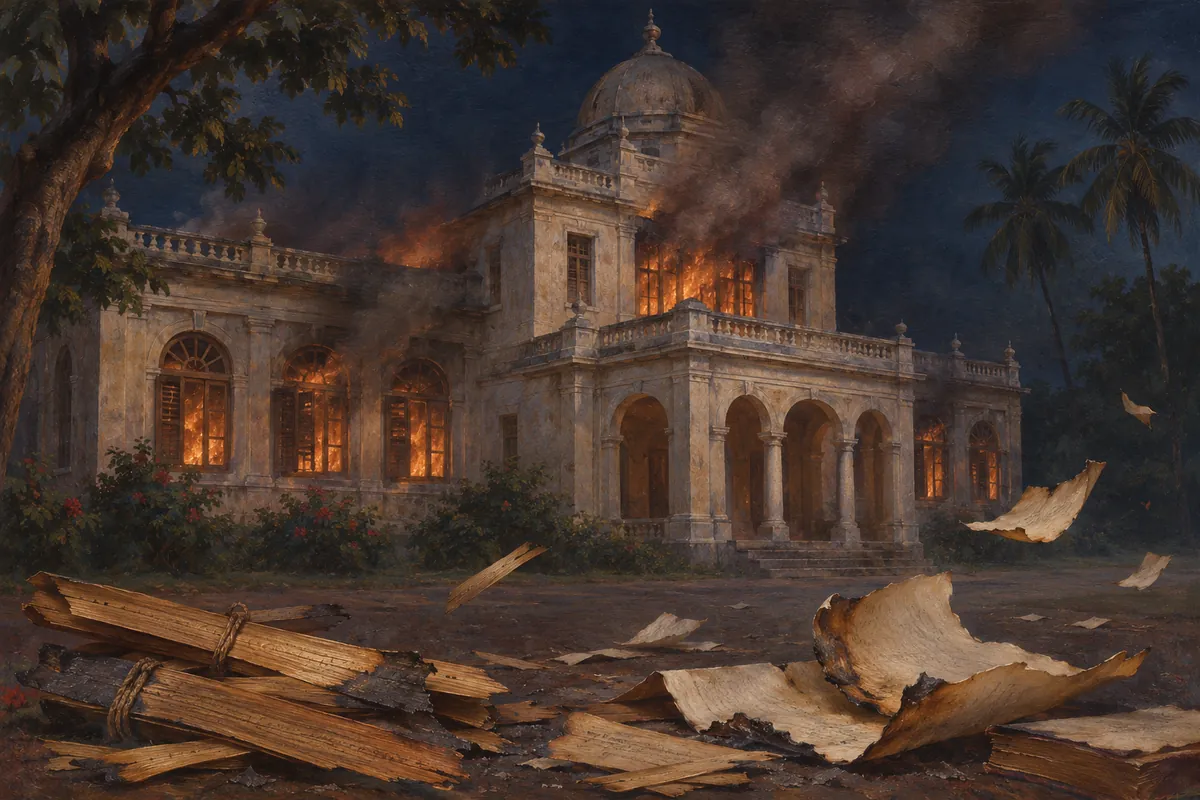
1981: the Jaffna Public Library burns
After gunmen killed two policemen at a TULF rally on 31 May, police and others rampaged through Jaffna. On the night of 31 May–1 June 1981 the Jaffna Public Library was set on fire. About 97,000 books and manuscripts, including palm-leaf texts, were destroyed, according to its retired chief librarian. The TULF headquarters, a newspaper office and shops were also burned. Four civilians were reported killed in the wider violence.
Who burned the library?
For Tamils the fire became a symbol of cultural destruction.
The library in flames
Jaffna's library, one of South Asia's finest, burned in 1981. Rebuilt after 2000, it reopened in 2004, though many rare items were lost for ever.
1982: the first presidential election
The Third Amendment (August 1982) let Jayewardene seek re-election early. On 20 October 1982 he won 52.9% of the vote to 39.1% for the SLFP's Hector Kobbekaduwa, with turnout above 80%. Rohana Wijeweera of the JVP came third with about 4%; Kumar Ponnambalam of the Tamil Congress took 2.7%.
1982: the referendum
On 22 December 1982 voters approved, by referendum, extending the life of the 1977 Parliament to 1989 instead of holding a general election. The Fourth Amendment followed on 23 December.
Black July (1983)
In July 1983 an ambush in Jaffna was followed by a week of anti-Tamil violence in Colombo and other towns. Black July turned a low-level insurgency into a war and sent Tamils abroad in large numbers.
23 July 1983: the Thirunelveli ambush
Late on 23 July 1983 LTTE fighters ambushed an army patrol, code-named Four Four Bravo, near Thirunelveli in Jaffna. A roadside bomb hit the lead jeep and soldiers were then shot and grenaded. Thirteen soldiers died at once and the toll is sometimes given as fifteen. LTTE commander Kittu later said he planned it.
Why Thirunelveli?
The ambush followed the killing of a senior LTTE fighter, Charles Anthony, earlier that month.
24–30 July 1983: violence in Colombo
On the night of 24 July, as the soldiers' bodies were brought to Colombo, rioting began. Over the following days mobs attacked Tamils and burned Tamil homes, shops and factories in Colombo and other towns. Britannica calls them organised anti-Tamil riots. Many survivors described mobs carrying electoral lists to find Tamil addresses.
25 and 27 July 1983: Welikada prison
On 25 July Tamil prisoners at Welikada prison in Colombo, most held under the PTA, were attacked and killed by Sinhalese inmates with knives and clubs. A second attack followed on 27 July. Accounts commonly give 53 dead across the two days, though some list higher totals. Amnesty reported that cell doors were deliberately left open. Among the dead was the militant leader Kuttimani.
Black July: how many died?
Death tolls are disputed, and different bodies counted differently.
Black July: organised or spontaneous?
On 30 July the government blamed a leftist plot and banned the JVP, the Nava Sama Samaja Party and the Communist Party.
1983: refugees at home and abroad
About 150,000 people were made homeless. Government shelters in Colombo held some 20,000 Tamils at first and around 50,000 at the peak. Many were moved north by ship and road. Others fled across the Palk Strait to Tamil Nadu, where India set up refugee camps.
August 1983: the Sixth Amendment
In August 1983 Parliament passed the Sixth Amendment, which banned advocating a separate state and required MPs to swear an oath against it (it was passed on 4 August and certified on 8 August). TULF MPs refused the oath and lost their seats. Several leaders moved to Madras.
The Sixth Amendment's effect
The amendment aimed to defeat separatism by law.
1983 onwards: the Tamil diaspora
Emigration rose sharply after Black July. Doctors, engineers and other professionals left first; poorer families followed, often selling land to pay for travel and seeking asylum. Canada, above all Toronto, became the largest destination; Britain, France, Germany and Switzerland also took large numbers.
India arms the militants
After 1983 India, under Indira Gandhi, allowed Tamil militant groups to base themselves in Tamil Nadu.
War without a name (1984–1986)
Between 1984 and 1986 the conflict spread across the north and east. Militant groups multiplied, the army grew, civilians on all sides became targets, and India tried to broker talks.
1984: talks and kidnappings
An All Party Conference opened on 10 January 1984 but produced no settlement. On 10 May an American couple, Stanley and Mary Allen, were kidnapped in Jaffna by the EPRLF's armed wing and freed days later. On 30 November LTTE fighters attacked Kent and Dollar Farms, settlements in Mullaitivu district, killing about 60–80 people, mostly Sinhalese settlers including women and children, by most accounts; the LTTE claimed the victims were armed settlers.
14 May 1985: Anuradhapura
On 14 May 1985 gunmen drove into Anuradhapura and opened fire on civilians, including monks, nuns and worshippers at the Sri Maha Bodhi shrine. About 146 Sinhalese were killed, by the most cited count. The same group reportedly killed 24 Wildlife Department staff in Wilpattu National Park. It was one of the deadliest attacks on civilians of the war to that point.
Anuradhapura: who was responsible?
Most accounts attribute the attack to the LTTE.
1985: the Thimphu talks
India brought the government and Tamil groups to Thimphu, Bhutan, in two rounds: 8–12 July and 12–17 August 1985.
1986: rights restored, rivals crushed
In January 1986 Sirimavo Bandaranaike's civic rights were restored. The Tenth Amendment (6 August 1986) removed the two-thirds requirement for proclamations under the Public Security Ordinance. In the north, armed groups fought each other; the LTTE moved against rivals such as TELO and emerged as the strongest Tamil force in Jaffna.
When did the war begin?
Popular histories often date the civil war to 23 July 1983.
India steps in (1987)
In 1987 the army launched its largest offensive yet, India intervened, and the two governments signed an accord that brought Indian troops to the island and a new provincial system. The year ended with India fighting the LTTE.
26 May 1987: Operation Liberation
On 26 May 1987 the army began Operation Liberation to retake Vadamarachchi, the LTTE's heartland on the Jaffna peninsula. Brigades led by Denzil Kobbekaduwa and Vijaya Wimalaratne took the area by early June. The army lost 33 killed and 182 wounded, its heaviest losses in one operation to that point.
4 June 1987: Operation Poomalai
India tried to send relief to Jaffna by boat on 3 June, but the Sri Lankan navy turned the flotilla back. On 4 June five Indian Air Force An-32 transports, escorted by Mirage 2000 fighters, dropped about 22–25 tonnes of food and medicine over the peninsula. Jayewardene halted the push on Jaffna town.
Poomalai: aid or warning?
India's External Affairs Ministry called the drop humanitarian help for the people of Jaffna.
5 July 1987: Nelliady
On the night of 5 July 1987 an LTTE fighter known as Captain Miller drove a truck packed with explosives into the army camp at Nelliady school in Vadamarachchi. It was the first suicide attack by the LTTE's ‘Black Tigers’. The LTTE claimed over 100 soldiers killed; official figures were far lower. True numbers remain unknown.
29 July 1987: the Indo–Sri Lanka Accord
In Colombo on 29 July 1987 Jayewardene and India's Prime Minister Rajiv Gandhi signed the Indo–Sri Lanka Accord. It offered devolution through provincial councils, a temporary merger of the Northern and Eastern Provinces subject to a later referendum in the east, recognition of Tamil as an official language, and Indian troops to guarantee a ceasefire.
The accord's enemies
The accord satisfied almost no one fully.
September–October 1987: the accord breaks
On 26 September the LTTE's Thileepan died after a hunger strike demanding changes to the accord's implementation. On 5 October twelve LTTE cadres in military custody swallowed cyanide when the government sought to take them to Colombo. The LTTE then turned on the Indian Peace Keeping Force (IPKF), and India began a full offensive.
October 1987: the battle for Jaffna
India's offensive, Operation Pawan, aimed to take Jaffna and disarm the LTTE. It met fierce resistance; an early helicopter assault near Jaffna University suffered heavy losses. On 22 October more than 70 people, including patients and staff, were killed when IPKF troops entered Jaffna Teaching Hospital.
The IPKF: what the sources say
The IPKF's record is judged very differently in India, Colombo and Jaffna.
14 November 1987: the Thirteenth Amendment
On 14 November 1987 Parliament passed the Thirteenth Amendment and the Provincial Councils Act. Provincial councils were created across the island, Tamil became an official language and English a link language. The amendment remains the legal basis of devolution in Sri Lanka, though many of its powers were never fully exercised.
Terror in the south (1987–1989)
While India fought the LTTE in the north, the JVP waged an insurrection in the Sinhala south. The state's response, by security forces and paramilitary death squads, produced one of the worst records of enforced disappearance in the world. Southerners remember it as the Bheeshanaya, the ‘time of terror’.
The JVP's second insurrection
The revolt began with a raid on Pallekele army camp in April 1987; a grenade attack in Parliament followed on 18 August. The JVP presented itself as defender of the nation against India and the accord. Its armed wing, the Deshapremi Janatha Viyaparaya (Patriotic People's Movement), killed police, soldiers, officials, UNP and left-wing activists and people defying its strikes and curfews. Estimates of its killings run into the thousands but vary widely.
16 February 1988: Vijaya Kumaratunga
On 16 February 1988 Vijaya Kumaratunga, the popular film star and SLMP leader who backed the accord and a peaceful settlement, was shot dead outside his home near Colombo. The accused gunman reportedly said in a statement that the JVP had hired him. Days later his allies formed the United Socialist Alliance.
Who ordered the killing?
The Kumaratunga killing remains politically charged.
1988: provincial councils and the merger
Provincial council elections began on 28 April 1988. The Fourteenth Amendment (May) enlarged Parliament to 225 seats. In September the Northern and Eastern Provinces were merged temporarily by proclamation. The EPRLF, a group allied with India, won the North-Eastern Provincial Council election in November under IPKF protection, while the LTTE stayed outside.
1988: immunity for the security forces
The Indemnity (Amendment) Act of 1988 gave immunity to security forces and officials for acts done “in good faith” between 1 August 1977 and 16 December 1988. Amnesty International later pointed out that it could be used as a defence in disappearance cases. The Fifteenth and Sixteenth Amendments of 17 December 1988 changed election rules and made Sinhala and Tamil languages of administration.
19 December 1988: Premadasa elected
At the presidential election of 19 December 1988 Ranasinghe Premadasa (UNP) won 50.4% of the vote against Sirimavo Bandaranaike's 45.0% and the SLMP's Ossie Abeygunasekera with 4.6%. Turnout was only about 55%. The JVP tried to wreck the poll with bombings, killings and threats, and in parts of the south polling stations stood empty.
1989: talking to the Tigers
Premadasa wanted the Indians gone. On 12 April he offered a ceasefire; on 5 May talks with the LTTE began in Colombo, and on 28 June both sides announced a cessation of hostilities. On 18 September India and Sri Lanka agreed that the IPKF would withdraw. Critics later alleged that the government supplied arms to the LTTE to fight the IPKF.
1989: the counter-insurgency
From mid-1989, with a nationwide state of emergency, the security forces and paramilitary groups such as the ‘Black Cats’ answered JVP terror with mass arrests, torture and killings. Bodies, some burned on tyres, appeared on roadsides, beaches and rivers. Detention centres such as Batalanda near Colombo later became the subject of a commission of inquiry.
13 November 1989: the death of Wijeweera
Rohana Wijeweera was arrested at Ulapane in the hill country, where he had lived on a tea estate under another name. On 13 November 1989 the government announced that he had been shot dead. Most of the JVP leadership was killed within weeks, and the insurrection collapsed by early 1990.
Wijeweera's death: three versions
Official accounts did not agree with each other.
How many disappeared? (1)
Exact numbers will probably never be known.
How many disappeared? (2)
Three regional presidential commissions were appointed in 1994 to cover removals after 1 January 1988.
Who were the victims?
The victims were overwhelmingly young Sinhalese men.
The Indians leave, the war returns (1990)
In 1990 the IPKF left, the ceasefire with the LTTE collapsed, and the east saw massacres of Tamils and Muslims. In October the LTTE expelled the entire Muslim population of the north.
February 1990: Richard de Zoysa
In February 1990 the journalist and actor Richard de Zoysa was abducted from his Colombo home and killed; his body was found on a beach. His mother, Dr Manorani Saravanamuttu, campaigned for justice and for the families of the disappeared. Amnesty also recorded villagers abducted and killed at Wavulkele in Gampaha that month.
24 March 1990: the last Indian troops leave
The last IPKF troops left Sri Lanka on 24 March 1990, ending a deployment that began in July 1987. The North-Eastern Provincial Council, run by the EPRLF, collapsed, and many of its members left with the Indians. The LTTE moved in to take over much of the north and east.
June 1990: Eelam War II begins
The 13-month ceasefire collapsed on 10–11 June 1990. The LTTE surrounded police stations in the east, and on government orders many officers surrendered after being promised safe conduct. Estimates of the police then killed range from about 600 to 774. UTHR(J) attributes the decision to a local LTTE commander rather than the top leadership.
3 August 1990: Kattankudy
On 3 August 1990, during evening prayers, about 30 gunmen entered mosques in Kattankudy, a Muslim town near Batticaloa, and opened fire. At least 147 men and boys were killed, according to UTHR(J). On 11–12 August between about 116 and 173 Muslims were killed at Eravur nearby. The government, survivors and observers blamed the LTTE for both.
Kattankudy: the LTTE's denial
The LTTE denied involvement in both massacres and never withdrew the denial.
August 1990: reprisals against Tamils
In the weeks after Kattankudy, Tamil villages in the east were attacked in turn.
September 1990: Sathurukondan and Eastern University
On 9 September 1990 184 Tamil civilians from Sathurukondan and neighbouring villages near Batticaloa, including children, were killed after being taken to an army camp, according to a later presidential commission under K. Palakidnar. Days earlier, on 5 September, about 158 people were taken from the Eastern University refugee camp and disappeared. Rights groups recorded many more disappearances in the east that year.
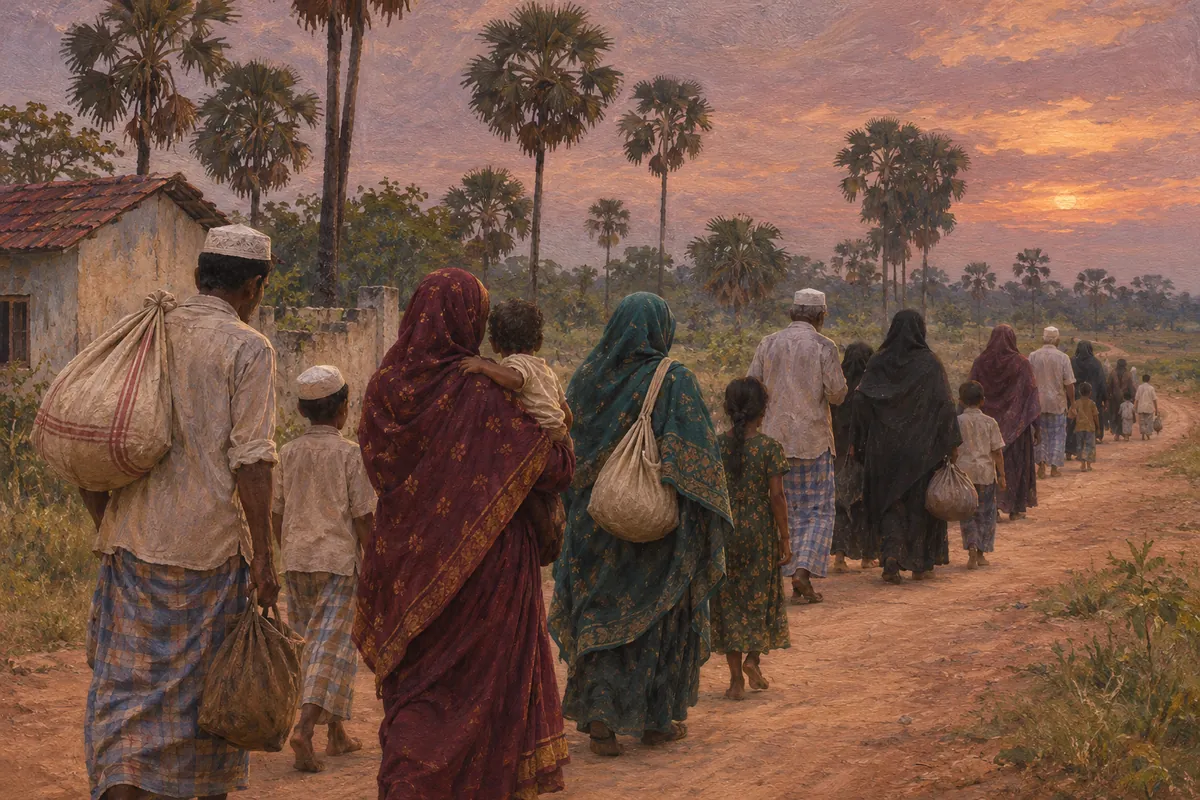
October 1990: the expulsion of the northern Muslims
From 15 October 1990, starting in Chavakachcheri, the LTTE ordered all Muslims to leave the Northern Province. Many were given 48 hours, in Jaffna reportedly only two, and allowed about 500 rupees and some clothing. By 30 October Muslims had been driven from Jaffna, Mannar, Kilinochchi, Mullaitivu and parts of Vavuniya.
The expulsion: numbers and memory
Estimates of those expelled range from about 70,000 to over 90,000; 75,000 is the most cited figure.
Black October
Muslim families left Jaffna and Mannar in 1990 with almost nothing. Many spent decades in Puttalam's camps; return began only after the war.
Looking back: Republic, Rupture and War
Historians now see 1972–1990 as the years when Sri Lanka's postcolonial settlement broke down. Constitutions, language and education policy, and the 1983 violence alienated many Tamils; militant groups answered with terror. India's intervention failed, and the southern insurrection and its suppression killed tens of thousands. Each community remembers its own wounds; a shared account is still being written.