 Fablewings
 › Sri Lankan history › Part 15
The Long War and Its End (1990–2009)
Between 1990 and 2009 the war between the Sri Lankan state and the Liberation Tigers of Tamil Eelam (LTTE) passed through three phases, broken by talks and a Norwegian-brokered ceasefire. A president, many politicians and tens of thousands of civilians and fighters died. It ended in May 2009 with the LTTE's defeat, but how the final months were fought, and how many civilians died, is still bitterly disputed.
Read in the page-turning reader
Eelam War II and the Premadasa years (1990–1993)
After Indian troops left in March 1990, President Ranasinghe Premadasa's talks with the LTTE collapsed within weeks. The fighting that followed, usually called Eelam War II, brought massacres on all sides, the expulsion of Muslims from the north, and assassinations that reached the top of two states.
1990: The Indians leave
The Indian Peace Keeping Force completed its withdrawal in March 1990, having lost more than 1,200 soldiers since 1987, according to IRIN. Premadasa, elected in December 1988 with 50.43 per cent of the vote, had pressed for its departure and was talking directly to the LTTE. With the Indians gone, the LTTE controlled much of the north.
June 1990: The police stations
In June 1990 the talks failed after the LTTE overran police stations in the Eastern Province. Many policemen surrendered on promises of safe passage and were then killed.
1990: Reprisals in the east
In late 1990 security forces were accused of killing or 'disappearing' many Tamils in Batticaloa and Amparai, while the LTTE massacred Muslim villagers, including 166 at Palliyagodella. Neighbouring communities were drawn into cycles of revenge.
October 1990: Expulsion of the northern Muslims
In October 1990 the LTTE ordered all Muslims out of the Northern Province, many with only hours' notice. About 72,000 people were displaced, most to camps in Puttalam.
1991: Wijeratne and Elephant Pass
On 2 March 1991 a car bomb in Colombo killed Ranjan Wijeratne, the minister in charge of defence, in a blast that killed about 19 people; the LTTE was blamed. In July 1991 the LTTE besieged the army base at Elephant Pass, the causeway linking the Jaffna peninsula to the mainland. The month-long siege, the LTTE's first large conventional battle, left about 2,000 dead on both sides, Al Jazeera reported.
21 May 1991: Rajiv Gandhi killed
At an election meeting in Sriperumbudur, Tamil Nadu, a young woman known as Dhanu garlanded former Indian Prime Minister Rajiv Gandhi and set off an explosive belt. Seventeen people died, including Gandhi and the bomber.
1991: The impeachment crisis
In 1991 Lalith Athulathmudali and Gamini Dissanayake led a move to impeach Premadasa, listing 24 alleged abuses of power. The Speaker rejected it in October. Expelled from the United National Party (UNP), they founded the Democratic United National Front (DUNF) on 28 November 1991.
1992: Araly and Colombo
On 8 August 1992 a landmine at Araly, on Kayts island off Jaffna, killed Lieutenant General Denzil Kobbekaduwa, commander of northern operations, with Major General Vijaya Wimalaratne and Rear Admiral Mohan Jayamaha. On 16 November 1992 the navy commander, Clancy Fernando, was killed by a suicide bomber in Colombo. Both attacks were attributed to the LTTE.
23 April 1993: Athulathmudali shot
On the evening of 23 April 1993, DUNF leader Lalith Athulathmudali was shot dead while addressing a rally at Kirulapone, Colombo, weeks before provincial elections.
1 May 1993: Premadasa assassinated
At about 12.45 p.m. on 1 May 1993, as Premadasa watched the UNP May Day procession at Armour Street, Colombo, a suicide bomber on a bicycle blew himself up beside him.
1993: Wijetunga and Pooneryn
Prime Minister D.B. Wijetunga was sworn in as president on 7 May 1993 to complete Premadasa's term. He treated the war chiefly as a terrorist problem. On 11 November 1993 the LTTE overran the army and navy complex at Pooneryn, across the lagoon from Jaffna. Several hundred soldiers and sailors were killed or went missing; official and press counts differ.
Kumaratunga: peace, then 'war for peace' (1994–2001)
Chandrika Kumaratunga came to power in 1994 promising peace. Talks failed within months, and her government fought on while offering devolution. The army retook Jaffna, but the LTTE won crushing victories at Mullaitivu, Kilinochchi and Elephant Pass.
1994: The People's Alliance
On 16 August 1994 the People's Alliance led by Chandrika Bandaranaike Kumaratunga, daughter of two prime ministers, won 105 of 225 seats on a peace platform and formed a government with smaller parties, ending 17 years of UNP rule. On 9 November she won the presidency with 62.28 per cent of the vote.
24 October 1994: Thotalanga
During the presidential campaign, just after midnight on 24 October 1994, a suicide bomber struck a UNP rally at Thotalanga, Grandpass, in Colombo. About 50 people died, including the UNP candidate Gamini Dissanayake and several party leaders. No one claimed it, but the attack was attributed to the LTTE. Dissanayake's widow, Srima, stood in his place.
1995: Truce and its collapse
In January 1995 the two sides agreed to stop fighting and talk. On 19 April LTTE frogmen sank the navy gunboats Sooraya and Ranasuru at Trincomalee, opening Eelam War III.
1995: Navaly church
On 9 July 1995, during a government offensive on the Jaffna peninsula, bombs fell on the Church of St Peter and St Paul at Navaly, where displaced families sheltered. Rights groups and the ICRC attributed the strike to the air force; the government at first denied it.
1995: Operation Riviresa
From October 1995 the army's Operation Riviresa ('Sunray') pushed into the Jaffna peninsula and retook Jaffna town, held by the LTTE since 1990. Before it fell, a huge exodus moved into the Vanni: more than 300,000 people by press estimates, 400,000 by the government's.
31 January 1996: The Central Bank bomb
LTTE suicide bombers drove a lorry of explosives into the Central Bank in Colombo's business district. The blast and fire killed at least 90 people, mostly office workers, and injured about 1,400.
July 1996: Mullaitivu overrun
On 18 July 1996 the LTTE overran the army base at Mullaitivu in an operation it called 'Unceasing Waves'. It is often described as the army's worst single defeat. In response the army pushed south from Elephant Pass and took Kilinochchi in late September.
1997: Jayasikurui
On 13 May 1997 the army launched Operation Jayasikurui ('Victory Assured'), a large multi-division offensive to open a land route through the Vanni to Jaffna. For about eighteen months troops fought slowly north, until the government announced the operation's end in December 1998 without reaching its goal.
October 1997: World Trade Centre and US ban
In October 1997 the United States designated the LTTE a foreign terrorist organisation. The same month LTTE attackers bombed the new World Trade Centre towers in Colombo, killing 15 people. A presidential commission also reported that month on Athulathmudali's killing.
25 January 1998: The Temple of the Tooth
Days before Kandy was to host fiftieth-anniversary independence celebrations, LTTE suicide bombers drove a lorry into the Sri Dalada Maligawa, the most revered Buddhist shrine in the country. About 17 people were killed and the facade badly damaged.
September 1998: Kilinochchi recaptured
On 27 September 1998 the LTTE stormed the army complex at Kilinochchi in 'Unceasing Waves II'; more than 1,000 soldiers were reported killed. Kilinochchi became the LTTE's administrative capital for ten years, with its own police, courts and tax offices. In India that year, a special court sentenced 26 people to death over Rajiv Gandhi's killing.
1999: Gonagala and Unceasing Waves III
On 29 July 1999 a suicide bomber killed Neelan Tiruchelvam, a moderate Tamil MP. In September the LTTE killed about 50 Sinhalese villagers at Gonagala in Ampara district. In November it launched 'Unceasing Waves III' and in days retook most of the Vanni ground lost in Jayasikurui.
18 December 1999: Attack on the president
At her final campaign rally at Colombo Town Hall, a suicide bomber attacked President Kumaratunga. She survived but lost the sight of one eye. Days later she was re-elected, defeating the UNP's Ranil Wickremesinghe.
22 April 2000: Elephant Pass falls
The LTTE captured the wells at Iyakkachchi that supplied the Elephant Pass base, and on 22 April 2000 the army withdrew. LTTE forces then advanced into the Jaffna peninsula, but the line held short of Jaffna town.
2000: Norway steps in
In May 2000 Erik Solheim, Norway's special envoy, began talks with Sri Lankan leaders, starting a facilitation role both sides accepted. Rights groups estimated that more than a million Sri Lankans were displaced. In December 2000 the LTTE declared a unilateral ceasefire; it ended it on 24 April 2001.
24 July 2001: Katunayake
An LTTE commando unit attacked the air force base beside Bandaranaike International Airport, the country's only international airport. Aircraft were destroyed on the ground and tourism slumped. In 2001 the economy contracted, by about 1.4 per cent, for the first time since independence.
December 2001: The UNP returns
Defections cost Kumaratunga her majority, and in the December 2001 election the UNP-led United National Front won. Ranil Wickremesinghe became prime minister, beginning an uneasy 'cohabitation' with a president from the rival party. On 19 December the LTTE declared a 30-day ceasefire, which the government matched two days later.
Ceasefire, split and tsunami (2002–2005)
The 2002 ceasefire brought the longest calm in two decades. Yet talks stalled, the LTTE split, the southern leadership fractured, and in December 2004 the tsunami killed tens of thousands. By late 2005 a new president, Mahinda Rajapaksa, was in office and violence was rising.
22 February 2002: The Ceasefire Agreement
Brokered by Norway, the Ceasefire Agreement froze front lines, reopened roads and created the Nordic-staffed Sri Lanka Monitoring Mission (SLMM). Prabhakaran signed for the LTTE in the Vanni and Prime Minister Wickremesinghe for the government on 22 February; it took effect the next day. Prisoners were exchanged, and the LTTE ban was lifted that September.
2002: Six rounds of talks
From September 2002 to March 2003 six rounds of talks were held in Thailand, Norway, Germany and Japan. In December 2002 the parties agreed to explore a federal solution within a united Sri Lanka.
2003: Walk-out and the ISGA
On 21 April 2003 the LTTE suspended talks, saying it was not given an equal voice. The ceasefire held. On 31 October it proposed an Interim Self-Governing Authority (ISGA) for the north and east under its control, provoking a strong backlash in the south.
March 2004: The Karuna split
On 3 March 2004 the LTTE's eastern commander, Vinayagamoorthy Muralitharan, known as Colonel Karuna, broke with Prabhakaran, claiming about 6,000 eastern fighters. He accused the northern leadership of discriminating against the east. In April LTTE forces moved against him and he fled; many of his cadres dispersed.
April 2004: The UPFA wins
In the April 2004 election Kumaratunga's United People's Freedom Alliance, which included the JVP, defeated the UNP, and Mahinda Rajapaksa became prime minister. In July a suicide bombing in Colombo was the first in the capital since 2001. Killings between the LTTE and the Karuna faction spread in the east.
26 December 2004: The tsunami
An undersea earthquake off Sumatra sent waves across the Indian Ocean that struck Sri Lanka's eastern, southern and western coasts within hours. Whole villages vanished. Groundviews puts the displaced at about half a million and houses destroyed at more than 100,000.
The tsunami death toll
No single figure is definitive.
The Queen of the Sea
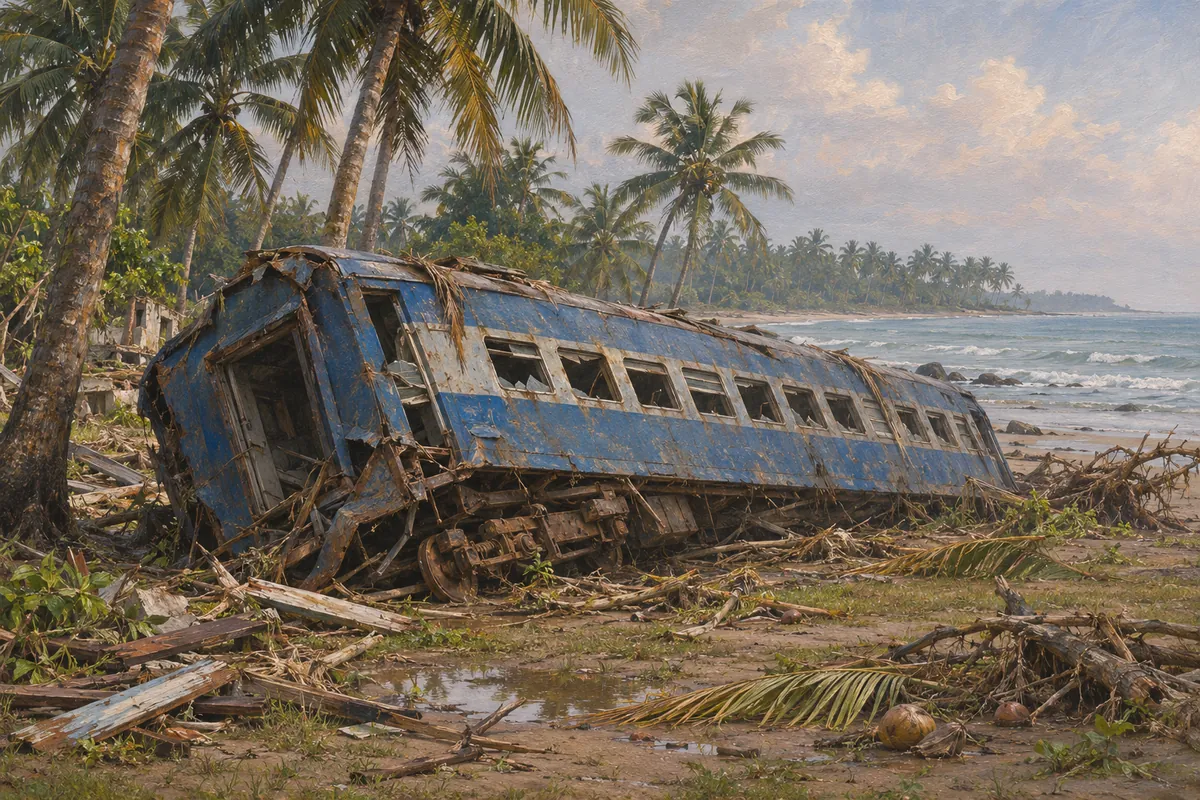
Near Telwatta, south of Colombo, the wave struck the crowded Colombo–Galle 'Queen of the Sea' train, carrying at least 1,700 passengers. Nearly all died, in one of the worst rail disasters ever recorded.
2005: Rebuilding amid suspicion
Reconstruction cost more than US$3 billion. Half the damaged coast lay in war-affected areas, making access, Groundviews notes, complex and politically charged.
12 August 2005: Kadirgamar
Foreign Minister Lakshman Kadirgamar was shot dead by a sniper at his Colombo home. A Tamil himself, he had led the diplomatic campaign for bans on the LTTE abroad. Police and the military blamed the LTTE, which denied it. A state of emergency was declared.
17 November 2005: Rajapaksa elected
After the Supreme Court ruled that Kumaratunga's term must end in 2005, Mahinda Rajapaksa defeated Wickremesinghe by 50.29 to 48.43 per cent, a margin of about 180,000 votes. The LTTE urged a boycott in areas it controlled.
Late 2005: Warnings and killings
In late November 2005 Prabhakaran warned that the LTTE would intensify its struggle without a just settlement. In December mine attacks killed dozens of soldiers. On 25 December Joseph Pararajasingham, a Tamil National Alliance MP, was shot dead in Batticaloa; each side blamed the other's allies.
Eelam War IV: the east (2006–2007)
During 2006 the ceasefire collapsed in all but name. A dispute over sluice gates at Mavil Aru triggered a campaign that drove the LTTE from the Eastern Province by July 2007. Attacks on civilians, aid workers and politicians rose sharply.
February–April 2006: Geneva and collapse
In February 2006 the two sides met in Geneva and reaffirmed the ceasefire. Attacks soon resumed. On 12 April a market bombing and riots in Trincomalee left at least 16 dead. On 25 April a suicide bombing at army headquarters in Colombo killed eight and wounded the army commander, Sarath Fonseka. The LTTE withdrew from talks indefinitely.
May–June 2006: Bans and bombs
On 29 May 2006 the European Union listed the LTTE as a terrorist organisation. On 15 June a mine attack on a bus at Kebithigollewa killed more than 60 civilians.
July 2006: Mavil Aru
The LTTE closed the sluice gates of the Mavil Aru reservoir near Trincomalee, cutting water that the government said served 15,000 families and 30,000 acres of paddy. The army launched an operation; the LTTE said it reopened the gates on 8 August, and the government announced it had taken them days later.
August 2006: Muttur
Fighting in and around the eastern town of Muttur in early August killed civilians and displaced thousands. On 4 August seventeen local staff of the French charity Action Contre la Faim (Action Against Hunger) were shot dead. The ceasefire monitors blamed the security forces; the government denied it and blamed the LTTE. On 12 August peace activist Ketheesh Loganathan was shot dead in Colombo, a killing attributed to the LTTE.
October–November 2006: Habarana and Geneva II
On 16 October 2006 a suicide truck bomb hit a naval convoy at Digampathana near Habarana, killing about 100 people, mostly sailors, one of the deadliest suicide attacks of the war. Talks in Geneva later that month produced nothing. On 10 November TNA MP Nadarajah Raviraj was shot dead in Colombo; the TNA blamed pro-government paramilitaries.
2007: Vakarai and the A5
From late 2006 the army attacked Vakarai, the LTTE's coastal stronghold in Batticaloa district, and it fell on 19 January 2007. Kokkadicholai was taken on 28 March, and on 12 April the A5 highway came under government control for the first time in 15 years.
11 July 2007: Thoppigala
Troops took Thoppigala, a forested rock in Batticaloa district, after a three-month battle, ending the LTTE's conventional presence in the east. The government held victory celebrations in Colombo.
2 November 2007: Tamilselvan killed
An air force strike in Kilinochchi district killed S.P. Tamilselvan, head of the LTTE's political wing and its chief negotiator in the 2002–03 talks. In December the army overran the LTTE position at Parappakandal, Gulf News recorded, as the front moved towards the Vanni.
The northern offensive (2008)
In January 2008 the government withdrew from the ceasefire. A rapidly expanded army advanced on several fronts into the Vanni, pushing the LTTE back towards Kilinochchi, while bombings struck the south.
January 2008: The ceasefire ends
The government formally withdrew from the 2002 agreement, and the monitors left. On 8 January a roadside bomb at Ja-Ela killed D.M. Dassanayake, minister of nation building; the LTTE was blamed.
April 2008: Weliveriya and Muhamalai
On 6 April 2008 a suicide bomber at the start of a marathon at Weliveriya killed Jeyaraj Fernandopulle, minister of highways, and others. Later that month an army advance at Muhamalai, on the Jaffna front, was repulsed with heavy losses; the two sides' casualty figures differed widely.
May–September 2008: The western push
Troops advanced up the north-west coast from Mannar, capturing Adampan in May, the Sea Tiger base at Vidattaltivu in July, Vellankulam in August and Mallavi in September. Civilians moved ahead of the fighting, many several times.
November–December 2008: Pooneryn and Paranthan
On 15 November 2008 the army captured Pooneryn, opposite Jaffna. On 23 November it began a three-pronged attack on Kilinochchi, which held through December. Paranthan, just to the north, fell on 31 December.
The final months (January–May 2009)
In five months the LTTE lost its capital, its coast and finally its leaders. Hundreds of thousands of civilians were trapped in a shrinking strip of land. What happened there is the most serious and lasting controversy of the war.
January 2009: Kilinochchi and Mullaitivu
Troops entered Kilinochchi on 2 January; Rajapaksa called it an unparalleled victory. Elephant Pass fell on 9 January and Mullaitivu town on 25 January. Journalists were barred, so claims could not be independently verified, Al Jazeera noted. On 8 January the critical editor Lasantha Wickrematunge was murdered in Colombo.
January 2009: The first 'safe zone'
The government declared a 'safe zone' of about 35 square kilometres and urged civilians to enter it. The UN estimated more than 300,000 people were trapped in the combat area.
February 2009: The hospitals
On 1 February Puthukkudiyiruppu hospital, the only functioning hospital in the combat zone, was hit; the ICRC put the dead at nine. HRW and other groups documented repeated shelling of hospitals in the following months.
12 February 2009: The second zone
The government declared a new No Fire Zone of about 12 kilometres along the coast, between the Nanthikadal lagoon and the sea. Tens of thousands crowded into tents on the sand. The LTTE moved its remaining forces into and around the strip. On 20 February LTTE light aircraft tried to bomb Colombo and were shot down.
Who was trapped, and how many?
The size of the trapped population mattered greatly for food and medicine.
April 2009: The great exodus
Government forces took Puthukkudiyiruppu, pushing the LTTE and civilians into the zone. On 20 April troops breached LTTE earth walls and tens of thousands crossed into government lines. By 28 April over 150,000 displaced people were in camps; the UN said 50,000 remained trapped.
April 2009: Diplomatic pressure
The British and French foreign ministers visited Colombo seeking a humanitarian ceasefire, and a brief 48-hour truce was declared in April. Large diaspora protests in London and other cities demanded a halt.
May 2009: The last strip
The zone shrank to a few square kilometres around Mullivaikkal. On 16 May Rajapaksa declared the LTTE militarily defeated. The last fighting took place on 17–18 May beside the Nanthikadal lagoon.
18 May 2009: The end of the LTTE
Fonseka said the military had liberated the country from terrorism. Leaders reported killed included Soosai of the Sea Tigers, intelligence chief Pottu Amman, Prabhakaran's son Charles Anthony, and political figures Balasingham Nadesan and Seevaratnam Pulidevan.
Prabhakaran's death
Velupillai Prabhakaran, who had led the LTTE since 1976, was reported killed on 18 May.
19 May 2009: Victory declared
Rajapaksa told parliament that terrorism had been totally defeated. In the south there were celebrations; in the north and the diaspora, grief and fear for the missing. Nearly 290,000 survivors were held in military-run camps near Vavuniya.
Mullivaikkal
The coastal strip at Mullivaikkal where the war ended is remembered each May by many Tamils as a place of mourning. The state marks the same week as a victory over terrorism.
Late 2009: The camps
More than 10,000 people identified as LTTE members were held in rehabilitation centres. By December 2009 many displaced civilians had been released from the camps. In August LTTE financier Selvarasa Pathmanathan ('KP') was detained in Malaysia and handed to Sri Lanka. An October US State Department report to Congress detailed alleged violations by both sides.
Counting the dead and seeking accountability
The war's end opened a long argument over numbers, responsibility and memory. The UN Secretary-General's Panel of Experts and Sri Lanka's own Lessons Learnt and Reconciliation Commission reached very different conclusions.
The UN country team's count
During the fighting UN staff in Colombo compiled a tally of civilian deaths.
2011: The UN Panel of Experts
Ban Ki-moon's panel, chaired by Marzuki Darusman with Yasmin Sooka and Steven Ratner, reported in April 2011. It found credible allegations of serious violations by both sides: government shelling of No Fire Zones and hospitals and denial of aid, and LTTE use of civilians as a buffer, shooting of escapees and forced recruitment. It said most civilian deaths were caused by government shelling.
Up to 40,000: the figure and its basis
The panel did not claim an exact total.
The government's position
The government refused to cooperate with the panel and called its report fundamentally flawed, saying it relied on unverified claims.
Figures for the whole war
Estimates of total deaths over the whole war are also disputed.
2010–2011: The LLRC
Rajapaksa appointed the LLRC on 15 May 2010, chaired by C.R. de Silva. Its report, tabled on 16 December 2011, found the forces had not deliberately targeted civilians, while accepting considerable civilian casualties and shelled hospitals. It recorded grave LTTE violations, including use of human shields, and urged investigations and reforms on land and devolution.
The LLRC's critics and defenders
Reactions split along familiar lines.
Evidence and its limits
Historians of the final phase face unusual problems of evidence.
Competing memories
For many Sinhalese the war's end freed the country from decades of bombings. For many Tamils May 2009 means mass death at Mullivaikkal. Muslims recall the 1990 expulsion and eastern massacres.
Looking back: The Long War and Its End
Historians agree 1990–2009 was the most violent era of modern Sri Lanka. They debate why peace failed: LTTE maximalism, southern rivalry, weak mediation, or a world less tolerant of insurgents after 2001. The military victory is plain; the civilian toll, the fate of the missing and a political settlement remain open questions in Sri Lanka and at the UN.