 Fablewings
 › Sri Lankan history › Part 16
After the War (2009–2026)
The war ended in May 2009, but peace raised new questions: how to rebuild the north and east, how to account for the war's final months, and how to pay for rapid, debt-funded development. Between 2009 and 2026 Sri Lanka swung between strong-man rule and reform governments, survived the Easter Sunday bombings, defaulted on its debts in 2022 and, in 2024, elected a party from outside the old political families.
Read in the page-turning reader
Victory and its aftermath (2009–2010)
Mahinda Rajapaksa's government emerged from the war with enormous popularity in the Sinhala-majority south. It used that capital to win two elections, jail its main rival and remove limits on presidential power, while international pressure over the war's conduct slowly grew.
2009: the end of the war
In mid-May 2009 government forces overran the last strip of territory held by the Liberation Tigers of Tamil Eelam (LTTE) near Mullivaikkal on the north-east coast. The LTTE leader Velupillai Prabhakaran was killed, and the government declared victory on 19 May. Celebrations filled the south. For many Tamils in the Vanni, however, the final months meant shelling, hunger and the loss of relatives, memories that shaped politics for the rest of this era.
2009: how many died at the end?
No agreed figure exists for civilian deaths in the war's last phase (January–May 2009).
2009: the camps
Roughly 280,000 people who had fled the fighting were held in closed camps, the largest at Menik Farm near Vavuniya. The government said screening was needed to find LTTE fighters; aid agencies and Tamil politicians criticised the restrictions on movement. Most people were released or resettled over 2009–2010, though demining, land returns and military occupation of private land remained disputes for years. Thousands of suspected ex-combatants went through government 'rehabilitation' programmes.
2009: Geneva's first verdict
In late May 2009 the UN Human Rights Council held a special session on Sri Lanka.
2010: the presidential election
Rajapaksa called an early presidential election for 26 January 2010. His opponent was Sarath Fonseka, the army commander who had led the final campaign and then fallen out with the government. Fonseka was backed by an unusual coalition of the UNP, the JVP and the main Tamil party, the TNA. Rajapaksa won about 58 per cent of the vote to Fonseka's 40 per cent, sweeping the Sinhala south while Fonseka led in the Tamil north and east.
2010: the arrest of Sarath Fonseka
On 8 February 2010, two weeks after the election, military police arrested Fonseka.
2010: parliamentary election
At the general election of April 2010 Rajapaksa's United People's Freedom Alliance (UPFA) won 144 of 225 seats, close to a two-thirds majority, which defections soon supplied. Fonseka was elected an MP while still in detention. The Rajapaksa brothers held the key posts: Gotabaya Rajapaksa remained defence secretary, Basil Rajapaksa ran economic development and Chamal Rajapaksa became Speaker. Critics spoke of family rule; supporters saw a strong team delivering roads, ports and stability.
2010: the 18th Amendment
In September 2010 Parliament passed the 18th Amendment by 161 votes to 17.
2010: the LLRC
In May 2010 Rajapaksa appointed the Lessons Learnt and Reconciliation Commission (LLRC) to examine the 2002–2009 period.
The Rajapaksa decade (2011–2014)
These years brought big infrastructure projects, much of it financed by Chinese loans, alongside rising international pressure over war crimes allegations, tension with the judiciary and a new wave of hard-line Buddhist nationalist groups. By late 2014 the government's coalition was cracking.
2011: the UN Panel of Experts
In April 2011 the UN published the report of a panel appointed by Secretary-General Ban Ki-moon.
2011: rebuilding and ending emergency rule
In August 2011 the state of emergency that had been renewed almost continuously since the 1980s was allowed to lapse, though the Prevention of Terrorism Act (PTA) remained. The government pushed big projects: highways, power plants and the new port at Hambantota in Rajapaksa's home district, whose first phase had opened in 2010. Supporters called this a post-war development dividend; critics questioned the cost, the borrowing and the concentration of projects in the south.
2012: Geneva turns
In March 2012 the Human Rights Council passed a US-led resolution (19/2) on Sri Lanka by 24 votes to 15, with 8 abstentions.
2012: the UN's own failings
In November 2012 an internal UN review led by Charles Petrie examined the UN's conduct in 2008–2009.
2012: a new Buddhist militancy
The Bodu Bala Sena ('Buddhist Power Force'), founded in 2012 and led by the monk Galagoda Aththe Gnanasara, campaigned against what it called Muslim and Christian threats to Sinhala Buddhists. In April 2012 a crowd including monks protested against a mosque in Dambulla's sacred area. Campaigns against halal certification followed in 2013. Muslim leaders saw an organised hate campaign; the BBS said it defended Buddhism; critics alleged quiet official tolerance.
2013: the impeachment of the Chief Justice
In January 2013 Parliament voted to impeach Chief Justice Shirani Bandaranayake, the first woman in the post.
2013: an elected council in the north
In September 2013 the Northern Province voted for its provincial council for the first time. The Tamil National Alliance (TNA) won 30 of 38 seats, and retired Supreme Court judge C. V. Wigneswaran became Chief Minister. The council's powers, devolved under the 13th Amendment of 1987, proved limited in practice, and clashes with the centrally appointed governor, a former army officer, were frequent.
2013: CHOGM in Colombo
In November 2013 Colombo hosted the Commonwealth Heads of Government Meeting. Canada's prime minister stayed away and India's prime minister did not attend, partly because of domestic Tamil pressure. Britain's prime minister David Cameron attended but visited Jaffna and called for an inquiry, an image that drew crowds of families of the disappeared. For the government, hosting the summit was proof of normality; for critics it was a missed chance to press reform.
2014: an international inquiry
In March 2014 the Human Rights Council voted 23 to 12, with 12 abstentions, for resolution 25/1.
2014: Aluthgama
On 15 June 2014, after a Bodu Bala Sena rally in the south-western town of Aluthgama, mobs attacked Muslim homes, shops and mosques there and in nearby Beruwala.
2014: China arrives
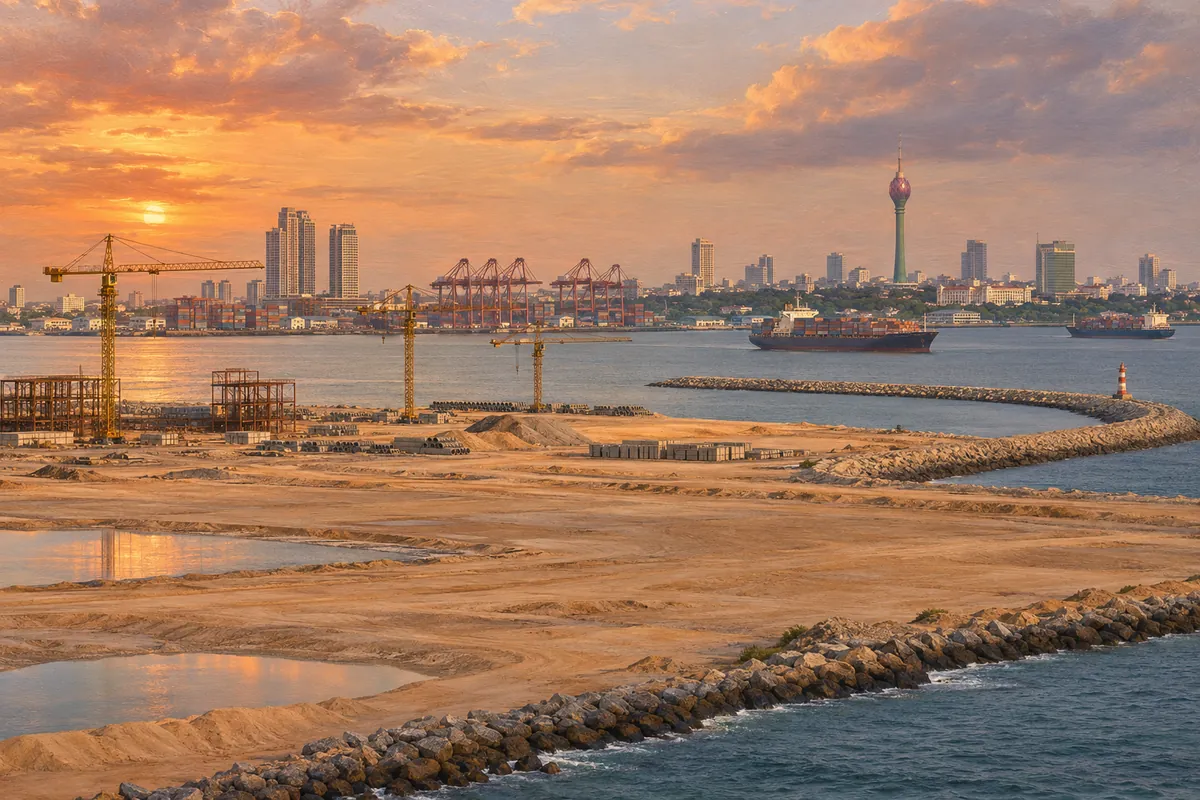
In September 2014 China's president Xi Jinping and Rajapaksa launched Colombo Port City, a vast area of land to be reclaimed from the sea beside the capital's harbour.
Building on the sea
Port City Colombo, launched in 2014, rose from land reclaimed beside the capital's harbour. To supporters it symbolised post-war ambition; to critics, a strategic gamble on Chinese finance.
2014: the coalition breaks
On 29 October 2014 a landslide at Meeriyabedda near Koslanda buried part of a tea-estate settlement. Weeks later politics was transformed. Rajapaksa called an early election, seeking a third term under the 18th Amendment. On 21 November his health minister and SLFP general secretary, Maithripala Sirisena, defected and was named the common opposition candidate, backed by the UNP, Chandrika Kumaratunga and, later, Muslim and Tamil parties.
Good governance and its limits (2015–2019)
The 'yahapalanaya' (good governance) government of President Sirisena and Prime Minister Ranil Wickremesinghe promised to curb presidential power, fight corruption and pursue reconciliation. It achieved real constitutional change, but a bond scandal, rivalry between its two leaders and failures of intelligence ended it in disillusion.
2015: a surprise defeat
On 8 January 2015 Sirisena won the presidency with about 51.3 per cent of the vote to Rajapaksa's 47.6 per cent. Rajapaksa still won a majority of Sinhala-majority districts, but Sirisena carried the Tamil north and east, Muslim areas and Colombo. Rajapaksa left the official residence in the early hours, and Wickremesinghe was sworn in as prime minister, although the UNP held a minority in Parliament.
2015: why Rajapaksa lost
Explanations for the result vary with the observer.
2015: the 19th Amendment
On 28 April 2015 Parliament passed the 19th Amendment by 215 votes to 1.
2015: the bond scandal
In February 2015 a Central Bank treasury bond auction, overseen by new governor Arjuna Mahendran, an appointee of Wickremesinghe, benefited a primary dealer, Perpetual Treasuries, linked to his son-in-law. Investigations, including a presidential commission in 2017, found serious irregularities; Mahendran left for Singapore and Sri Lanka sought his extradition. The scandal badly damaged the government's anti-corruption image and became a lasting weapon for Rajapaksa supporters.
2015: the August election
At the general election of 17 August 2015 the UNP-led alliance won 106 seats and Rajapaksa's UPFA 95, with the TNA third on 16. Rajapaksa entered Parliament as an MP. Sirisena, now SLFP leader, brought part of the SLFP into a 'national unity' government with the UNP. The arrangement gave the government numbers but divided loyalties: many SLFP members still looked to Rajapaksa.
2015: the UN report and resolution 30/1
In September 2015 the OHCHR published the OISL report.
2016: new institutions
In 2016 Parliament sat as a Constitutional Assembly to draft a new constitution, and in August it passed the Office on Missing Persons Act; the office began work in 2018. An Office for Reparations followed. Some military-held land in the north was returned. Families of the disappeared, many of them Tamil mothers who began continuous roadside protests in 2017, said progress was too slow; nationalist groups said the reforms endangered the armed forces.
2017: Hambantota leased
In July 2017 Sri Lanka signed an agreement giving China Merchants Port Holdings a 70 per cent stake in a joint venture to run Hambantota port for 99 years, in return for about US$1.12 billion. The port was handed over in December 2017. Protests by opposition parties and some unions followed; the government said the money would help repay other foreign debts and that security matters stayed with Sri Lanka.
2017: was Hambantota a 'debt trap'?
Many Western media and officials described the lease as China seizing an asset when Sri Lanka could not pay.
2017: disaster and Geneva
On 14 April 2017, Sinhala and Tamil New Year, the Meethotamulla rubbish dump on Colombo's edge collapsed onto homes, killing more than 30 people and exposing years of neglect of waste management. In March 2017 the Human Rights Council gave Sri Lanka two more years to implement resolution 30/1 (resolution 34/1), again with Colombo's support. A further extension followed in 2019.
2018: the Rajapaksa comeback begins
Local government elections on 10 February 2018 were a shock for the government. The new Sri Lanka Podujana Peramuna (SLPP), led in practice by Mahinda and Basil Rajapaksa, won the largest share of the vote, about 40 per cent, and control of most councils. The result exposed splits between Sirisena and Wickremesinghe, who blamed each other, and showed that Sinhala nationalist voters had not deserted the Rajapaksas.
2018: Digana and Kandy
In early March 2018 anti-Muslim riots spread through Digana, Teldeniya and other parts of Kandy district.
2018: the constitutional crisis
On 26 October 2018 President Sirisena suddenly dismissed Prime Minister Wickremesinghe and appointed Mahinda Rajapaksa in his place. Wickremesinghe refused to leave, saying he still had a majority. Sirisena suspended Parliament and, on 9 November, dissolved it and called elections. Rajapaksa lost two no-confidence votes in chaotic sessions where MPs threw chairs and chilli powder. For seven weeks Sri Lanka had two rival prime ministers.
2018: the Supreme Court decides
On 13 December 2018 a seven-judge bench of the Supreme Court unanimously ruled the dissolution of Parliament unconstitutional under the 19th Amendment.
2019: Easter Sunday
On 21 April 2019, Easter Sunday, suicide bombers attacked three churches, St Anthony's in Kochchikade, St Sebastian's in Negombo and Zion Church in Batticaloa, and three Colombo hotels, the Shangri-La, Cinnamon Grand and Kingsbury. Further blasts followed at a Dehiwala guest house and a house in Dematagoda where police officers died. The attackers belonged to a local Islamist network around the preacher Zahran Hashim, of the National Thowheed Jamath. Islamic State claimed responsibility.
2019: the death toll
Early official statements put the dead at more than 350.
2019: warnings ignored
It soon emerged that Indian intelligence had sent specific warnings in the weeks before the attacks.
2019: the backlash
In May 2019 mobs attacked Muslim homes, shops and mosques in Minuwangoda, Kuliyapitiya and other parts of the North Western Province; one Muslim man was killed. A state of emergency stayed in force for four months. Muslim ministers resigned together in June to defuse demands for their removal. Many Muslims, who had condemned the bombers and in some cases had reported Zahran to the authorities, felt collectively blamed.
2019: Gotabaya Rajapaksa elected
On 16 November 2019 Gotabaya Rajapaksa, the former defence secretary, won the presidency with about 52.3 per cent to Sajith Premadasa's 42.0 per cent. He campaigned on national security after the Easter attacks, promising discipline and development. Again the vote split along ethnic lines: Gotabaya won most Sinhala-majority areas, Premadasa the Tamil and Muslim north and east. Gotabaya appointed his brother Mahinda as prime minister.
Gotabaya Rajapaksa and the road to collapse (2019–2022)
Gotabaya Rajapaksa governed with a technocratic and military style, a two-thirds majority and a restored strong presidency. Within three years tax cuts, the pandemic, policy experiments and an unsustainable debt burden combined into the worst economic crisis since independence, and a mass protest movement drove him from office.
2019–2020: tax cuts and Geneva withdrawal
In December 2019 the new government cut VAT from 15 to 8 per cent and abolished several other taxes, saying this would boost growth. Rating agencies downgraded Sri Lanka in 2020, shutting it out of international bond markets. In February 2020 the government withdrew its co-sponsorship of resolution 30/1, calling it a betrayal of the armed forces. In March 2020 the president pardoned a soldier convicted of the 2000 Mirusuvil killings of eight Tamil civilians.
2020: the pandemic
Sri Lanka's first local COVID-19 case was confirmed in March 2020, and an island-wide curfew was imposed on 20 March. The military, led by army commander Shavendra Silva, played a central role in quarantine and contact tracing. Early containment was praised, but tourism, already hit by the Easter attacks, collapsed again, and remittances and foreign reserves came under heavy pressure.
2020–2021: forced cremations
In April 2020 the government made cremation compulsory for everyone who died of COVID-19.
2020: a two-thirds majority
The general election, delayed by the pandemic, took place on 5 August 2020. The SLPP won 145 seats and, with allies, more than two-thirds of Parliament. The UNP collapsed to a single national-list seat after Sajith Premadasa's breakaway Samagi Jana Balawegaya (SJB) became the main opposition. Mahinda Rajapaksa continued as prime minister; brothers Chamal and Basil and nephew Namal held major ministries.
2020: the 20th Amendment
In October 2020 Parliament passed the 20th Amendment by 156 votes to 65.
2021: the Easter commission reports
In February 2021 the Presidential Commission of Inquiry into the Easter attacks, appointed in 2019, delivered its final report.
2021: resolution 46/1
In March 2021 the Human Rights Council adopted resolution 46/1 by 22 votes to 11, with 14 abstentions.
2021: the organic fertiliser ban
In late April 2021 the government announced, and in May gazetted, a ban on imports of chemical fertilisers, pesticides and herbicides, aiming to make Sri Lanka the first country to farm wholly organically. Supporters cited health concerns, including chronic kidney disease, and the cost of imports. Farmers protested as supplies ran out. The ban was relaxed and then largely reversed from November 2021, after one main growing season.
2021: what the ban did
The government presented the policy as an environmental and health reform.
2021: disasters and new laws
In May 2021 the container ship X-Press Pearl caught fire off Colombo and sank, spilling plastic pellets and chemicals along the western coast in one of the country's worst marine pollution disasters. The same month Parliament passed the Colombo Port City Economic Commission Act, setting special rules for the reclaimed zone. Critics feared a separate enclave under weak oversight; the government promised a new financial hub.
2022: shortages
By early 2022 foreign reserves had fallen so low that Sri Lanka struggled to pay for fuel, gas, medicine and food. Queues for fuel and cooking gas stretched for kilometres; power cuts lasted up to 13 hours a day; several people died in queues. Inflation soared, eventually passing 60 per cent. On 31 March protesters gathered outside Gotabaya Rajapaksa's private home in Mirihana, and the government imposed curfews and blocked social media.
2022: default
On 12 April 2022 the Ministry of Finance announced it was suspending payments on most external debt pending a restructuring, the first default in Sri Lanka's history. When grace periods on two bond coupons expired in May, the default became formal. Total public debt was well above 100 per cent of GDP. The government turned to the International Monetary Fund, which the Rajapaksas had long resisted.
2022: who caused the crisis?
Explanations divide along political lines.
2022: the Aragalaya
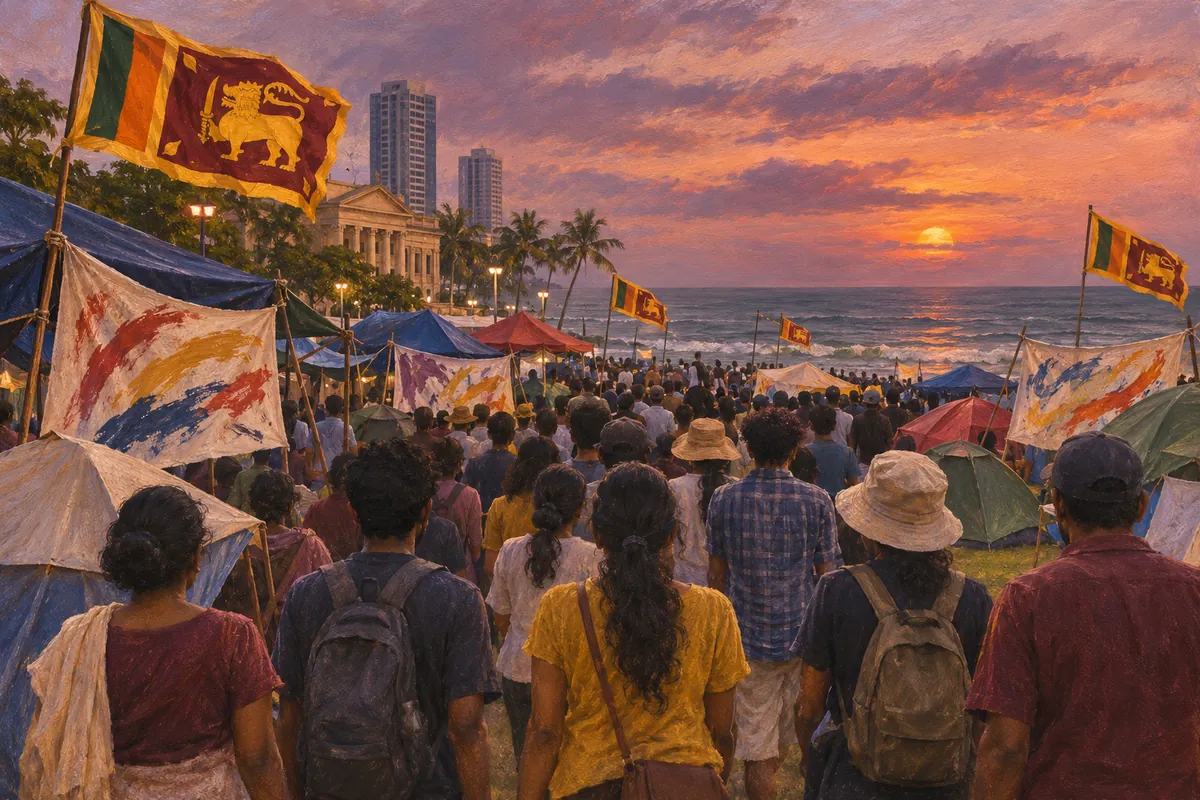
From 9 April 2022 protesters occupied Galle Face Green in Colombo, naming their camp 'GotaGoGama' ('Gota go village'). The 'Aragalaya' (struggle) drew students, professionals, trade unions, clergy and many Tamils and Muslims, and spread across the island. On 9 May government supporters attacked the camp; reprisals followed in which homes of ruling-party politicians were burned and MP Amarakeerthi Athukorala died. Mahinda Rajapaksa resigned as prime minister the same day, and Ranil Wickremesinghe replaced him.
Galle Face, 2022
The GotaGoGama camp on Colombo's seafront became the heart of the 2022 protests, with tents, libraries, kitchens and art, until it was cleared in July 2022.
2022: the president falls
On 9 July 2022 huge crowds entered the President's House and Secretariat in Colombo; protesters set fire to Wickremesinghe's private home. Gotabaya Rajapaksa fled to the Maldives on 13 July and then to Singapore, from where he resigned on 14 July. He was the first Sri Lankan president to resign. He returned in September 2022. In November 2023 the Supreme Court ruled that he, his brothers and senior officials had violated citizens' rights through their handling of the economy.
2022: Wickremesinghe chosen by Parliament
On 20 July 2022 Parliament elected Wickremesinghe president with 134 votes, against 82 for Dullas Alahapperuma.
2022: first steps to recovery
On 1 September 2022 the government reached a staff-level agreement with the IMF for a four-year programme worth about US$2.9 billion. In October Parliament passed the 21st Amendment, restoring some checks on presidential power removed by the 20th, including a Constitutional Council, and barring dual citizens from Parliament. Taxes were raised steeply from late 2022, and since July fuel had been rationed through a national QR-code system.
Recovery and a new political order (2023–2026)
Under an IMF programme, painful taxes and debt restructuring stabilised the economy. Voters then rejected the established parties, electing the leftist National People's Power (NPP) in 2024. Its government faced old questions of accountability, plus new shocks: a deadly cyclone in 2025 and a fuel crisis caused by war in the Middle East in 2026.
2023: the IMF programme
On 20 March 2023 the IMF Executive Board approved a 48-month Extended Fund Facility of about US$3 billion. Conditions included higher taxes, cost-reflective fuel and electricity prices, central bank independence and anti-corruption measures. A domestic debt restructuring was approved in July 2023. Inflation fell rapidly and fuel queues ended, but poverty rose sharply and many families cut back on food and schooling.
2023: courts and Easter
On 12 January 2023 the Supreme Court ruled that former president Sirisena and senior officials had violated citizens' fundamental rights by failing to prevent the Easter attacks.
2023: elections postponed, laws passed
Local government elections due in March 2023 were postponed indefinitely, with the government saying there was no money to hold them; opposition parties accused it of fearing defeat. Parliament passed a new Anti-Corruption Act in 2023, an IMF-linked reform. Provincial council elections, overdue since 2017–2019, were also not held. Agreements in principle with official creditors, including China, were reached in late 2023.
2024: hardship and controversy
From January 2024 VAT rose to 18 per cent and was extended to more goods. The same month Parliament passed the Online Safety Act, which the government said would curb harmful content; journalists, tech firms and rights groups said it threatened free speech. On 23 July 2024 the cabinet issued an apology to Muslims and others over the forced cremations of 2020–2021. Bondholder restructuring talks continued through the year.
2024: Anura Kumara Dissanayake
At the presidential election of 21 September 2024 Anura Kumara Dissanayake of the NPP, an alliance led by the JVP, won about 42.3 per cent of first preferences, ahead of Sajith Premadasa (about 32.8 per cent) and Wickremesinghe (about 17.3 per cent). For the first time second preferences had to be counted, and Dissanayake was declared the winner. He was sworn in on 23 September and the next day appointed Harini Amarasuriya prime minister.
2024: why the outsiders won
The JVP had led two armed uprisings, in 1971 and 1987–1989, and had won only about 3 per cent in 2019.
2024: the November landslide
Dissanayake dissolved Parliament, and at the general election of 14 November 2024 the NPP won 159 of 225 seats with about 61.6 per cent of the vote, the first two-thirds majority for a single party under proportional representation. It topped the poll in every district except Batticaloa, including Jaffna. The SJB won 40 seats; the SLPP was reduced to 3. Many long-serving politicians lost their seats. In December 2024 bondholders accepted a debt exchange.
2025: a test at the local level
Local government elections were finally held on 6 May 2025. The NPP won about 4.5 million votes and came first in 265 councils, ahead of the SJB with about 2.3 million votes; the SLPP did not top the poll in any council. Researchers Harindra Dassanayake and Rajni Gamage noted that the NPP's share, around 43 per cent, was nearly 20 points below November 2024, a sign of impatience over unmet promises.
2025: tariffs and trade
In April 2025 the United States announced a 44 per cent 'reciprocal' tariff on Sri Lankan goods, a heavy blow because the US takes about a fifth of the country's exports, mainly clothing. After negotiations the rate was cut to 30 per cent and then, from August 2025, to 20 per cent. The government presented the reduction as a diplomatic success; exporters warned that competitors had secured similar or better rates.
2025: a former president arrested
On 22 August 2025 the Criminal Investigation Department arrested former president Wickremesinghe.
2025: Geneva once more
On 6 October 2025 the Human Rights Council adopted a new resolution on Sri Lanka without a vote, extending the OHCHR's mandate for two years.
2025: Chemmani reopened
In February 2025 construction work at Chemmani near Jaffna uncovered human remains. Court-supervised excavation began in May.
2025: Cyclone Ditwah
On 28 November 2025 Cyclone Ditwah struck Sri Lanka, bringing extreme rain, floods and landslides across all 25 districts. By mid-December the Disaster Management Centre counted 644 dead and 183 missing, with more than 1.3 million people affected; Kandy district suffered most. More than 6,000 houses were destroyed and over 110,000 damaged. It was one of the deadliest natural disasters in Sri Lanka since the 2004 tsunami.
2025: budget and emergency aid
On 7 November 2025 President Dissanayake, also finance minister, presented the 2026 budget, saying the economy was expected to regain pre-crisis levels by the end of 2025. After the cyclone, a 50 billion rupee supplementary estimate was added for relief, and the budget passed on 5 December by 158 votes to 1. On 19 December the IMF approved about US$206 million in emergency financing for reconstruction and postponed its next programme review.
2026: war far away, crisis at home
The US and Israeli strikes on Iran that began on 28 February 2026 and the closure of the Strait of Hormuz hit Sri Lanka hard: it imports most of its energy and held only about a month of fuel stocks. In mid-March the government reintroduced QR-code fuel rationing, last used in 2022, and declared Wednesdays a holiday for public offices and schools from 15 March until 8 April. Fuel prices rose by roughly a third.
2026: was this 2022 again?
Some commentators called the fuel shortage Sri Lanka's second economic crisis in a decade.
2026: the IMF reviews
In May 2026 the IMF Board completed the combined fifth and sixth reviews of the programme, releasing about US$695 million. It found performance generally strong but noted that two continuous criteria, on payment arrears and import restrictions, were missed. The government used an escape clause in its fiscal law to lower its 2026 primary surplus target, and a support package of about 92 billion rupees was approved. In June the IMF cut its 2026 growth forecast to 3 per cent.
2026: unfinished business
In June 2026 the justice minister promised that the PTA would be repealed and replaced within the year; rights groups criticised the draft replacement. In July the US set a 10 per cent duty on Sri Lankan goods under a new trade investigation. Provincial council elections, promised for early 2026, had still not been held by November. The 2027 budget bill was presented in October, with the budget speech set for 12 November 2026.
Looking back: After the War
Historians and analysts now read 2009–2026 less as a simple post-war story than as a test of Sri Lanka's institutions. Military victory did not bring a political settlement or agreed truth about the war's end. Debt-funded development ended in default. Yet courts, voters and protesters repeatedly checked those in power, from 2015 to 2022 to 2024. How far the NPP's 'system change' lasts, and whether accountability and devolution follow, remains open.